
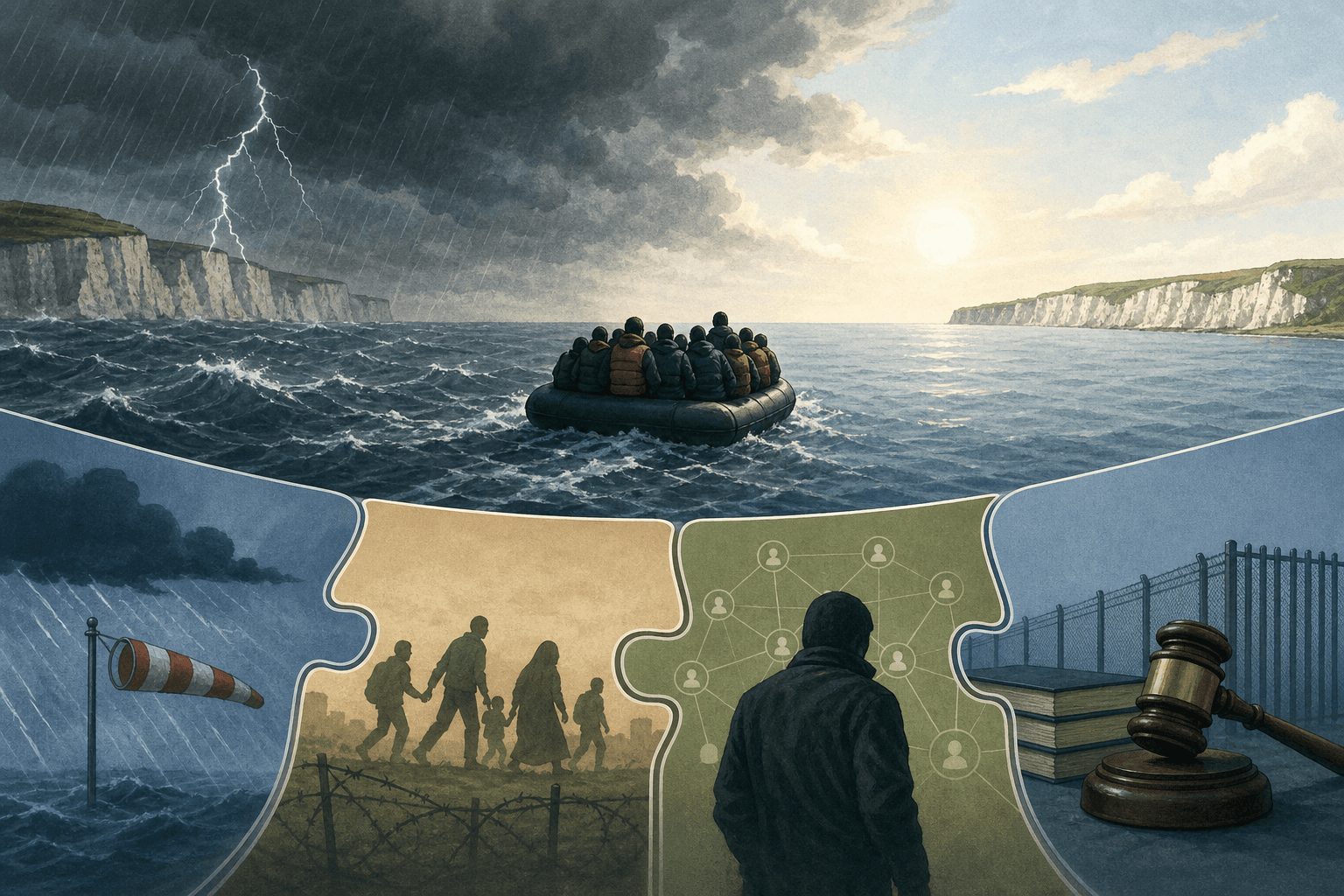
The relationship between weather patterns and irregular migration across the English Channel has become a contentious subject among policymakers and analysts. Approximately 41,500 people were detected crossing in small boats during 2025, the second-highest annual figure on record. However, arrivals declined substantially in early 2026, prompting debate over the underlying causes. Seldom has a single variable attracted such scrutiny in the discourse surrounding migration policy.
The UK Home Office employs a classification system to assess crossing conditions daily. Days are categorised as red, amber, or green based on wave height, precipitation, and wind direction. A red day indicates a greater than fifty-five percent probability of crossing activity. In early 2025, there were sixty red days between January and April, more than double the figure recorded the previous year.
Nevertheless, researchers at the Migration Observatory have argued that weather alone is insufficient to explain fluctuations in arrival numbers. While conditions can influence the timing of individual crossings, their impact on aggregate annual totals remains limited. The decline observed in 2026, when roughly nine thousand people crossed by the end of May, coincided with broader reductions across European maritime routes. This correlation suggests that factors beyond meteorology are at play.
The perilous nature of the crossing itself warrants serious consideration. At least seventy-six people perished attempting the journey in 2024, making it the deadliest year on record. Smuggling networks have increasingly resorted to overcrowded vessels, sometimes carrying over two hundred passengers in boats designed for far fewer. Such hazardous conditions persist regardless of whether the sea appears calm or turbulent.
Ultimately, attributing migration trends predominantly to weather constitutes an oversimplification of a deeply complex phenomenon. Policy interventions, geopolitical instability, and the professionalisation of smuggling gangs all contribute to the equation. Had governments implemented comprehensive legal pathways earlier, the crisis might have taken a different trajectory. What remains indisputable is that reducing this issue to a single determinant undermines meaningful analysis.