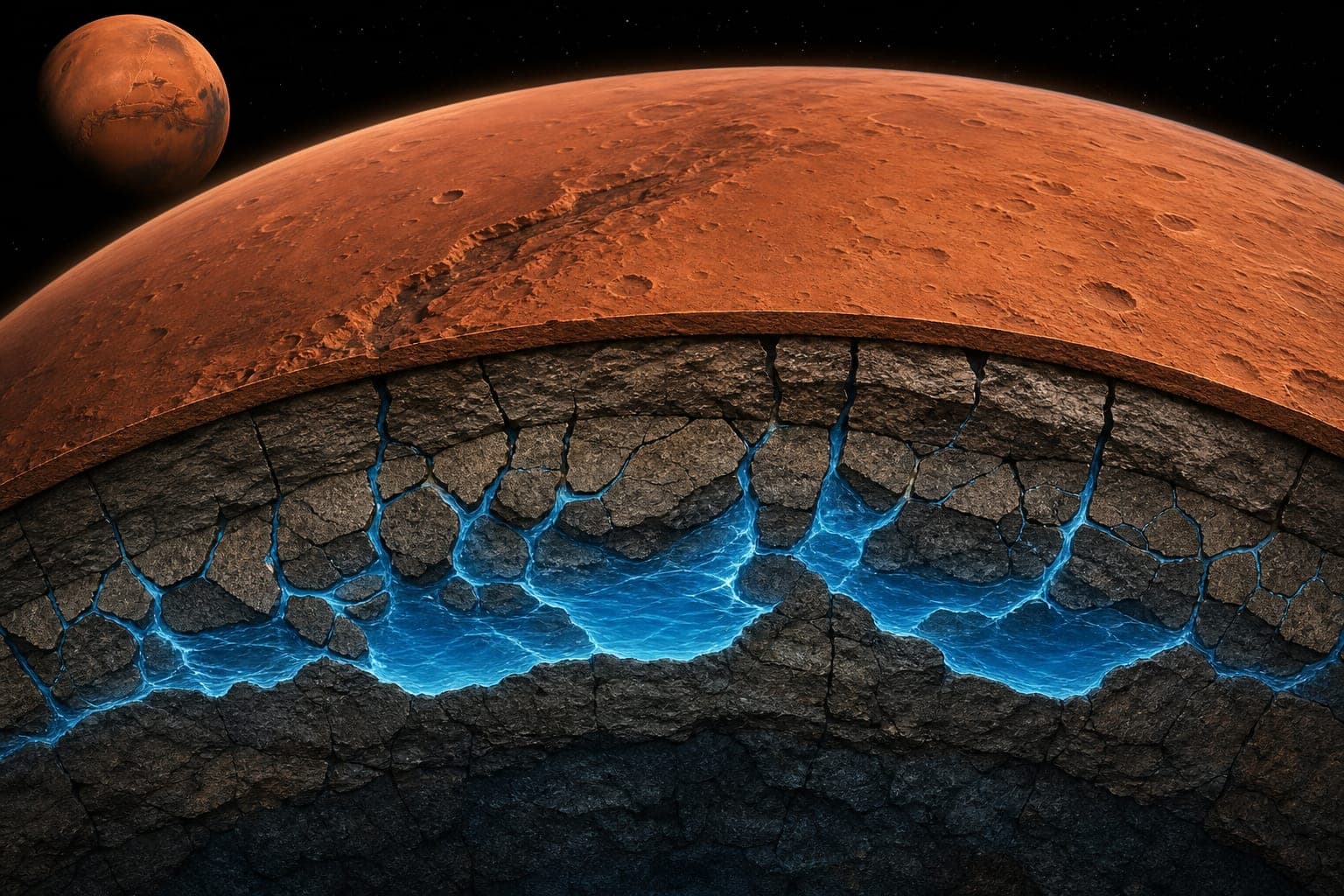
Seldom has a single planetary mission yielded such transformative insights as NASA's InSight lander. Although the mission ceased operations in December 2022, its seismic data continue to reshape our understanding of Mars. A landmark study published in the Proceedings of the National Academy of Sciences has revealed compelling evidence. Vast quantities of liquid water may be sequestered deep within the Martian crust.
Led by geophysicist Vashan Wright of the Scripps Institution of Oceanography, the research team employed sophisticated rock physics models. They also utilised Bayesian statistical methods to analyse seismic wave velocities recorded by InSight. Their findings indicate that fractured igneous rock saturated with liquid water best explains the observed data. This water is believed to occupy tiny cracks and pores at depths between 11.5 and 20 kilometres.
The implications of such a discovery are profound. Were this subterranean water to be brought to the surface, it could cover Mars entirely to a depth of one to two kilometres. This volume potentially exceeds that of the ancient oceans hypothesised to have existed over three billion years ago. However, the reservoir remains far beyond current drilling capabilities, even by terrestrial standards.
What distinguishes this research from prior investigations is its integration of multiple analytical approaches. Earlier studies using Europe's Mars Express orbiter had identified possible briny deposits beneath the south polar ice cap. The InSight analysis, by contrast, provides evidence of a far more extensive and globally distributed water system. A subsequent corroborating study from Japan has further bolstered these conclusions using laboratory experiments on analogous rock.
Nevertheless, not all scientists are persuaded by these interpretations. A rebuttal published in the same journal contends that the data do not necessarily require a water-saturated mid-crust. Such scholarly debate underscores the inherent complexity of interpreting remote geophysical measurements. Future missions equipped with advanced seismometers may ultimately resolve this question with greater precision.