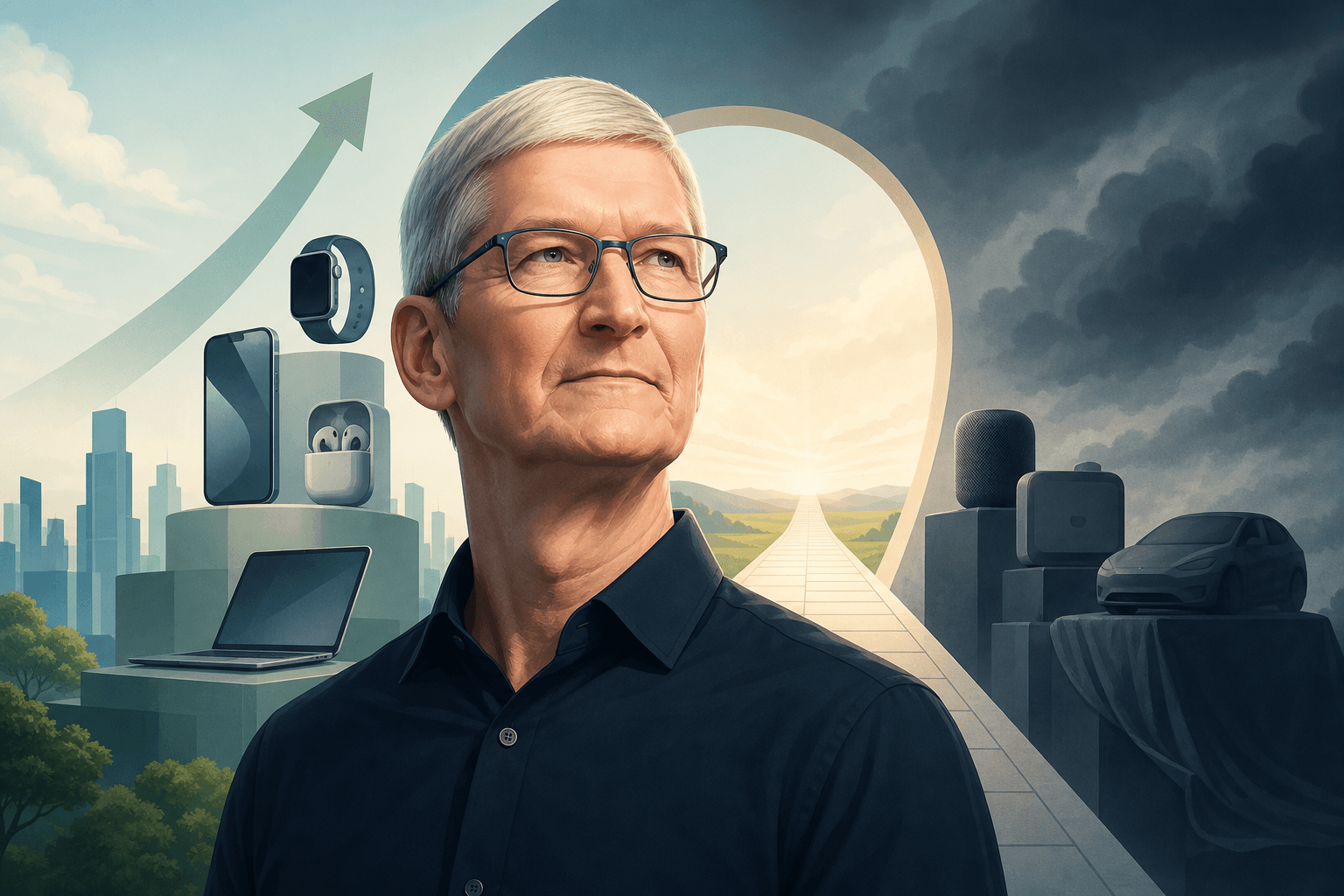
Seldom has a corporate succession been scrutinized as intensely as Tim Cook's appointment as Apple's CEO in 2011. Following the death of visionary founder Steve Jobs, skeptics questioned whether an operations executive could sustain Apple's innovative momentum. Yet Cook's tenure has yielded extraordinary financial results. Under his stewardship, Apple's market capitalization surged from approximately $350 billion to over $4 trillion. Harvard professor David Yoffie aptly noted that Cook performed extraordinarily well by any traditional metric.
Among Cook's most consequential strategic pivots was the deliberate expansion into recurring digital services. Recognizing that the global smartphone market was approaching saturation, Cook diversified Apple's revenue streams. The services division, encompassing Apple Music, iCloud, Apple Pay, and Apple TV+, generated $109 billion in fiscal 2025. This high-margin business now accounts for roughly twenty-six percent of total revenue. Such diversification has fundamentally insulated Apple from the cyclical volatility inherent in hardware sales.
Cook also presided over landmark product launches that extended Apple's ecosystem considerably. The Apple Watch, which he considers his proudest achievement, evolved from a fashion accessory into a health-monitoring device. AirPods became a cultural phenomenon, while Apple's proprietary silicon chips revolutionized Mac performance and efficiency. The transition from Intel processors, completed by 2023, demonstrated Cook's aptitude for long-term strategic execution.
Nevertheless, Cook's record is not without conspicuous missteps that warrant examination. He himself has acknowledged the disastrous 2012 launch of Apple Maps as his most significant blunder. The cancelled AirPower wireless charging mat represented a rare public engineering failure for the company. Perhaps most notably, the ambitious Apple Car project, internally designated Project Titan, was abandoned in 2024 after a decade. These setbacks underscore the inherent risks of pursuing innovation at unprecedented scale.
As Cook transitions to executive chairman on September 1, his successor John Ternus inherits a formidable enterprise. Cook's legacy ultimately demonstrates that operational discipline can complement visionary ambition in sustaining corporate preeminence. His tenure has redefined what effective succession looks like in the technology sector. The question confronting Ternus now is whether incremental refinement can perpetuate growth in an increasingly competitive landscape.