For decades, scientists have sorted humanity's ancient relatives into three familiar genera: Homo, Australopithecus, and Paranthropus. These taxonomic categories have shaped how researchers and the public alike conceptualise human origins. However, a provocative new study published in the American Journal of Biological Anthropology contends that this framework is overdue for revision. The paper, authored by Dr. Ian Towle of Monash University, argues that accumulating fossil and genetic evidence has rendered these groupings scientifically untenable.
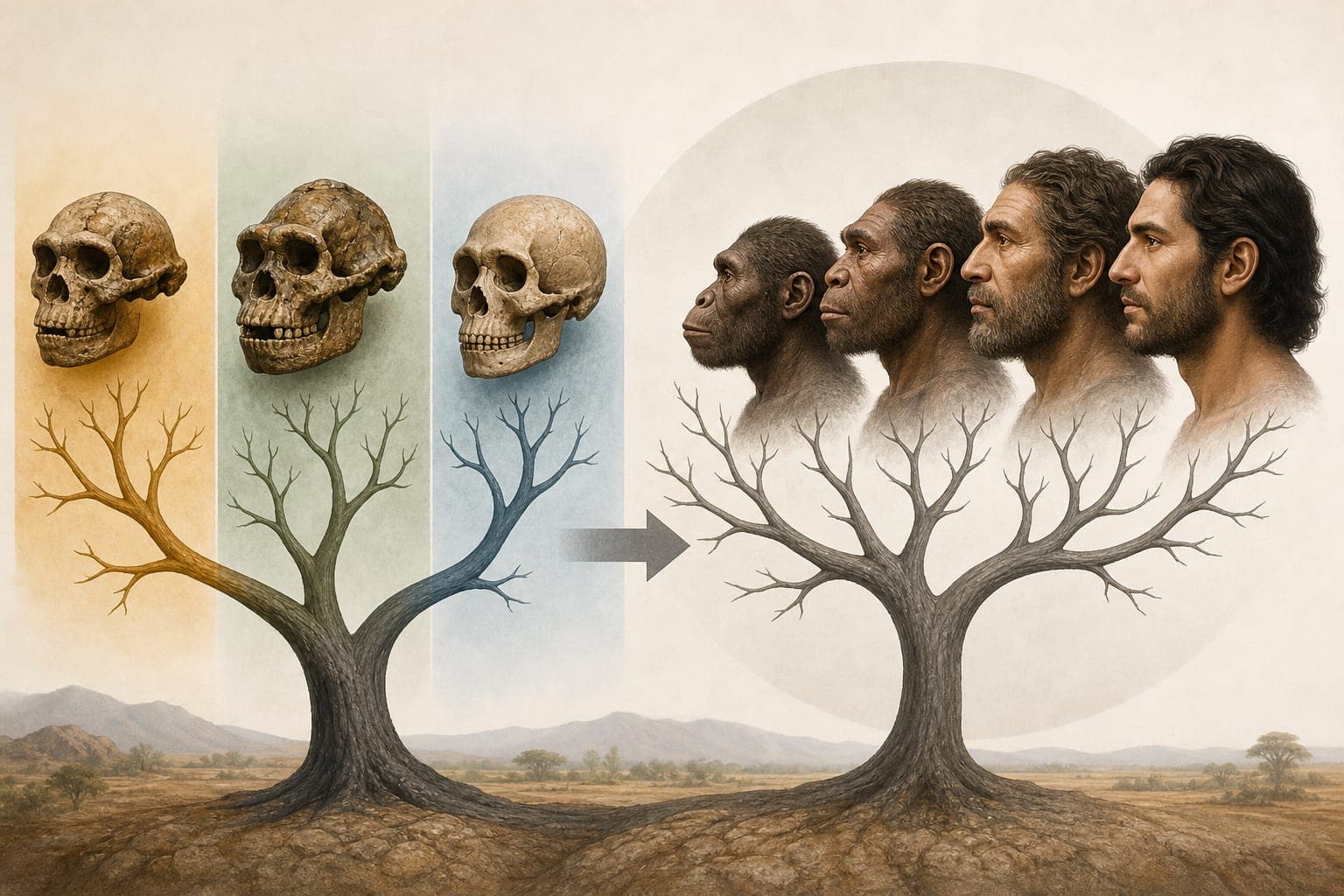
The core problem, according to Towle, is that the current genera do not represent genuine evolutionary branches. In taxonomy, a valid grouping should form a clade, meaning it includes a common ancestor and all of its descendants. Australopithecus, which includes the renowned skeleton known as Lucy, is widely considered non-monophyletic. This means that its member species do not all share an exclusive common ancestor, undermining the group's coherence.
Compounding this issue is the erosion of traits once deemed definitive for distinguishing these genera. Brain size, tool use, and bipedal locomotion were historically used to demarcate Homo from its predecessors. Yet recent discoveries have progressively blurred these boundaries. Homo naledi, for instance, possesses a remarkably small brain despite being classified within our own genus.
Towle's proposed solution is to subsume both Australopithecus and Paranthropus into a single, expanded Homo genus. This enlarged classification would encompass all hominin species from the past four to five million years. Such a revision would resolve problems of non-monophyly and align hominin taxonomy with clade-based principles used elsewhere in biology. Nevertheless, critics note that collapsing three genera would sacrifice intuitive distinctions that many researchers consider biologically meaningful.
The debate ultimately reflects a broader tension within evolutionary science between classification based on shared ancestry and classification based on observable traits. As the fossil record increasingly reveals a dense, branching pattern of hominin evolution, rigid categorical boundaries appear ever more arbitrary. Whether or not Towle's proposal gains widespread acceptance, it underscores how profoundly new evidence can reshape even the most fundamental scientific frameworks.