
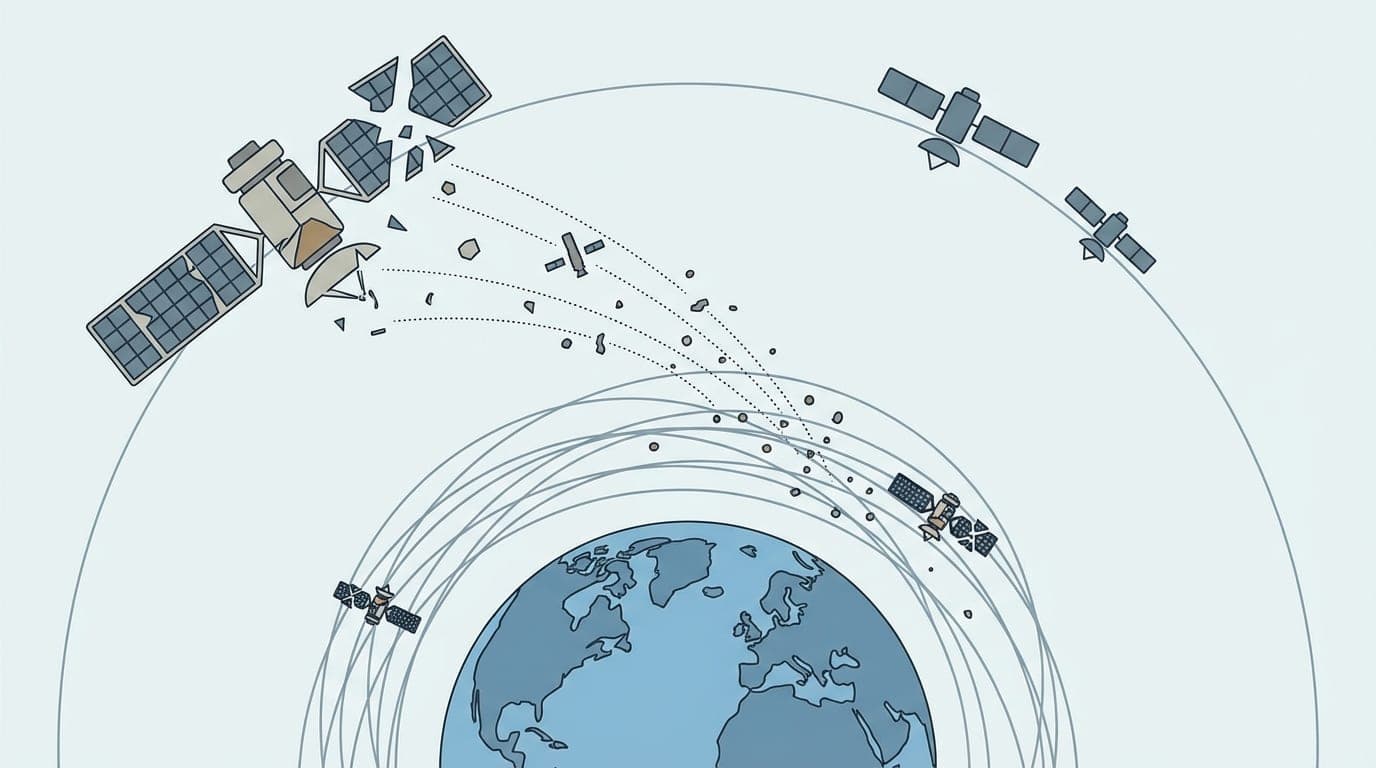
For the second time in barely three months, a SpaceX Starlink satellite has suffered an in-orbit anomaly, generating a debris field. On March 29, 2026, Starlink satellite 34343 experienced an unspecified malfunction at approximately 560 kilometres above Earth. Communications with the spacecraft were immediately lost. The commercial tracking firm LeoLabs subsequently detected tens of fragments in the satellite's vicinity. This recurrence has drawn serious attention from the space safety community worldwide.
LeoLabs characterised the incident as a fragment creation event likely caused by an internal energetic source. This assessment suggests a propulsion system or battery failure rather than a collision with existing debris. The previous anomaly, involving Starlink-35956 on December 17, 2025, exhibited remarkably similar characteristics. That earlier malfunction caused rapid propellant venting, a four-kilometre drop in orbital altitude, and the release of hundreds of debris fragments.
Despite the severity of these events, SpaceX has sought to mitigate concerns regarding immediate hazards. The company stated that neither the International Space Station nor NASA's forthcoming Artemis II mission faced elevated risk. Notably, a Falcon 9 rocket launched 29 additional Starlink satellites merely six hours after the latest anomaly was confirmed. SpaceX has not disclosed the root cause of either incident, though engineers are reportedly deploying software updates across the fleet.
The broader implications of these malfunctions extend well beyond the immediate debris fields they produce. As of March 2026, SpaceX operates over 10,000 active Starlink satellites, constituting approximately 65 percent of all functional spacecraft in orbit. Astrophysicist Jonathan McDowell has cautioned that a shared design flaw could affect thousands of similar satellites. Should such a systemic vulnerability exist, the cumulative risks would escalate considerably.
These incidents have reignited discourse surrounding the Kessler syndrome, a theoretical cascading collision scenario. In this hypothesis, orbital debris density reaches a threshold where collisions become self-perpetuating, rendering certain orbits effectively unusable. Scientists recently proposed the CRASH Clock as a metric for estimating catastrophic collision timelines. The imperative for enhanced international coordination, transparent reporting, and robust debris mitigation has never been more pronounced.