
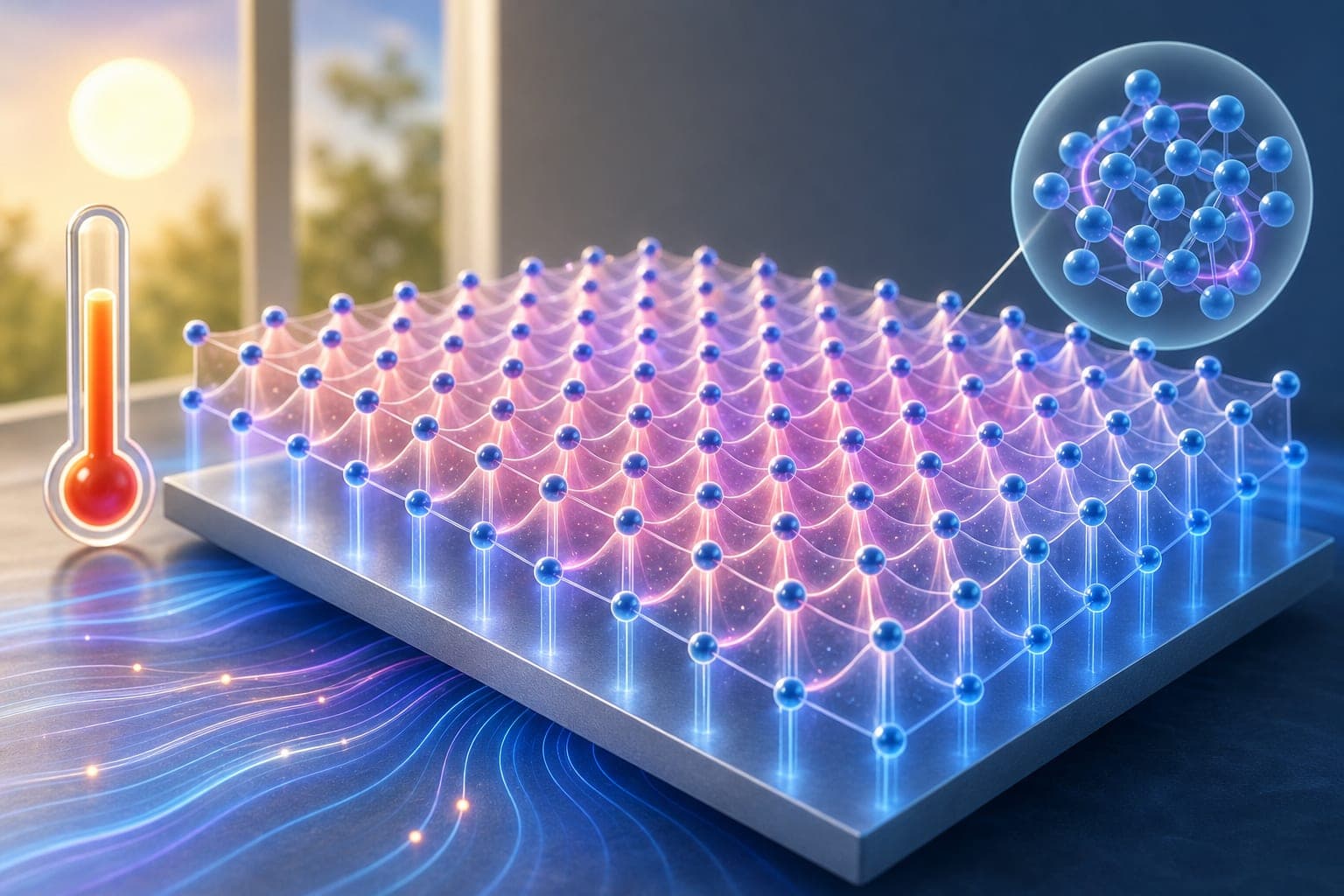
Seldom has a discovery in quantum physics generated such widespread anticipation. An international team of researchers has observed a supersolid quantum state at room temperature. Previously, such exotic states required cooling to near absolute zero. This achievement fundamentally challenges long-held assumptions about quantum matter.
The quantum state was engineered inside a microcavity, a tiny structure designed to trap light. Researchers combined a liquid crystal with an organic semiconductor to enable strong light-matter coupling. Laser pulses then supplied the energy necessary to trigger the quantum reaction. The resulting state exhibits properties of both a superfluid and a crystalline solid simultaneously.
What distinguishes this breakthrough is the elimination of costly cryogenic infrastructure. Conventional quantum experiments depend on refrigeration systems that maintain temperatures near absolute zero. The microcavity operated at temperatures approaching sixty degrees Celsius. This versatile platform thus makes quantum phenomena far more accessible to laboratories worldwide.
The researchers produced hybrid quasiparticles known as exciton polaritons by coupling photons with matter. These quasiparticles formed a Bose-Einstein condensate, behaving collectively as a single quantum entity. Periodically spaced bright fringes of light confirmed the supersolid phase. However, the quantum state remains remarkably short-lived due to material degradation.
Despite this limitation, the implications for emerging technologies are profound. Advanced computing systems and quantum sensors could eventually benefit from room-temperature operation. Reproducible fabrication and longer-lasting samples will be essential for practical applications. Nevertheless, this discovery establishes a compelling foundation for future quantum engineering.