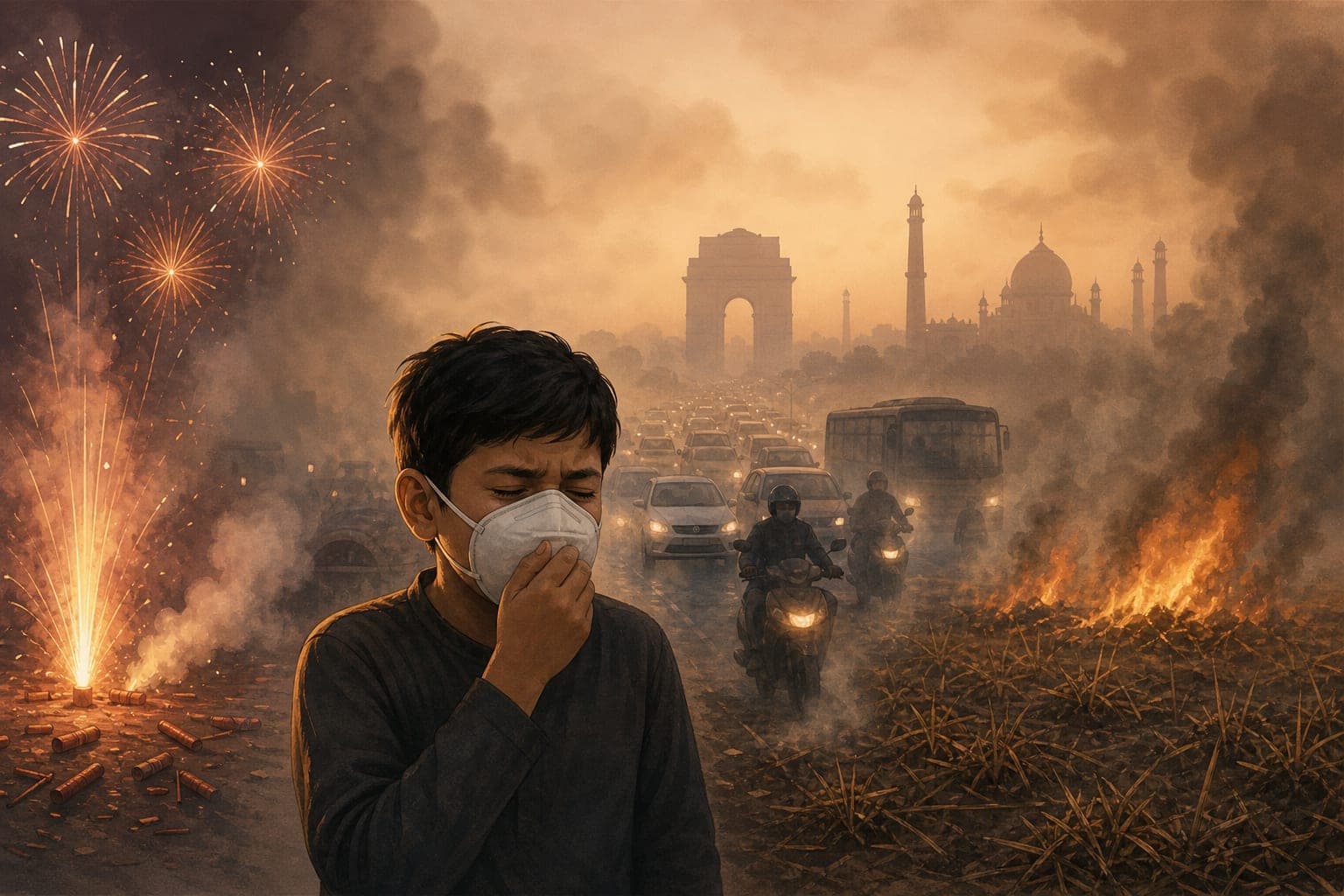
Seldom has a festive occasion been so overshadowed by an environmental crisis. On the eve of Diwali 2026, New Delhi recorded its worst air quality in a decade. The Central Pollution Control Board registered an Air Quality Index of 369, placing the city firmly in the 'very poor' category. Swiss air monitoring firm IQAir subsequently ranked Delhi the most polluted major city in the world. The convergence of fireworks, agricultural burning, and stagnant weather conditions precipitated an atmospheric emergency of alarming proportions.
Multiple factors have been attributed to this deterioration. Stubble burning in the neighbouring states of Punjab and Haryana contributed approximately twenty percent of Delhi's fine particulate pollution. Vehicular emissions accounted for a further fifteen percent, compounding the already hazardous baseline of industrial and domestic pollutants. Meteorological conditions exacerbated the situation, as low wind speeds and a shallow atmospheric boundary layer trapped pollutants near the surface. Several monitoring stations across the capital breached the 'severe' threshold, with Jahangirpuri recording an AQI of 450.
In response, authorities invoked Stage III of the Graded Response Action Plan, a framework of emergency measures designed to mitigate pollution. These stringent restrictions included bans on non-essential construction, limitations on diesel vehicles, and intensified road-cleaning operations. The government ordered schools to hold online classes and encouraged citizens to work from home. Despite such interventions, experts contend that reactive measures alone remain insufficient to address the systemic roots of the crisis.
The public health implications are profound and well documented. Hospitals consistently report surges in respiratory ailments, including asthma attacks, bronchitis, and eye infections, in the days following Diwali. PM2.5 levels in some areas soared to over fifty times the World Health Organization's recommended guideline. Children, the elderly, and individuals with pre-existing conditions are disproportionately vulnerable. The perennial recurrence of this crisis underscores the inadequacy of short-term palliative responses.
At its core, the debate surrounding Delhi's pollution encapsulates a broader tension between cultural heritage and environmental imperatives. The Supreme Court's recent characterisation of firecracker use as a 'religious practice' has complicated enforcement of existing bans. Nevertheless, the scientific consensus is unequivocal: without sustained structural reforms, Delhi's air quality will continue to deteriorate. Addressing the crisis demands an integrated approach encompassing cleaner agricultural practices, accelerated adoption of electric vehicles, and robust enforcement mechanisms.