
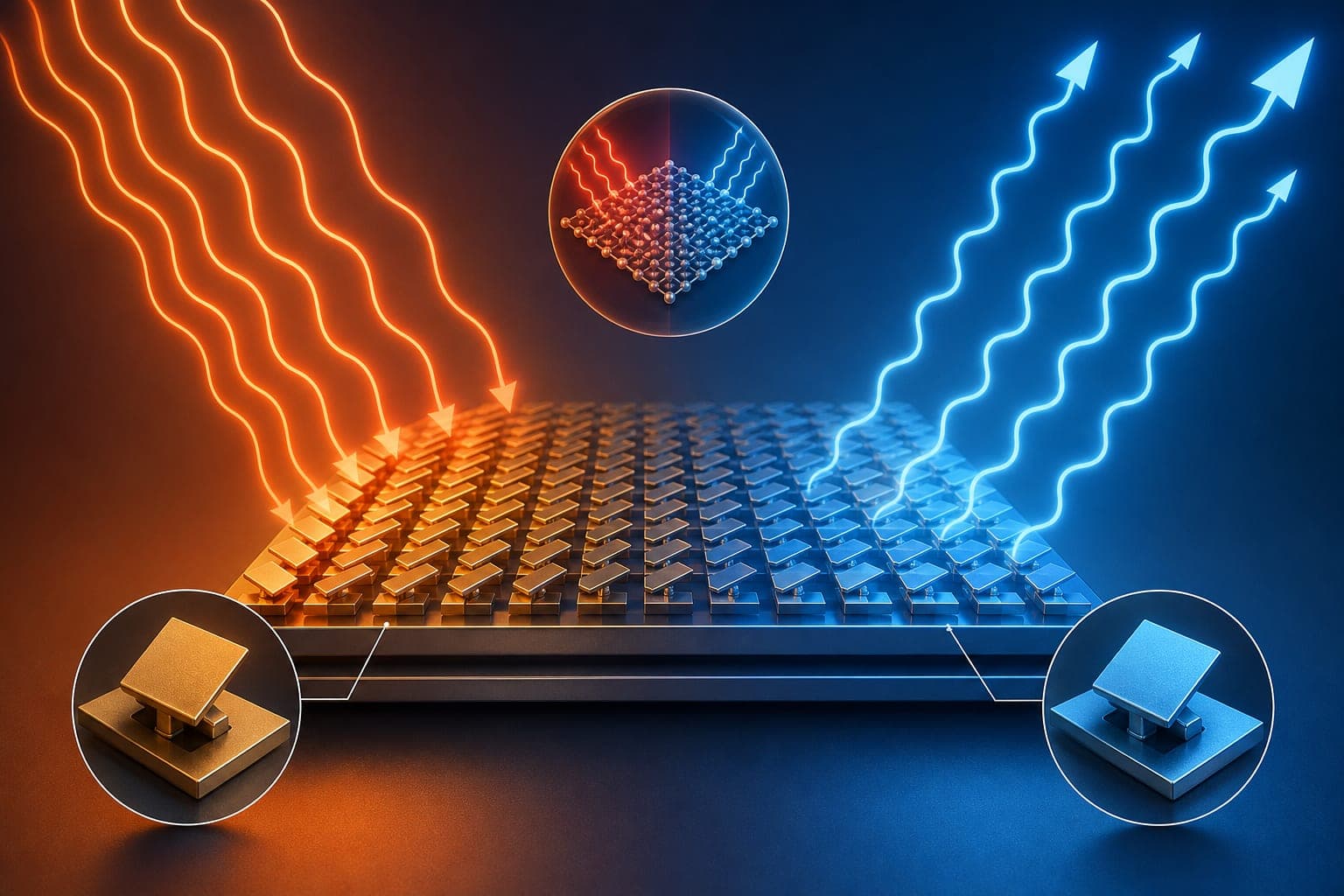
Seldom has a theoretical advance in thermal physics generated such widespread attention among both scientists and engineers. A team at Osaka Metropolitan University has proposed a device that circumvents Kirchhoff's law of thermal radiation. This principle, established in the nineteenth century, dictates that a material's ability to absorb heat must equal its ability to emit heat. For over 160 years, this reciprocity has constrained how engineers manage thermal energy in practical applications.
What distinguishes this innovation is its unprecedented integration of two well-established materials into a single functional architecture. The first component is indium arsenide, a semiconductor whose interaction with infrared light becomes asymmetric under a magnetic field. The second is germanium-antimony-tellurium, a phase-change compound capable of switching between amorphous and crystalline states. Together, these materials form a metagrating that can direct heat radiation in specific, controllable directions.
Perhaps most remarkably, the device exhibits nonvolatile behaviour, retaining its programmed configuration even after power is removed. Earlier nonreciprocal thermal designs required continuous energy input and functioned only at steep angles. By contrast, this system operates at near-normal incidence and maintains its settings indefinitely. This characteristic renders the device analogous to computer memory, storing thermal states rather than electrical charges.
The potential applications of such a breakthrough are considerable and far-reaching. Professor Koichi Okamoto has articulated the goal of developing compact devices that control heat as precisely as electronic circuits. Infrared sensors with directional selectivity could substantially reduce background noise and improve detection accuracy. Furthermore, photonic memory elements operating in the mid-infrared spectrum represent an entirely novel approach to information storage.
It should be noted that the device currently exists only as a theoretical proposal and has not yet been fabricated. Nevertheless, the researchers maintain that it relies on proven manufacturing methods and commercially available materials. Should subsequent experimental validation confirm these findings, the implications for thermal management technology would be profound. The convergence of magneto-optical physics and phase-change materials may thus herald a new era in thermal engineering.