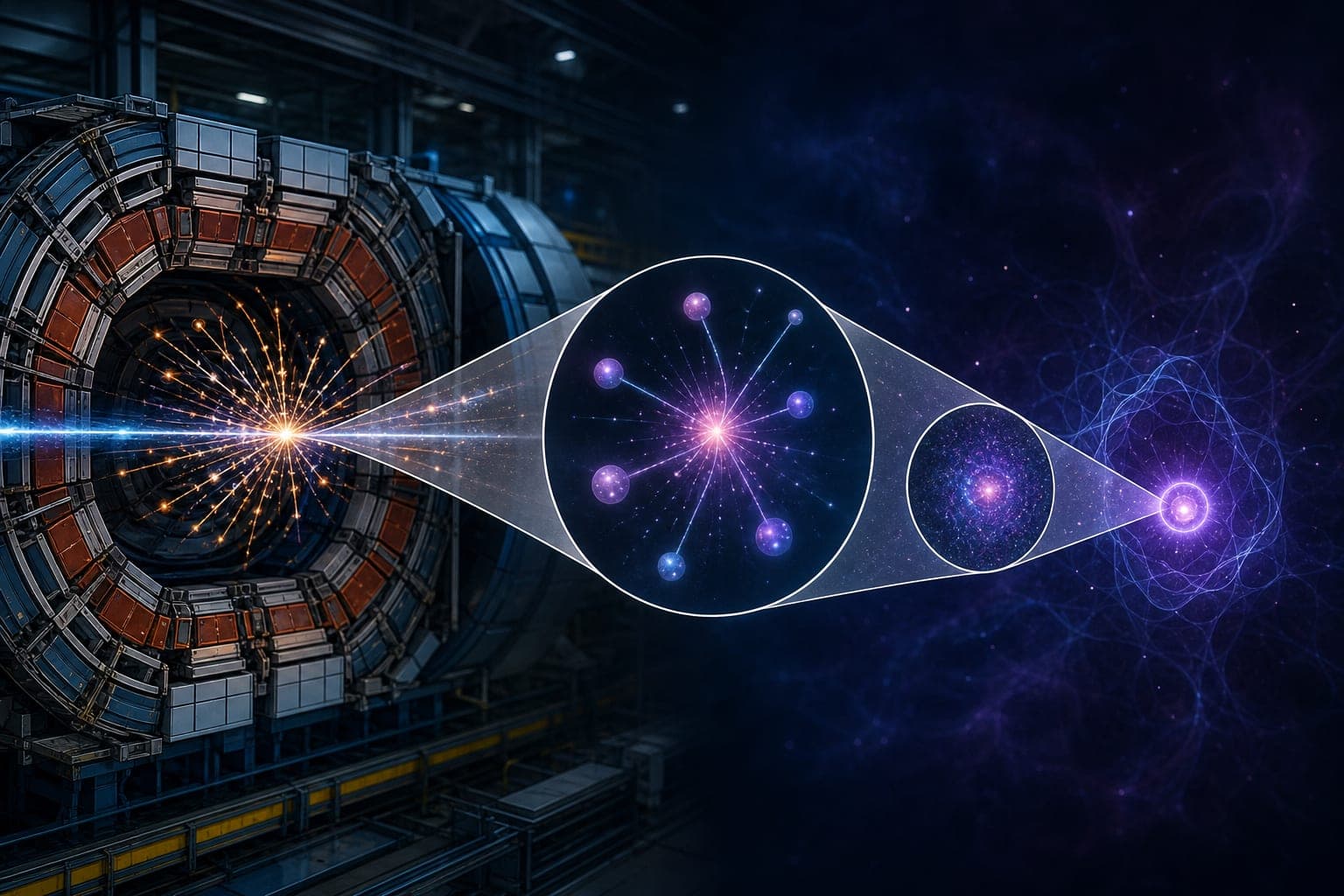
Seldom has a single observation in particle physics generated such profound anticipation. On November 3, 2026, a UK-led team of physicists announced evidence of the rarest subatomic decay ever observed. The discovery, made at CERN's Large Hadron Collider near Geneva, brings researchers closer to an enigmatic realm. Physicists have dubbed this domain the 'zeptoverse,' a world roughly 100 billion times smaller than an atom.
The research centred on particles containing beauty quarks, fleeting entities that exist for barely one and a half trillionths of a second. In an exceptionally rare event, a beauty quark annihilates with its antiquark counterpart, producing two smaller particles called muons. This decay occurs only once in every ten billion instances, rendering it extraordinarily difficult to detect. Researchers had been hunting for evidence of this elusive process since 1984.
A major upgrade to the LHCb experiment in 2024 proved instrumental in achieving this breakthrough. The enhanced detector collected data at up to five times its previous rate throughout 2024 and 2025. By amalgamating this new data with earlier observations gathered between 2011 and 2018, the signal reached 3.2 sigma. This threshold constitutes the accepted standard for preliminary evidence of a new phenomenon in physics.
What distinguishes this finding is its potential to probe the fundamental architecture of reality itself. The Standard Model, which has governed particle physics for over fifty years, remains incomplete. It cannot account for dark matter, a substance that pervades the cosmos yet has never been directly detected. Some theoretical frameworks suggest that at zeptometre scales, particles become more sensitive to dark matter's influence.
Nevertheless, the zeptoverse remains a frontier merely glimpsed rather than thoroughly explored. The statistical significance falls below the five-sigma level required to claim a confirmed discovery. Further upgrades to CERN's equipment, anticipated in the 2030s, should enable far more detailed scrutiny. Should subsequent data corroborate these preliminary findings, the implications for fundamental physics would be transformative.