
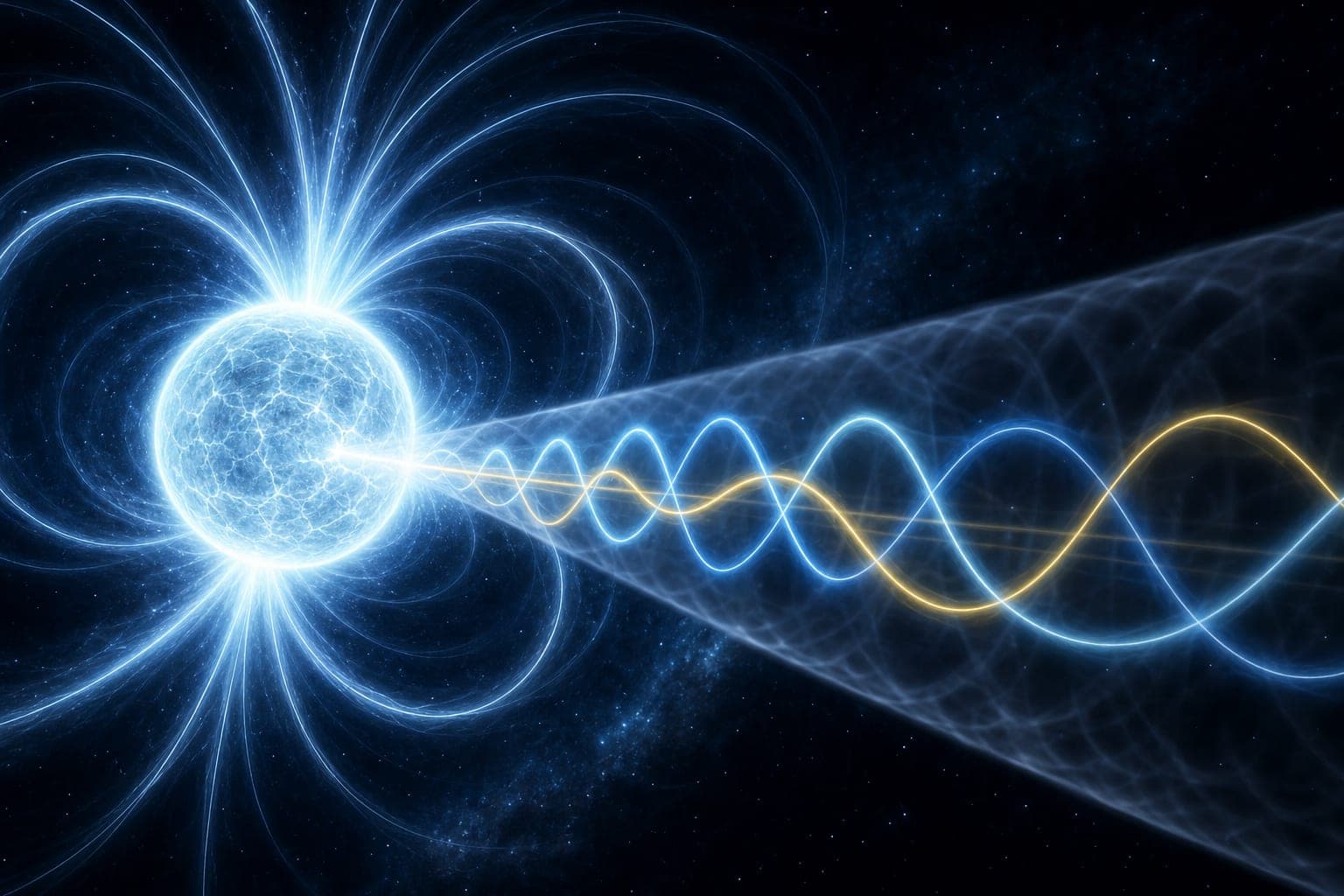
Seldom has a single astronomical observation carried such profound implications for our understanding of fundamental physics. An international team of researchers has reported the strongest evidence yet that empty space is not truly void. By studying a magnetar, a rare type of neutron star, scientists believe they have observed a phenomenon called vacuum birefringence. This effect, first predicted in 1936, suggests that powerful magnetic fields can alter how light travels through seemingly empty space.
The theoretical groundwork for this discovery dates back nearly nine decades. In 1936, the renowned physicist Werner Heisenberg and his student Hans Euler proposed that space is permeated by virtual particles. These fleeting entities, consisting of electrons and their antimatter counterparts, constantly flicker in and out of existence. Under ordinary conditions, this quantum activity remains entirely imperceptible. However, Heisenberg predicted that sufficiently intense magnetic fields could compel these particles to affect light's behaviour.
The research team, led by Rachael Stewart at George Washington University, focused on magnetar 1E 1547-5408. This celestial object rotates once every 2.1 seconds and generates magnetic fields a trillion times stronger than Earth's. NASA's Imaging X-ray Polarimetry Explorer conducted over 140 hours of meticulous observation between March and April 2025. The telescope detected unusually high polarisation in the magnetar's X-ray emissions, reaching 65 percent at certain energy levels.
What distinguishes this finding from previous attempts is the robustness of the polarisation data. Earlier observations in 2017 using optical telescopes had yielded inconclusive results that remained open to alternative interpretations. The current measurements, published in the journal Nature, demonstrate patterns that conventional atmospheric models cannot adequately explain. Only when the effects of vacuum birefringence are incorporated do the theoretical predictions align with the observed data.
Nevertheless, the researchers acknowledge that further corroboration is necessary before a definitive conclusion can be drawn. Observations of additional magnetars with varying magnetic orientations would strengthen the case considerably. Should future studies confirm these findings, vacuum birefringence could become a practical tool for probing fundamental physics. As one co-author stated, astronomers are no longer merely studying celestial objects but using them to test the laws of nature.