
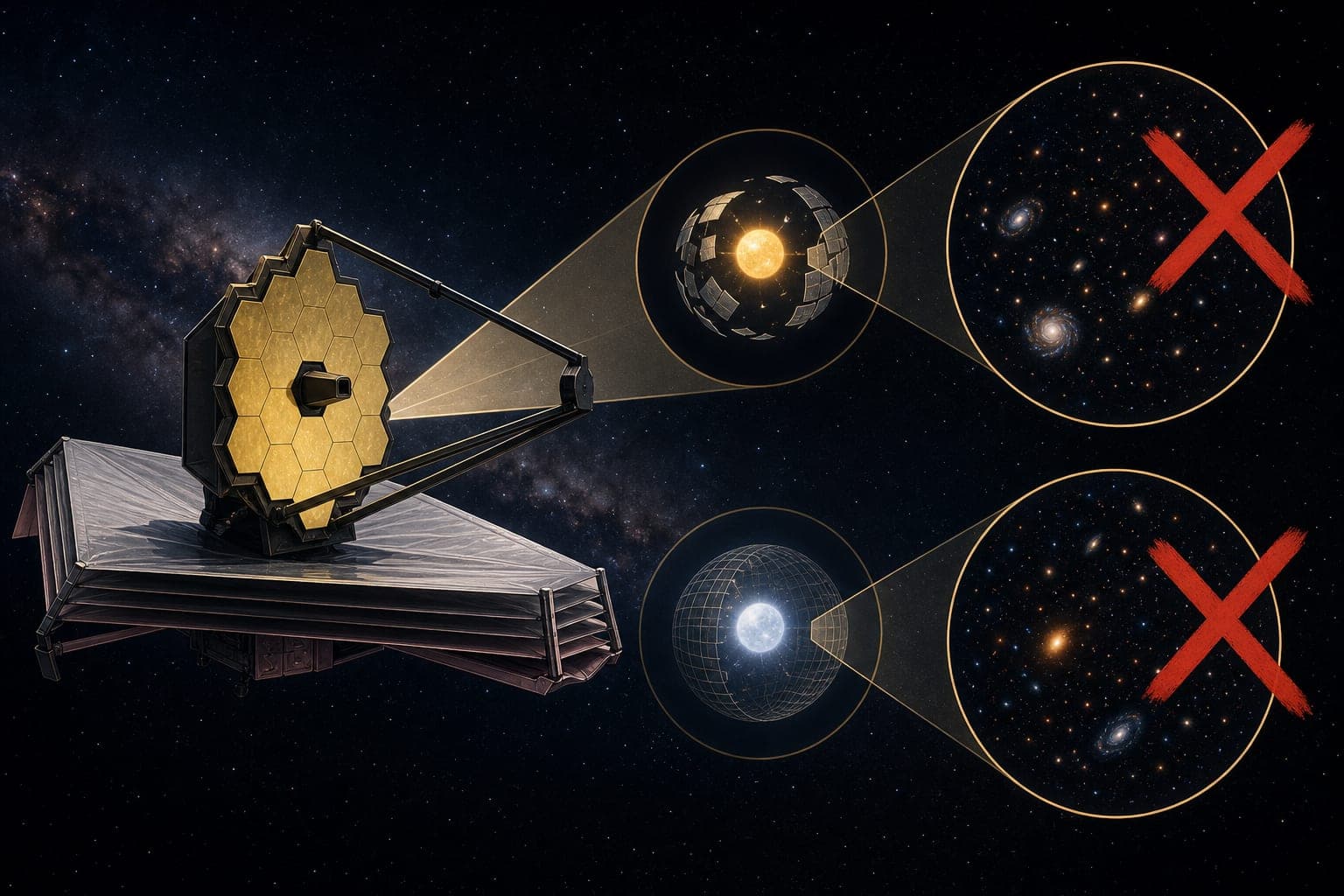
Seldom has a scientific investigation so elegantly demonstrated both the promise and the pitfalls of searching for extraterrestrial intelligence. The James Webb Space Telescope recently examined two stars that had been flagged as potential Dyson sphere candidates. These hypothetical megastructures, first proposed by physicist Freeman Dyson in 1960, would harvest a star's entire energy output. The findings, published in July 2026, have captivated the astronomical community worldwide.
Project Hephaistos, led by Matías Suazo at Uppsala University, initially identified seven red dwarf stars exhibiting anomalous infrared excess. The team had scrutinised approximately five million stars using data from the Gaia, 2MASS, and WISE surveys. Among the seven candidates, two designated D and E had survived increasingly rigorous tests. They remained the most compelling candidates, having withstood every archival diagnostic available before JWST observation.
Using its Mid-Infrared Instrument, the JWST swiftly exposed the true nature of these candidates. The infrared excess did not originate from megastructures but from background galaxies projected within one arcsecond of the stars. The galaxy behind Candidate D, at a redshift of approximately 0.9, proved consistent with a Hot Dust-Obscured Galaxy. Meanwhile, Candidate E's background galaxy displayed characteristics of a dusty starburst at a lower redshift.
What distinguishes this investigation from prior efforts is the unprecedented methodological rigour it has established. Never before had Dyson sphere candidates been subjected to such a comprehensive verification process. The researchers developed novel techniques for disentangling overlapping light sources, thereby circumventing certain instrumental limitations. This systematic approach now constitutes a replicable framework for future technosignature searches.
Far from representing a futile endeavour, the investigation yielded scientifically valuable outcomes beyond its original scope. Two previously undetected galaxies were discovered, each presenting genuine astrophysical interest in its own right. Furthermore, the star-galaxy alignments offer promising opportunities for next-generation telescopes employing adaptive optics. The research conclusively illustrates that ruling out a compelling candidate is by no means equivalent to drawing a blank.