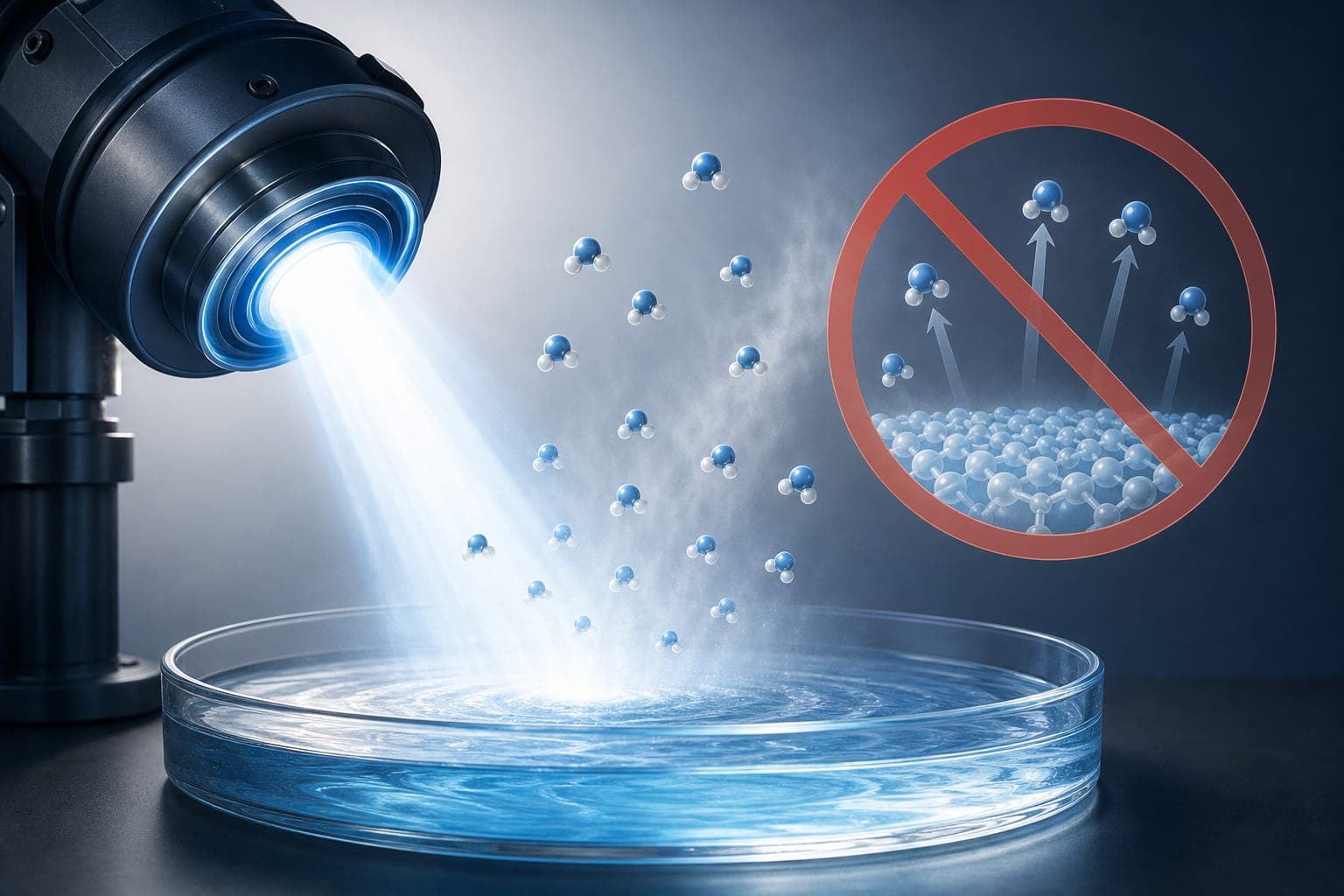
A contentious scientific debate has intensified following a striking experiment published in the journal PNAS in 2026. Researchers directed visible light at extreme intensities onto a flat water surface. The photon flux exceeded solar levels by a factor of ten billion. Yet the evaporation rate showed no measurable enhancement whatsoever. This counterintuitive result challenges a prominent hypothesis that has captivated the scientific community.
The hypothesis in question is the so-called photomolecular effect, first proposed by MIT researchers in 2023. Their initial experiments suggested that photons could directly cleave clusters of water molecules from the air-water interface. Crucially, this process would operate independently of thermal energy. In hydrogel-based experiments, evaporation rates appeared to exceed the theoretical thermal limit by two to five times. Green light, in particular, seemed to elicit the strongest response.
The new study employed fundamentally different methodology to scrutinise these claims. Scientists tracked the precise recession of the water surface to quantify evaporation directly. They also utilised a vibrational probe with angstrom-scale sensitivity to examine molecular bonding. Neither macroscopic nor microscopic measurements revealed any alteration attributable to visible light. Notably, even at 532 nanometres, the wavelength previously associated with peak photomolecular activity, no effect was detected.
The discrepancy between the two sets of findings may stem from differences in experimental conditions. Earlier studies used hydrogels, porous materials that absorb considerable water, as the evaporation medium. The new experiment tested a flat, unobstructed air-water interface without such intermediary materials. Consequently, the researchers suggest that previously observed anomalies might reflect properties of the hydrogel rather than an intrinsic light-water interaction.
Should the photomolecular effect ultimately be validated, its implications would be far-reaching. Proponents argue it could revolutionise solar desalination and fundamentally alter climate models. Conversely, if the effect proves to be an artefact, current thermodynamic frameworks would remain intact. Regardless of the outcome, this empirical dispute exemplifies how rigorous scientific inquiry demands reproducibility and methodological transparency.