
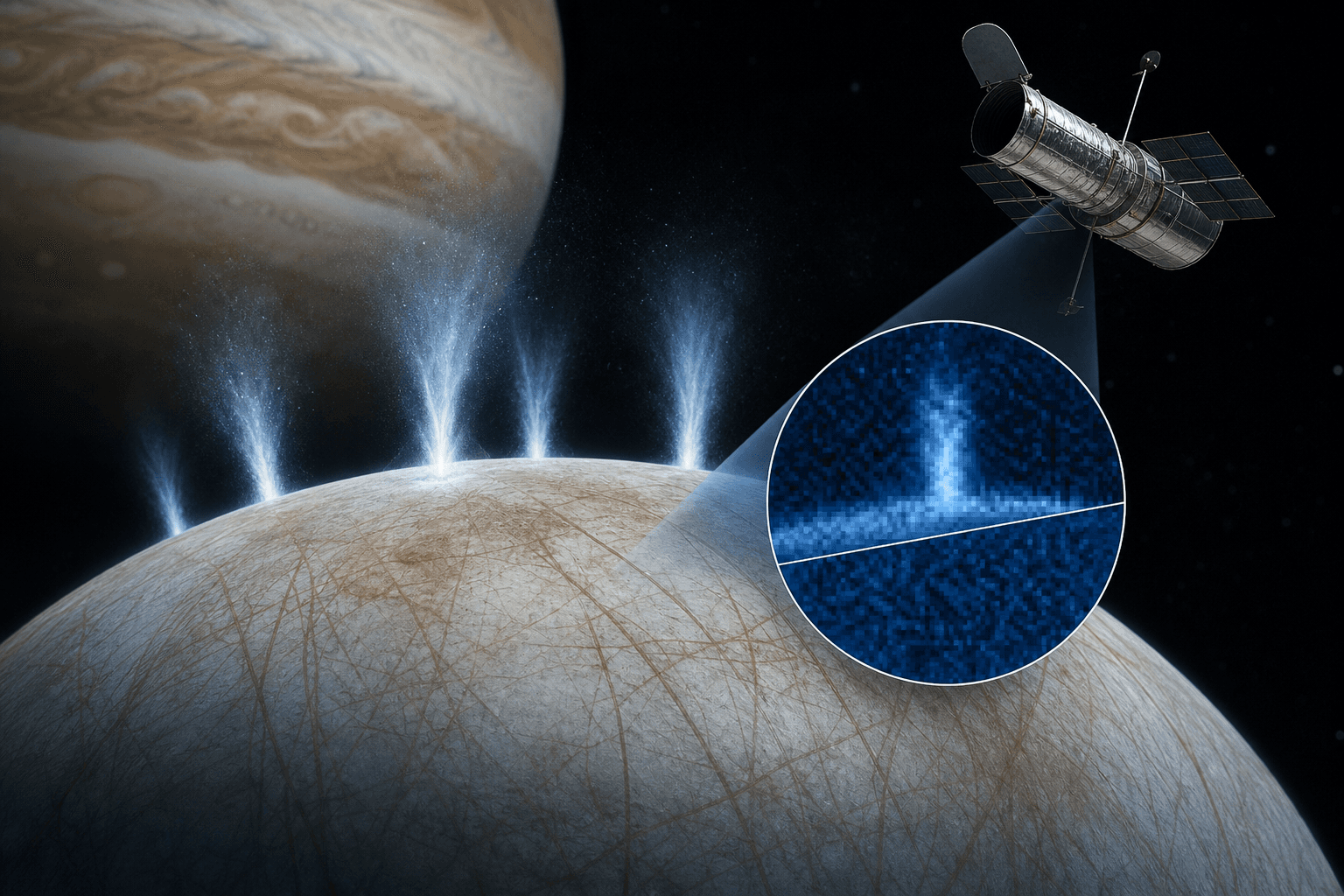
Seldom has a celebrated scientific claim been so thoroughly reconsidered by its own authors. In 2014, researchers published findings suggesting that water vapour plumes were erupting from Europa. The discovery, based on Hubble Space Telescope ultraviolet observations, captivated the scientific community. It implied that material from a subsurface ocean could be sampled without drilling through kilometres of ice.
A reanalysis published in 2026 has now cast substantial doubt on those original findings. The same team revisited 23 Hubble observations collected between 1999 and 2020. They focused on Lyman-alpha emissions, a wavelength of ultraviolet light scattered by hydrogen atoms. Critically, the researchers discovered that even minor misalignment in Europa's image position could fundamentally alter data interpretation.
The statistical confidence in the plumes' existence has diminished from 99.9 percent to below 90 percent. Lead author Dr. Lorenz Roth acknowledged that this level of certainty is insufficient to support original claims. What initially appeared to be evidence of water vapour may have been mere statistical noise. The dataset neither confirms nor definitively rules out the existence of such plumes.
This development exemplifies the self-correcting nature of the scientific method. Rather than defending their earlier assertions, the researchers subjected them to more rigorous scrutiny. Such intellectual honesty is not a weakness but a fundamental strength of empirical inquiry. It demonstrates that provisional conclusions must always remain open to revision when new analysis warrants it.
The question of Europa's plumes remains unresolved, yet forthcoming missions may provide definitive answers. NASA's Europa Clipper spacecraft, expected to arrive at Jupiter in 2030, will conduct repeated close passes. Its sophisticated instruments far surpass Hubble's capabilities for detecting active eruptions. Until then, Europa's geysers remain physically plausible but observationally unconfirmed.