
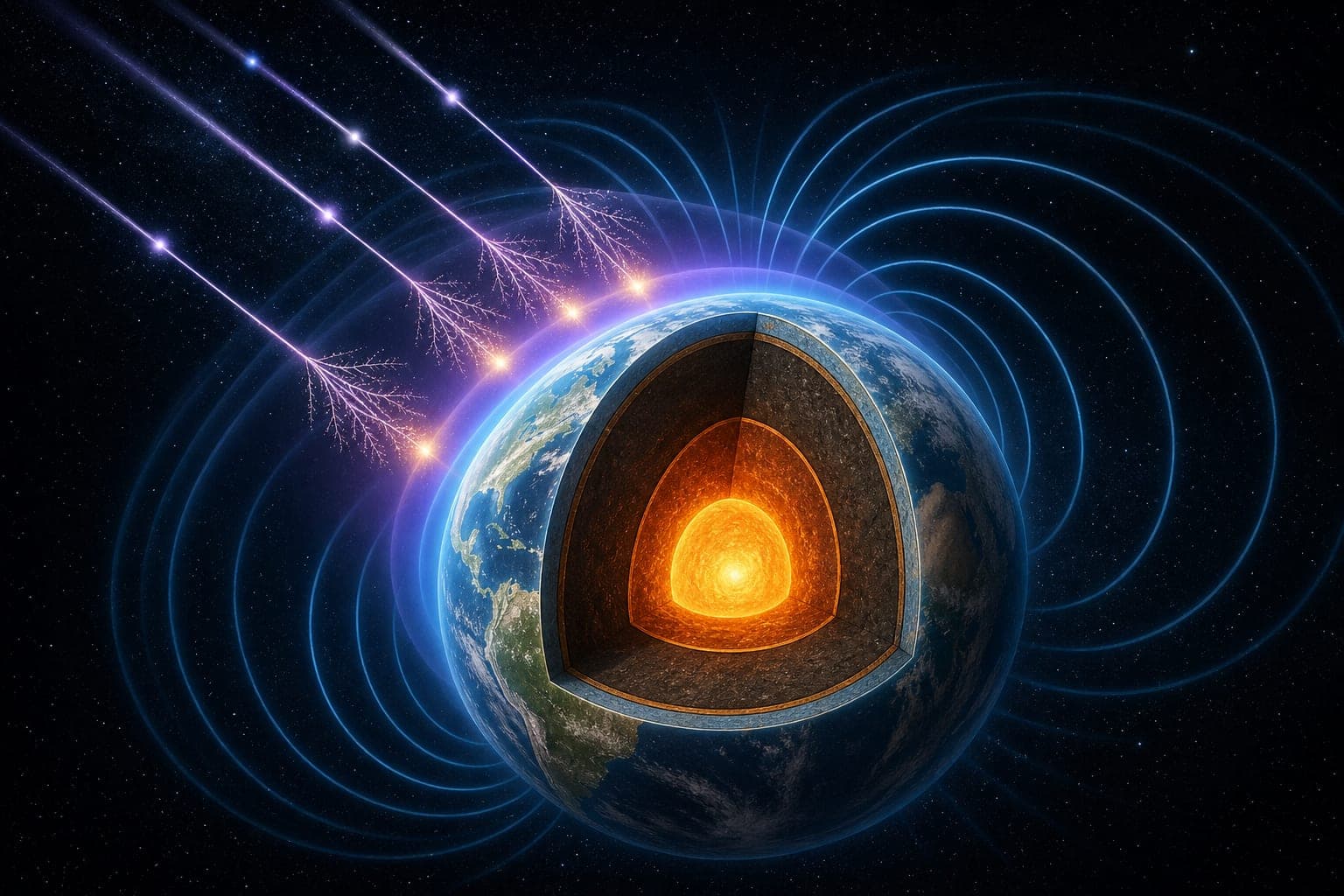
Seldom has a scientific endeavour been as ambitious as turning an entire planet into a detector. A team of physicists, led by Atsushi Taruya, has done precisely that. By utilising Earth's magnetic field and ionosphere, they created a planet-sized instrument. Their objective was to hunt for dark matter, the enigmatic substance constituting roughly a quarter of the universe's energy content. Despite decades of research, its composition remains one of modern physics' most profound mysteries.
The methodology hinges on a remarkable natural phenomenon. The space between Earth's surface and the ionosphere forms a cavity that amplifies electromagnetic waves. Hypothetical particles called axions could decay into photons within Earth's magnetic field. These photons would then resonate inside this cavity at specific, predictable frequencies. By analysing a decade of geomagnetic data from a British observatory, the researchers sought such signatures.
What emerged from the data proved both compelling and perplexing. The experiment detected dozens of candidate signals consistent with theoretical predictions. Using stringent criteria, the team narrowed these to thirty-one credible dark photon signals. Nevertheless, verification remains imperative, as conventional sources could account for these anomalies. The researchers concede that distinguishing genuine dark matter signals from background noise poses a formidable challenge.
A particularly ingenious aspect of this approach lies in its capacity to differentiate between particle types. Axion signals would vary geographically, being strongest near Southeast Asia and weakest at the poles. Dark photon signals, conversely, would appear uniform across the globe. This distinction arises because axions interact with Earth's magnetic field, whose intensity fluctuates by location. Such spatial analysis could ultimately reveal which particle, if either, constitutes dark matter.
The implications of this research extend well beyond its immediate findings. The new constraints on axion interactions are approximately one hundred times more rigorous than previous results. Furthermore, this paradigm demonstrates that planetary-scale natural systems can complement laboratory-based experiments. Should subsequent studies corroborate these preliminary signals, the discovery would fundamentally reshape our understanding of the cosmos. For now, the enigma of dark matter endures, yet the Earth itself may hold the answer.