Seldom has a single experimental measurement so decisively challenged a long-standing theoretical framework in particle physics. Researchers at CERN's Large Hadron Collider have conducted a landmark study within the ALICE experiment. Their findings, published in Physical Review Letters in August 2026, distinguish between two competing models. These models describe how gluons, the particles binding quarks together, are distributed inside atomic nuclei.
Gluons carry the strong nuclear force and are responsible for binding quarks inside protons and neutrons. Although quarks are frequently characterised as the fundamental constituents of matter, gluons warrant equal attention. Nearly all the mass of visible matter originates from the energy stored within gluon interactions. Understanding their behaviour inside nuclei is therefore essential to comprehending how matter itself acquires structure.
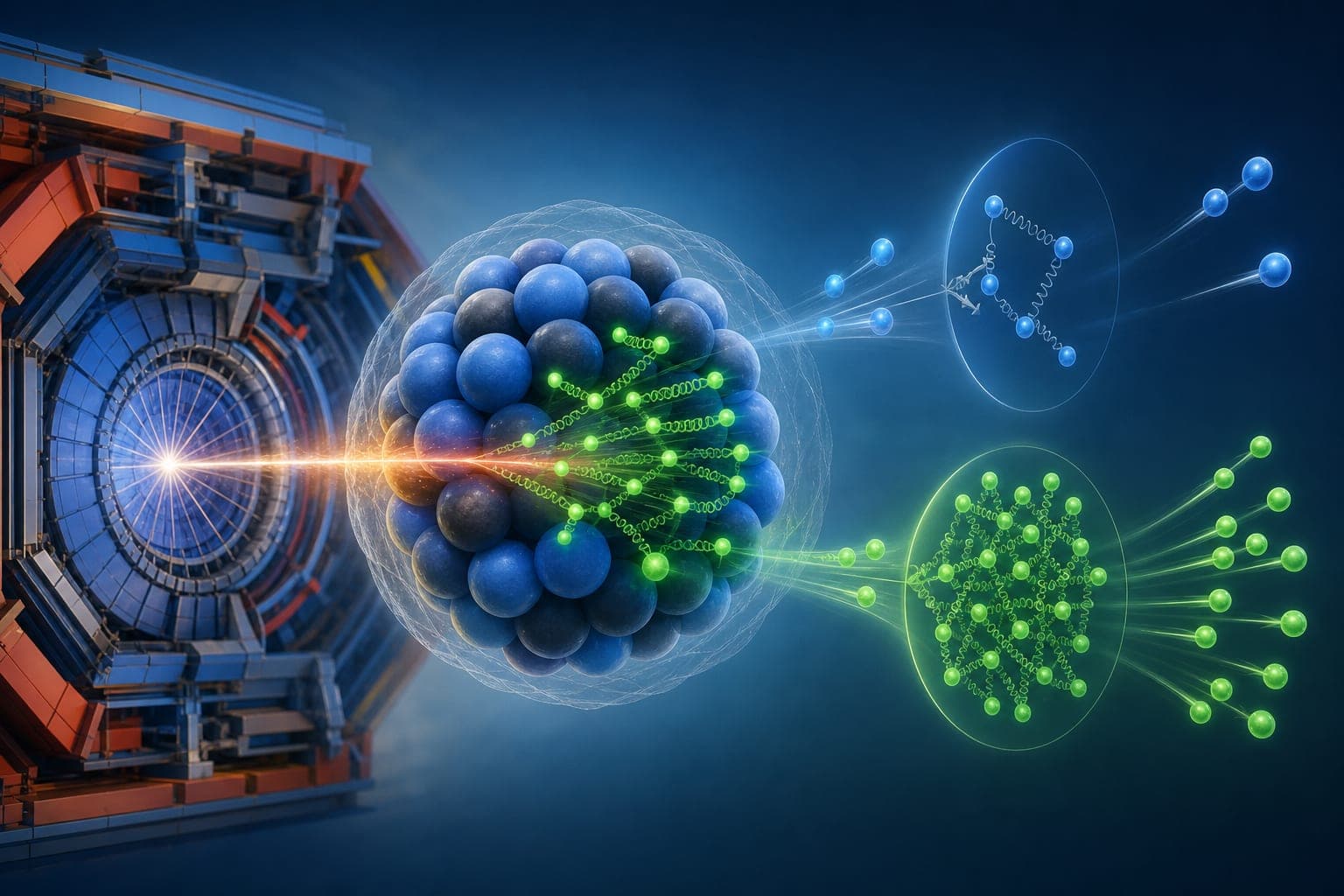
Two rival explanations had long produced similar predictions, making them difficult to distinguish experimentally. The first, known as nuclear shadowing, proposes that gluons are merely suppressed within dense nuclear environments. The second, gluon saturation, suggests that gluons become so densely packed that they interact collectively. Scientists had lacked the multidimensional data necessary to differentiate between these frameworks.
The ALICE team employed a technique called incoherent photonuclear production of particles known as J/psi. By measuring production rates across varying energies and momentum transfers simultaneously, they achieved unprecedented spatial resolution. At the smallest scales probed, J/psi production was significantly suppressed, with a statistical significance of three standard deviations. This suppression is inconsistent with conventional shadowing models yet aligns with saturation predictions.
The implications of this research extend well beyond a single measurement. Should subsequent experiments corroborate these findings, physicists may need to revise fundamental assumptions about nuclear structure. Furthermore, the methodology establishes a powerful new tool for probing gluon dynamics at extreme densities. Future facilities, including the planned Electron-Ion Collider, are expected to test saturation models with even greater precision.