
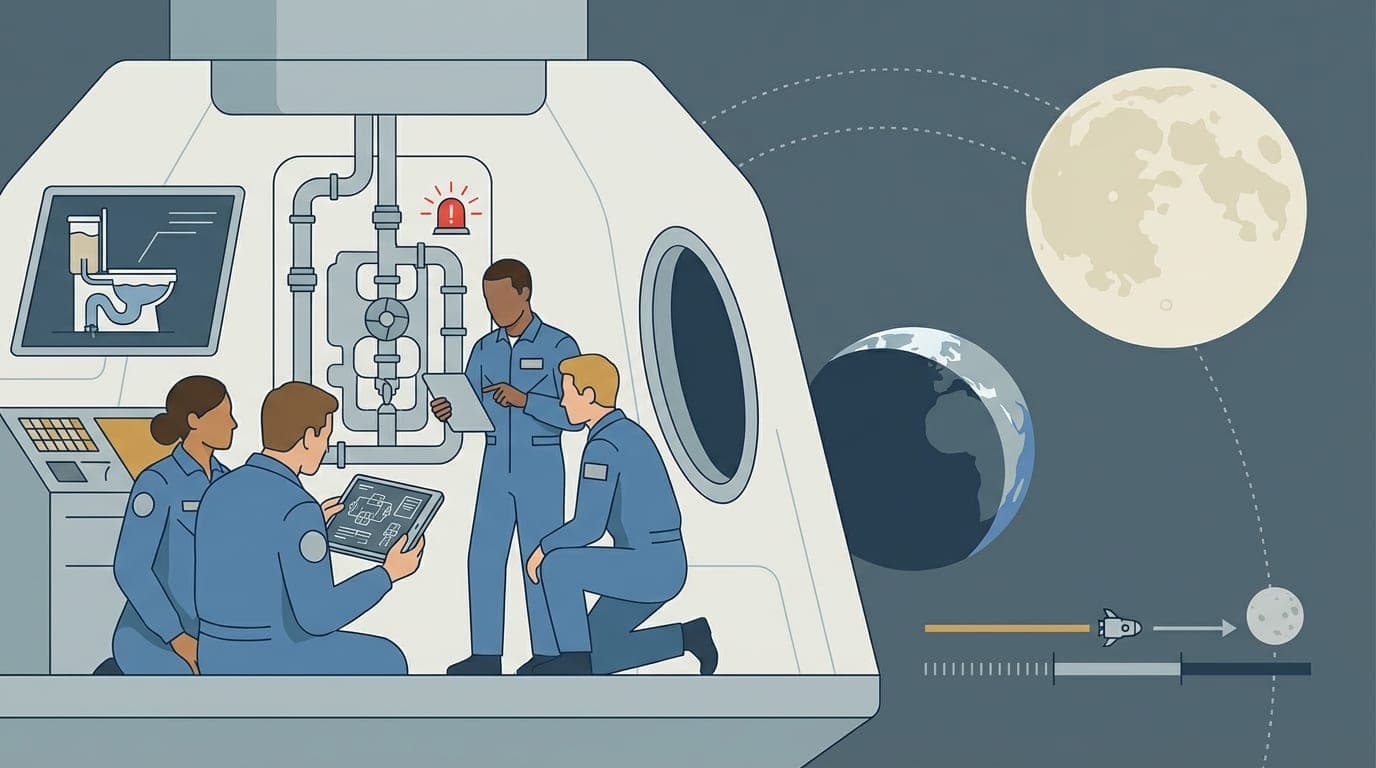
Seldom has a historic space mission been accompanied by such a mundane yet persistent technical difficulty. The Artemis II crew, now more than halfway to the moon, has encountered recurring problems with the Orion capsule's toilet system. Launched on April 1, 2026, from Kennedy Space Center, this ten-day mission represents humanity's first lunar voyage since 1972. The crew comprises three NASA astronauts and one Canadian Space Agency astronaut, making it a landmark international endeavour.
The waste management malfunction first emerged shortly after liftoff when a jammed fan disrupted the system's urine collection capability. Engineers suspect that frozen urine may be obstructing the vent line, thereby preventing proper flushing. Mission Control has instructed the astronauts to utilise contingency urine collection bags as an interim measure. Nevertheless, the system remains operational for solid waste, and ground teams continue to troubleshoot the persistent issue remotely.
Commander Reid Wiseman, pilot Victor Glover, and mission specialists Christina Koch and Jeremy Hansen constitute the historic crew. Notably, Glover will become the first person of colour to travel around the moon. Koch will be the first woman to undertake this trajectory, while Hansen is the first non-American on a lunar mission. Their collective achievement underscores the increasingly diverse composition of contemporary space exploration programmes.
The mission is poised to surpass the distance record established by Apollo 13 in 1970. That crew reached approximately 248,655 miles from Earth during their celebrated emergency return. Artemis II is expected to exceed that benchmark by roughly 4,000 miles, travelling over 252,000 miles from Earth. The astronauts will perform a six-hour lunar flyby, photographing the far side and witnessing a rare solar eclipse.
Despite the inconvenience, the crew's morale reportedly remains high aboard the compact Orion capsule. This test flight is laying the groundwork for subsequent Artemis missions, including a planned lunar surface landing in 2028. The toilet malfunction, while garnering considerable public attention, serves as a valuable reminder of the formidable engineering challenges inherent in sustained deep-space habitation. Ultimately, the lessons derived from this mission will prove indispensable for future lunar infrastructure development.