Seldom has a medical case illustrated the dangers of solar observation as vividly as that of Nia Payne. In August 2017, the 26-year-old Staten Island resident glanced at the solar eclipse without adequate protective eyewear. She viewed the sun unprotected for approximately six seconds before borrowing glasses from a stranger. Within hours, her vision became blurry, distorted, and dominated by a persistent dark spot.
Payne presented at the New York Eye and Ear Infirmary of Mount Sinai several days after the eclipse. Her visual acuity measured 20/20 in the right eye and 20/25 in the left. These figures, by clinical standards, suggested only mild degradation. However, her subjective experience told a profoundly different story. A crescent-shaped scotoma sat permanently in the centre of her visual field.
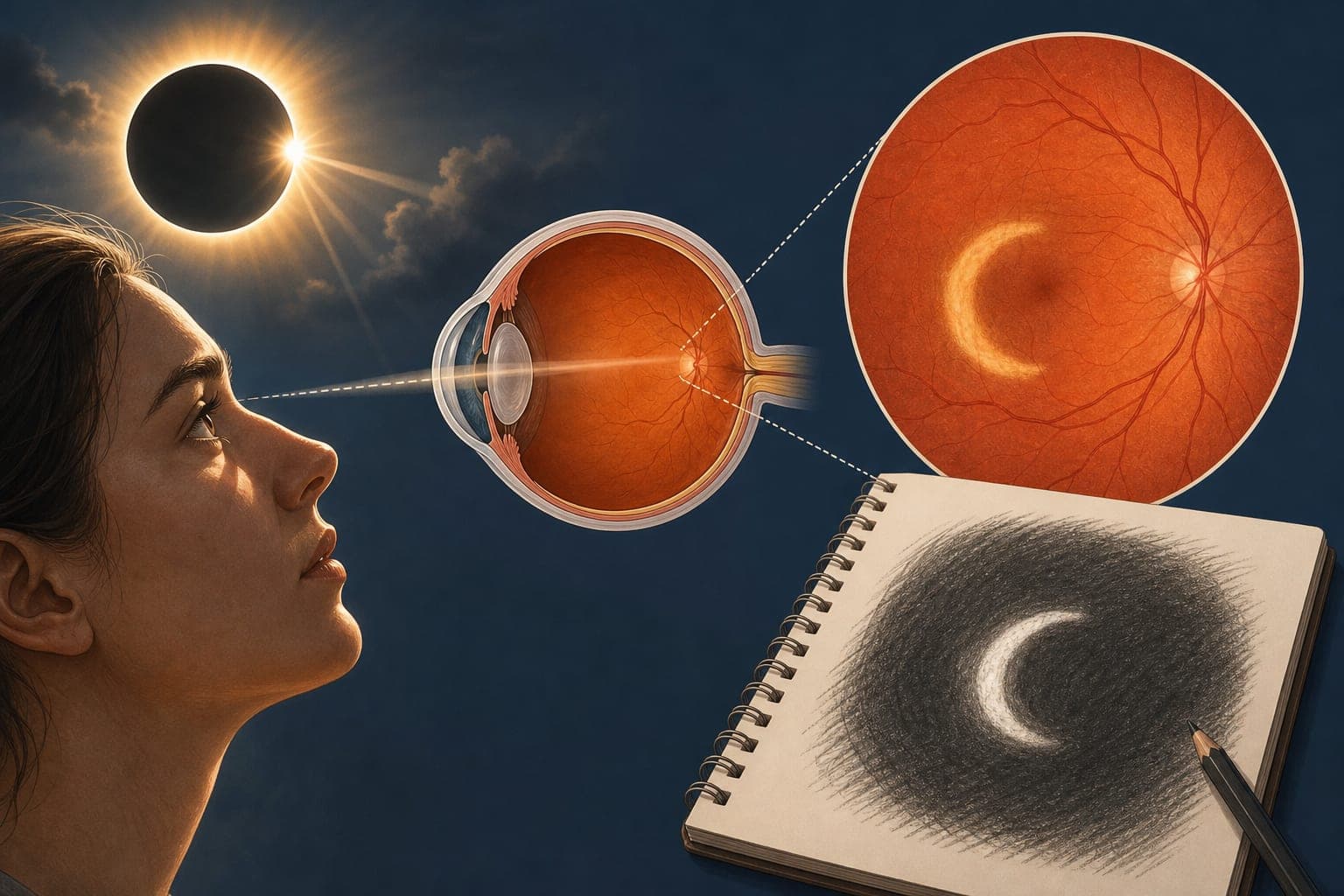
What rendered this case scientifically remarkable was the correspondence between the injury and the eclipse itself. Advanced imaging revealed that the damaged photoreceptor cells formed a distinct crescent pattern on her retina. In New York, the moon had obscured roughly seventy percent of the sun during the eclipse. The burn precisely mirrored that celestial configuration, as though the eye had photographed the event.
Furthermore, when physicians asked Payne to draw what she perceived in her damaged vision, the illustration was striking. Her drawing corresponded almost exactly to both the retinal scan and the eclipse's shape. Doctors described this alignment between subjective perception and clinical imaging as unusually direct. The case was subsequently published in JAMA Ophthalmology in December 2017, drawing considerable scholarly attention.
Solar retinopathy, the formal diagnosis, has no established treatment and frequently results in irreversible damage. The condition arises from photochemical toxicity when concentrated sunlight destroys delicate photoreceptor cells. Payne's condition has neither materially worsened nor improved in the years since her exposure. Her case serves as an enduring cautionary reminder that even fleeting, unprotected solar observation can inflict permanent harm.