
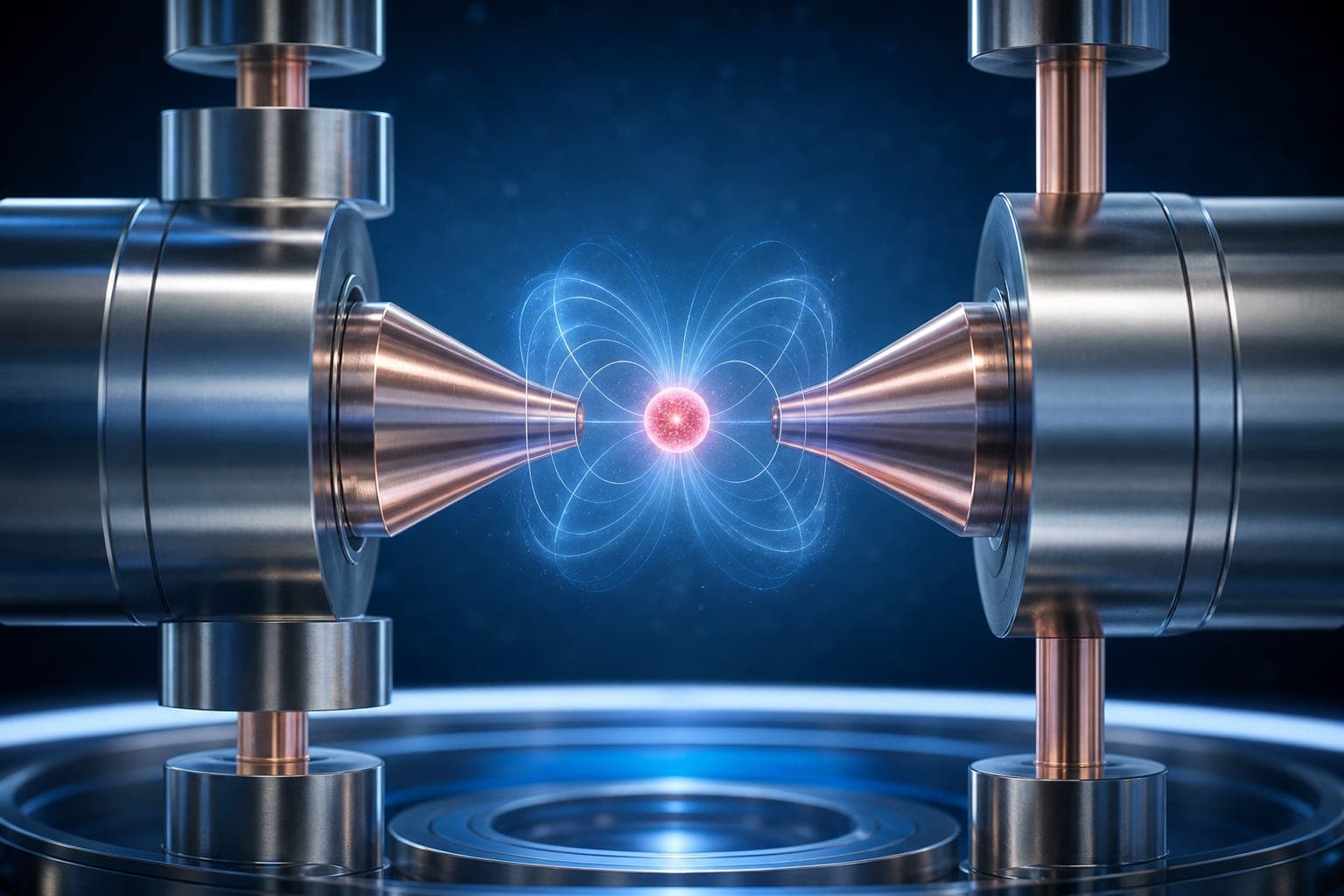
A team of physicists has achieved a remarkable breakthrough in particle physics. They trapped a single positron inside a special device for months. A positron is the antimatter counterpart of an electron. It has the same mass but carries an opposite charge. The particle was cooled to a temperature just above absolute zero.
The research was led by Gerald Gabrielse at Northwestern University. His team created a device called a one-positron quantum cyclotron. The positron was suspended in a vacuum using magnetic and electric fields. If it touched ordinary matter, it would vanish instantly. Therefore, keeping it isolated required extraordinary precision.
The scientists' ultimate goal is to measure the positron's magnetic moment. This property describes how strongly a particle behaves like a tiny magnet. They previously measured the electron's magnetic moment with incredible accuracy. Now, they plan to compare the two measurements. Any difference could reveal flaws in the Standard Model of physics.
The Standard Model predicts that matter and antimatter should be perfectly balanced. However, the universe contains far more matter than antimatter. If a mismatch were found, it would be revolutionary in physics. This experiment has not yet delivered a final measurement. Nevertheless, scientists believe it opens the door to groundbreaking discoveries.