Seldom has a medical innovation appeared as deceptively simple as this one. Researchers at Mass General Brigham in Boston have developed artificial intelligence models capable of predicting cancer survival from a single facial photograph. Published in The Lancet Digital Health in October 2026, the study introduces a paradigm shift in clinical assessment. The findings suggest that facial appearance encodes prognostic information previously inaccessible to conventional diagnostic methods.
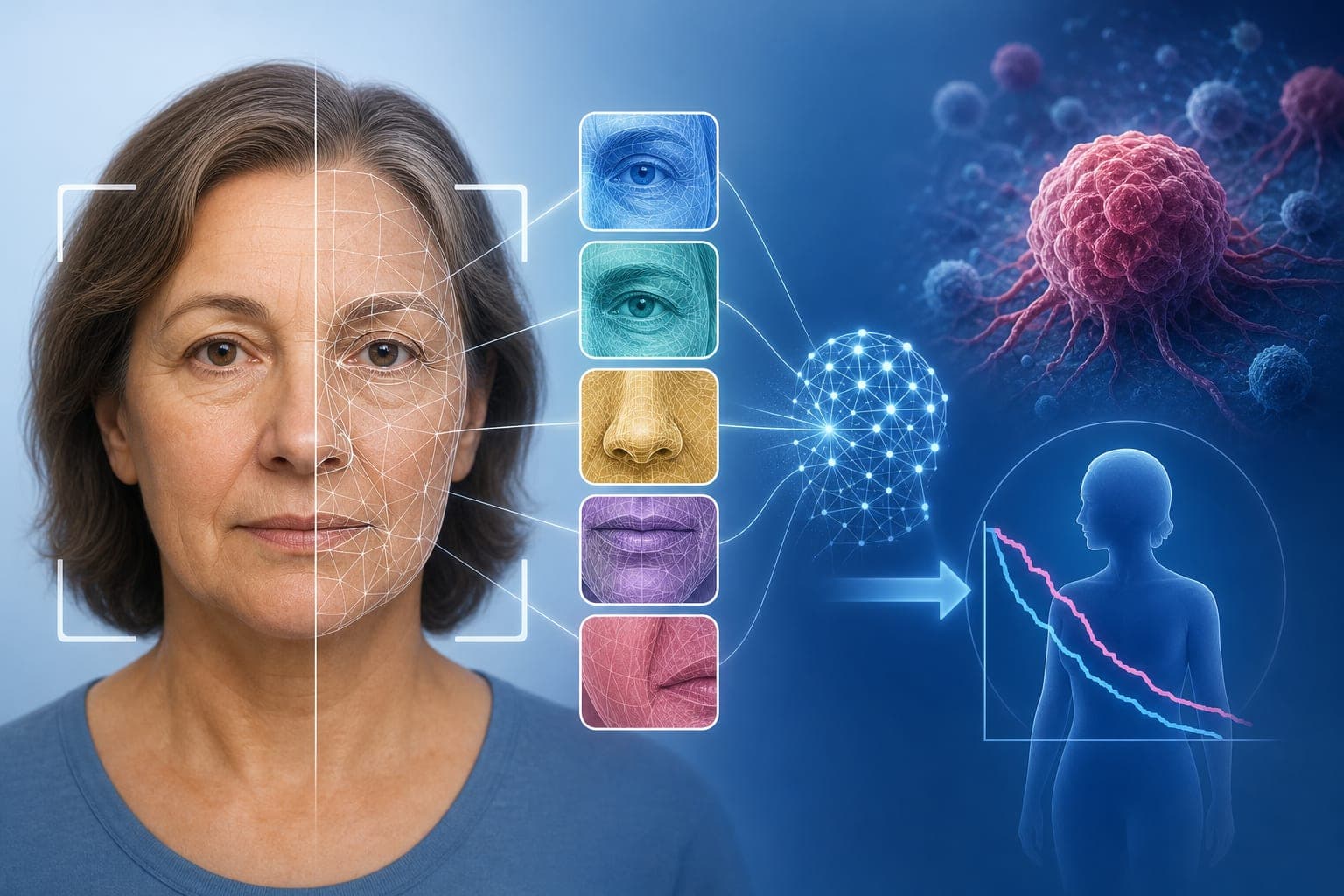
The foundation model, called FAHR-Face, was trained on more than 40 million facial images. It was subsequently refined to produce two complementary tools with distinct clinical applications. FAHR-FaceAge estimates a patient's biological age, while FAHR-FaceSurvival directly predicts mortality risk. Notably, each algorithm scrutinizes different facial regions to derive its respective assessment.
The age estimation tool focuses on the nasolabial folds, temples, and forehead. The survival predictor, by contrast, evaluates the area beneath the eyes and around the nasal bridge. Among patients whose estimated biological age exceeded their chronological age by over twenty years, twenty-one percent died within ninety days. Furthermore, lifestyle factors such as smoking were associated with accelerated facial aging patterns.
What distinguishes this research from prior methodologies is its foundation model architecture. Rather than training separate algorithms from scratch, the researchers adapted a single robust model for multiple tasks. This scalable approach yielded independently prognostic biomarkers that, when combined, enhanced overall survival prediction. External validation corroborated the model's efficacy across diverse patient cohorts.
Nevertheless, experts have urged caution regarding premature clinical implementation. The study relied on retrospective data rather than a prospective clinical trial. Independent reviewers have characterised it as a promising proof of concept requiring further validation. Should subsequent trials confirm these findings, facial AI could fundamentally augment how oncologists personalise treatment strategies.