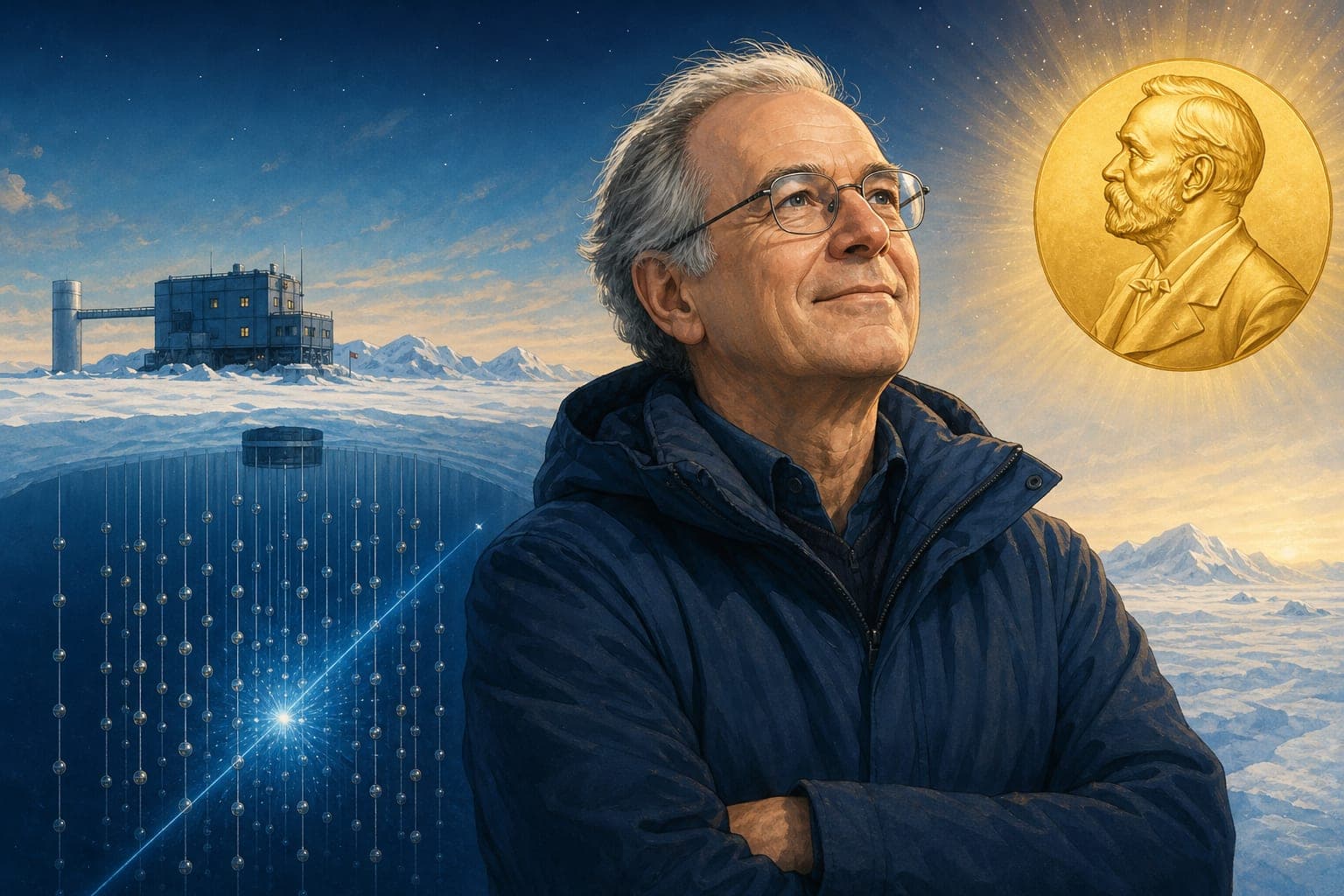
Seldom has a Nobel Prize carried such a palpable sense of personal vindication. Belgian-born physicist Francis Halzen, aged 82, was awarded the 2026 Nobel Prize in Physics on October 6. The Royal Swedish Academy of Sciences recognized his decisive contributions to neutrino astronomy. For Halzen, the announcement marked the end of years of annual disappointment each October.
Halzen conceived the IceCube Neutrino Observatory, a remarkable instrument embedded within a cubic kilometer of Antarctic ice. This unprecedented detector captures neutrinos, elusive subatomic particles that traverse the cosmos virtually unimpeded. Unlike conventional telescopes that gather starlight, IceCube observes the universe through these ghostly messengers. The observatory has been fully operational since 2011, yielding transformative discoveries.
His vision originated in the 1980s when he recognized that glacial ice at the South Pole could ensnare neutrinos. The undertaking was fraught with technical and logistical hurdles that could have derailed the project entirely. Halzen acknowledged that his university took considerable risks in supporting the endeavor. At each critical milestone, the possibility of failure loomed large.
What distinguishes Halzen's achievement is its broader implications for astrophysics. IceCube has detected high-energy neutrinos originating from a distant galaxy near the constellation Orion. These findings have inaugurated a new era of multimessenger astronomy. Researchers now combine neutrino data with traditional telescopes and gravitational-wave detectors to scrutinize distant cosmic phenomena.
Halzen's perseverance offers a compelling narrative about the nature of scientific progress. He candidly admitted that each October had previously left him feeling miserable as the prize eluded him. Nevertheless, his tenacity and unwavering commitment to the project ultimately prevailed. His story underscores that groundbreaking discoveries often demand extraordinary patience and resilience.