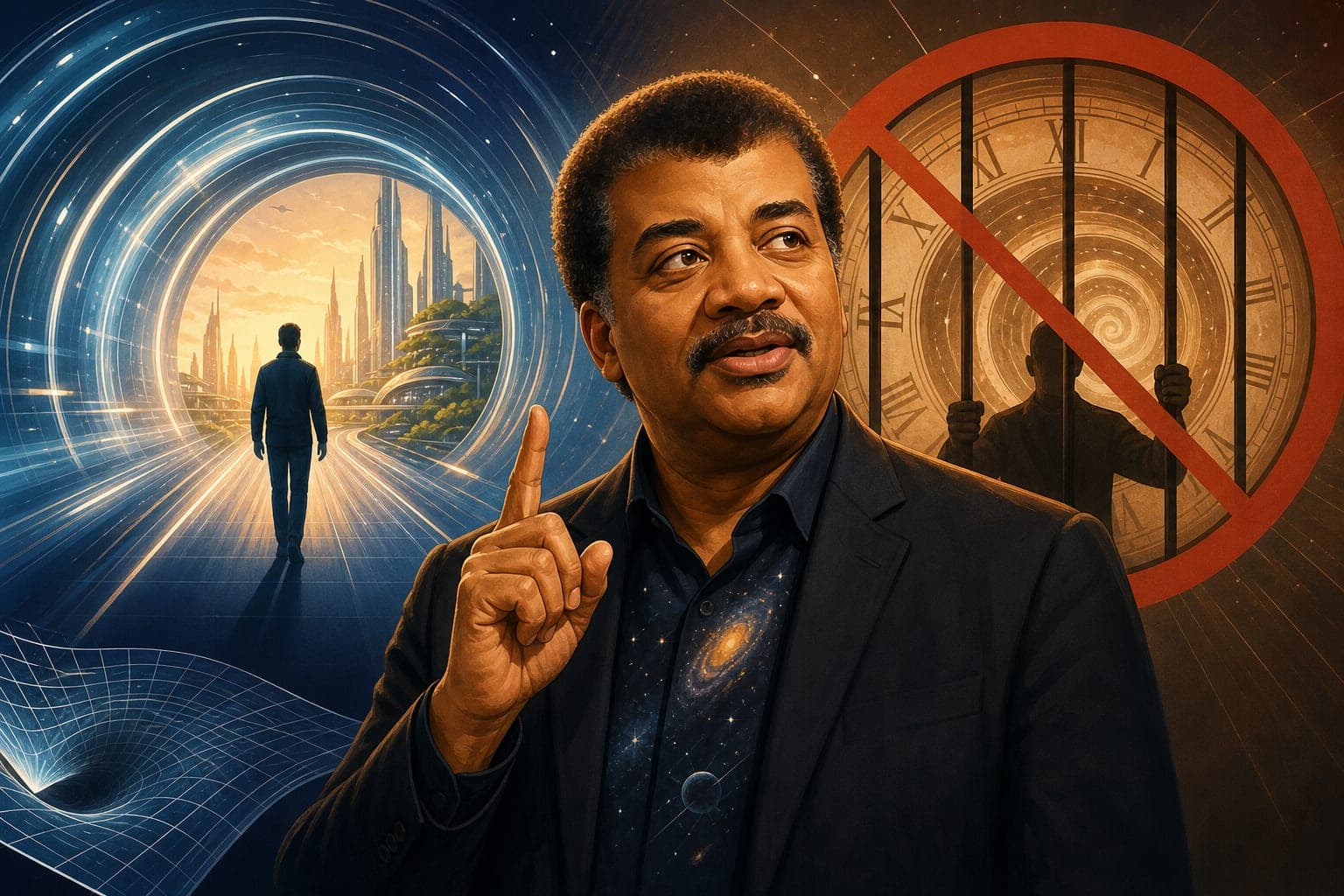
Seldom has a scientific claim sparked as much public fascination as forward time travel. Renowned astrophysicist Neil deGrasse Tyson recently affirmed that traveling into the future is entirely plausible. Appearing on Hot Ones Game Night, Tyson was asked whether humans would ever achieve time travel. His initial response was a blunt dismissal, yet he quickly offered an intriguing clarification.
Tyson drew a crucial distinction between forward and backward temporal movement. He stated unequivocally that we can travel to the future but never to the past. The underlying principle rests on Einstein's special relativity, first published in 1905. This groundbreaking theory demonstrated that time is not absolute but rather relative to the observer's motion.
The mechanism Tyson described hinges on a phenomenon known as time dilation. If a person were accelerated through space at tremendous speed, their experience of time would slow considerably. Upon returning to Earth, they might have aged only ten minutes while everyone else aged a year. In essence, they would have leaped into other people's futures without skipping ahead in their own.
Despite its seemingly fantastical nature, time dilation has been empirically validated through numerous experiments. Astronauts aboard the International Space Station age slightly less than people on Earth. Precision atomic clocks flown on aircraft have confirmed measurable discrepancies in elapsed time. These findings underscore that relativistic effects are not merely theoretical constructs but observable realities.
Tyson's remarks also dispelled popular misconceptions perpetuated by science fiction. He described each person as a prisoner of the present, forever caught between an inaccessible past and an unknowable future. While Hollywood blockbusters may depict characters traversing centuries at will, the physics remains unforgiving. Nevertheless, the sheer possibility of forward time travel continues to captivate both scientists and the broader public.