
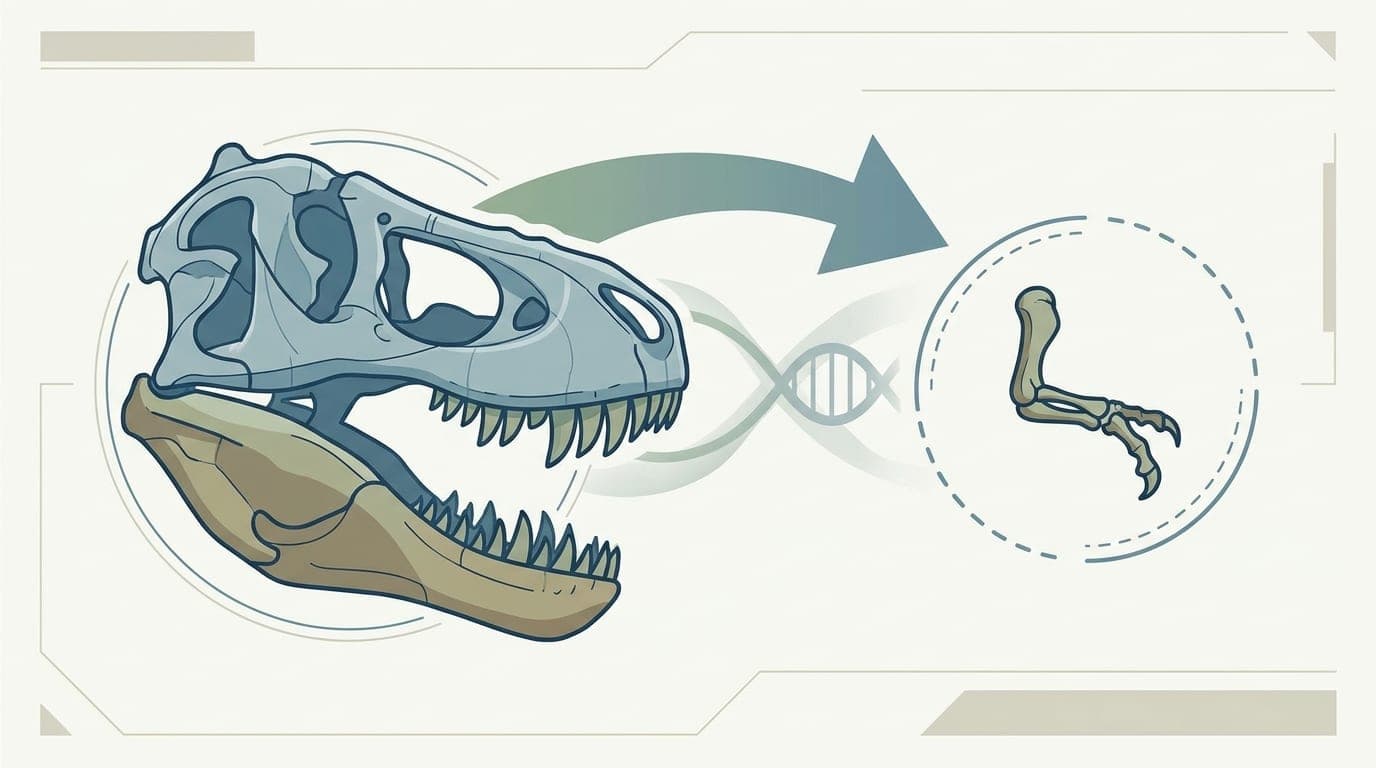
Seldom has a single anatomical feature captivated the scientific community as profoundly as the tiny arms of Tyrannosaurus rex. For decades, palaeontologists have debated why such a formidable apex predator possessed disproportionately small forelimbs. A new study, published in the Proceedings of the Royal Society B, now offers a compelling explanation. Researchers from University College London and Cambridge University propose that this trait arose from a significant evolutionary trade-off.
The research team examined data from 82 species of theropods, the group of two-legged, predominantly carnivorous dinosaurs. Their analysis revealed that the shortening of forelimbs occurred independently across at least five distinct lineages. These included tyrannosaurids and abelisaurids, among others. Crucially, the correlation between reduced arms and robust skulls was stronger than the link between small arms and overall body size.
Lead author Charlie Roger Scherer, a doctoral student at UCL Earth Sciences, summarised the findings concisely. The research demonstrated that powerful heads effectively superseded the arms as the primary method of attack. As giant herbivorous prey such as sauropods became more prevalent, grasping with claws proved increasingly impractical. Consequently, predators that could deliver devastating bites gained a decisive survival advantage.
To quantify skull robustness, the researchers devised a novel methodology incorporating bite force, skull dimensions, and bone connectivity. On this measure, T. rex achieved the highest score among all species analysed. Tyrannotitan, a massive predator from present-day Argentina, ranked closely behind. These findings suggest that an evolutionary arms race between predators and their increasingly gigantic prey drove this remarkable anatomical convergence.
What distinguishes this study from previous research is its comprehensive, cross-lineage approach to the question. Rather than examining a single species in isolation, the team identified broader evolutionary patterns across diverse theropod groups. The researchers noted that different lineages arrived at the same outcome through varied developmental pathways. This phenomenon of convergent evolution underscores how powerful ecological pressures can shape anatomy in remarkably similar ways.