
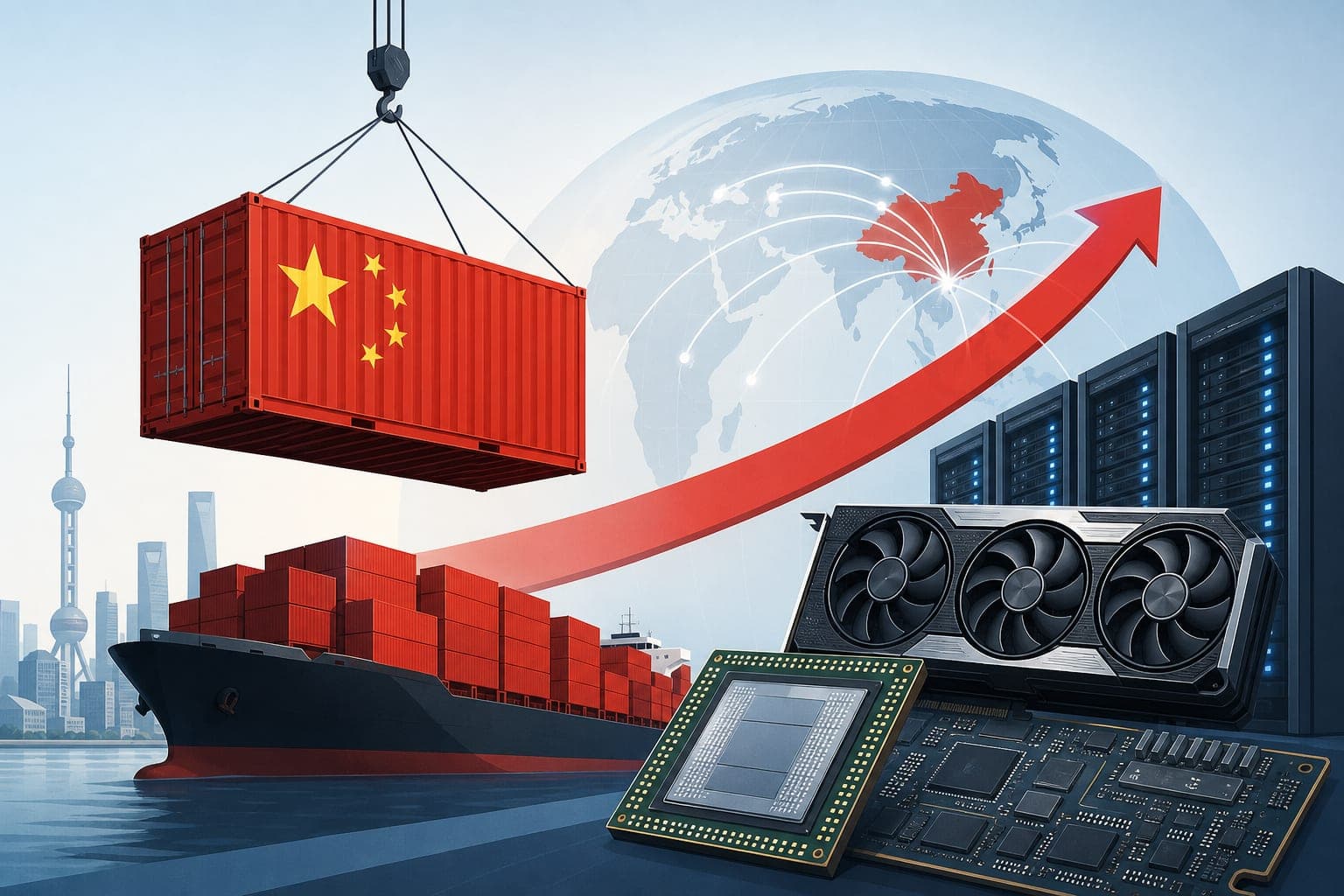
Seldom has a single technology so profoundly reshaped global trade patterns. China's exports surged 36.3% year-on-year in September, reaching $447.18 billion. This remarkable acceleration, up from 25% growth in August, far exceeded the Bloomberg median forecast of 25.7%. The figures underscore how artificial intelligence is fundamentally altering the composition of international commerce.
Technology-related products constituted the primary catalyst behind this extraordinary expansion. Semiconductor exports alone surged more than 108%, while shipments of data-processing machines jumped nearly 55%. Notably, Goldman Sachs observed that chip export values rose 136% despite volume increasing by merely 1%. This divergence points to price-driven growth fueled by a global shortage of AI-related hardware.
The geographic distribution of these shipments reveals China's deepening integration into global technology supply chains. Exports to the United States climbed 39.6%, while those to the European Union rose 25.3%. ASEAN nations emerged as the largest regional market, absorbing $81.7 billion in Chinese goods. Strong flows to South Korea and Taiwan further illustrate China's pivotal role in Asia's tech ecosystem.
The cumulative impact on China's trade surplus has been staggering. The monthly surplus widened to a record $133.5 billion in September. For the first nine months, the surplus reached $938.1 billion, on track to surpass last year's $1.2 trillion record. Imports also rose 31%, partly driven by elevated energy costs, yet they could not offset the export juggernaut.
These figures carry profound implications for trade policy and geopolitical strategy. A surplus approaching one trillion dollars inevitably intensifies scrutiny from trading partners. The data arrives ahead of a planned Trump-Xi meeting and days after an EU-China deal on hybrid vehicles. Whether this AI-driven export boom proves sustainable hinges on regulatory responses and global demand trajectories.