
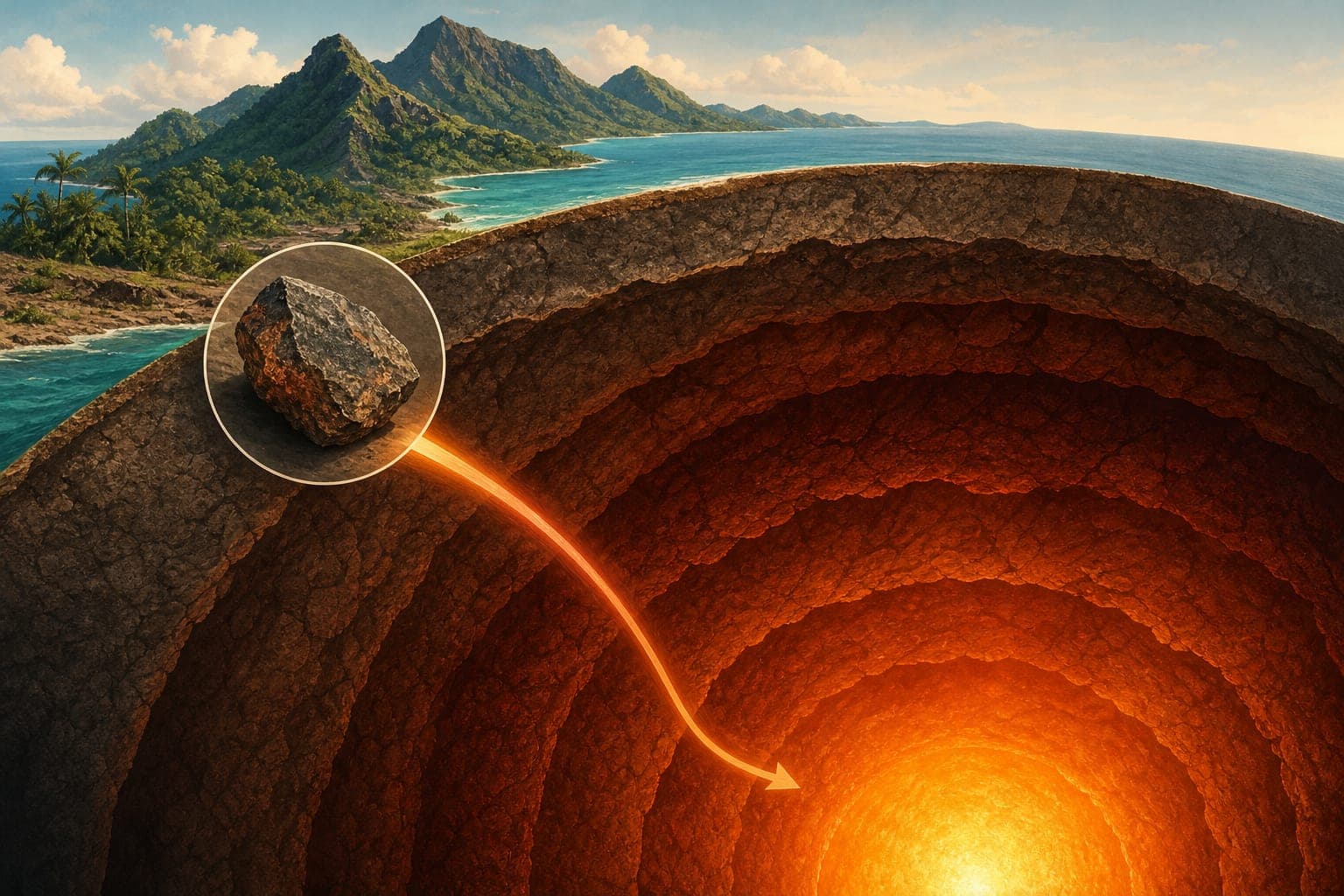
Seldom has a single rock sample so profoundly disrupted established scientific thinking. An international research team has analyzed a rare rock from Papua New Guinea. This rock was dragged more than 90 kilometers beneath the surface roughly four million years ago. It then returned to the surface, carrying a temperature story that contradicts current geological models.
The rock, classified as an eclogite, was collected on Goodenough Island in eastern Papua New Guinea. It formed where the Australian and Pacific tectonic plates converge in a subduction zone. In such zones, one plate sinks beneath the other, pulling surface rocks deep underground. Minerals like coesite and zircon preserved inside the rock helped scientists reconstruct its remarkable journey.
What baffled researchers was the rock's unexpected thermal history. At 45 kilometers deep, the rock reached about 800 degrees Celsius. That is significantly hotter than models predict for that depth. Yet as it descended beyond 90 kilometers, the temperature rose by only another 100 degrees. Conventional wisdom holds that temperatures should steadily increase with depth.
Scientists have proposed two plausible explanations for this anomaly. Intense friction where tectonic plates meet may generate additional heat at shallower depths. Alternatively, the subduction zone may not yet have cooled to the lower temperatures anticipated. Neither hypothesis has been confirmed, leaving the question open for further investigation.
The findings, published in Nature Geoscience, carry implications beyond geology alone. Understanding heat distribution in subduction zones is crucial for predicting earthquakes and volcanic activity. These zones also play a vital role in Earth's long-term carbon cycle. Should these revised thermal models prove accurate, scientists may need to fundamentally rethink how our planet recycles material.