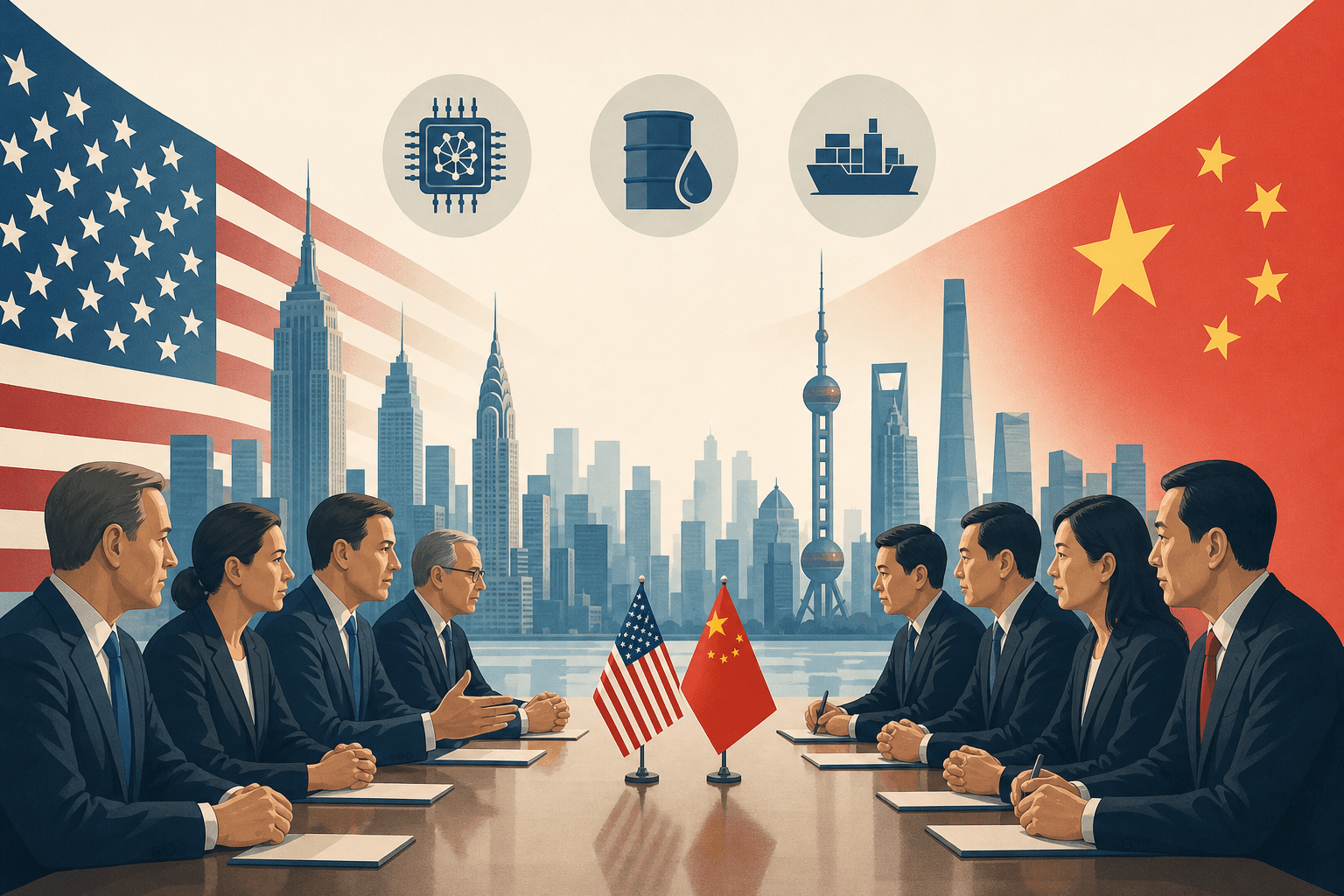
Seldom have preparatory trade negotiations carried such consequential weight for global markets. US Treasury Secretary Scott Bessent and China's Vice Premier He Lifeng convened in New York on Sunday. Their mandate is to lay the groundwork for a summit between President Trump and President Xi Jinping. The leaders are scheduled to meet at the White House on September 24, marking Xi's first visit to Washington in over a decade.
Energy disruptions stemming from the Iran conflict, the artificial intelligence boom, and bilateral investment top the agenda. Both sides seek to maintain stability within a tariff truce that expires in November. Adding urgency for US officials are the approaching midterm elections, where inflation remains a persistent voter concern. US Trade Representative Jamieson Greer will also participate in the discussions.
The broader context of these talks is a fraught bilateral relationship shaped by successive rounds of tariff escalation. A trade truce reached in late 2025 suspended heightened reciprocal tariffs on Chinese imports until November 2026. In exchange, China pledged to resume purchases of US agricultural products and pause rare-earth export controls. Whether this arrangement can be extended remains a pivotal question.
What distinguishes this round of negotiations is the convergence of emerging geopolitical pressures alongside longstanding trade grievances. The race to govern artificial intelligence has introduced a new dimension to the bilateral dynamic. Concurrently, the Iran conflict has disrupted energy supply chains, compelling both nations to recalibrate their strategic calculus. These compounding variables make the forthcoming summit a watershed moment for the global economy.
Analysts contend that the September summit's significance lies not in grand bargains but in normalising leader-level engagement. Regular dialogue itself, rather than major deliverables, may become the marker of stability in US-China relations. Nevertheless, with tariff exclusions set to lapse and geopolitical tensions persisting, the stakes for both economies remain exceptionally high. The outcome will reverberate across transpacific supply chains and global financial markets.