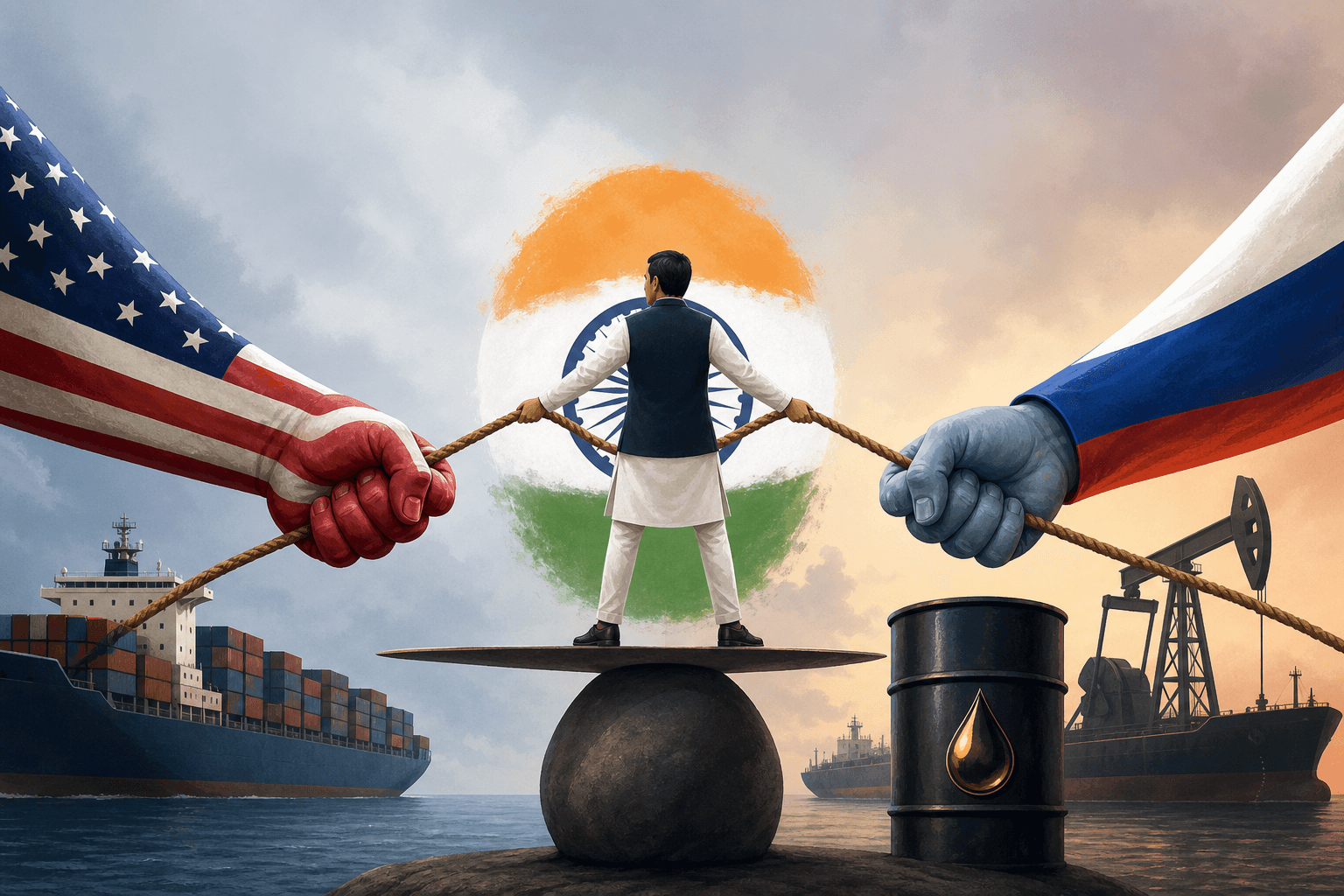
Seldom has India faced such an acute geopolitical predicament in its trade policy. The Lindsey O. Graham Sanctioning Russia and Iran Act of 2026 was signed into law on September 18. This sweeping legislation empowers the US President to levy tariffs of up to 100% on major importers of Russian energy. India, having become one of the world's largest purchasers of Russian crude, finds itself squarely in the crosshairs.
The magnitude of India's exposure is considerable. Russian crude accounted for approximately 51% of India's oil imports in July 2026. India imports over 88% of its total crude oil requirements, making procurement flexibility a paramount concern. A forced reduction in Russian supplies could raise fuel costs for 1.4 billion citizens. Indian refiners such as Reliance Industries and Nayara Energy would bear the brunt of any disruption.
New Delhi has responded with uncharacteristic firmness, warning that the legislation could undermine bilateral ties with Washington. India's Ministry of External Affairs stated it had articulated its position clearly to US officials. The government has pledged to work with trade and industry bodies to mitigate the legislation's ramifications. Notably, India maintains that it only recognises UN-mandated sanctions, not unilateral coercive measures.
The economic calculus is further complicated by diminishing price advantages. Russia's discount on crude narrowed from $77.7 per tonne in April to merely $10.6 in June 2026. Meanwhile, alternative suppliers from the Middle East present their own risks. Nearly half of India's crude imports transit through the Strait of Hormuz, a corridor increasingly vulnerable to regional conflict.
For India's policymakers, the imperative is to diversify energy procurement without jeopardising economic stability. Indian Oil Corporation has already begun sourcing from Brazil's Petrobras to offset reduced Russian volumes. Whether India can sustain this strategic recalibration while preserving its autonomy remains an open question. The outcome will have far-reaching ramifications for global energy markets and geopolitical alignments alike.