
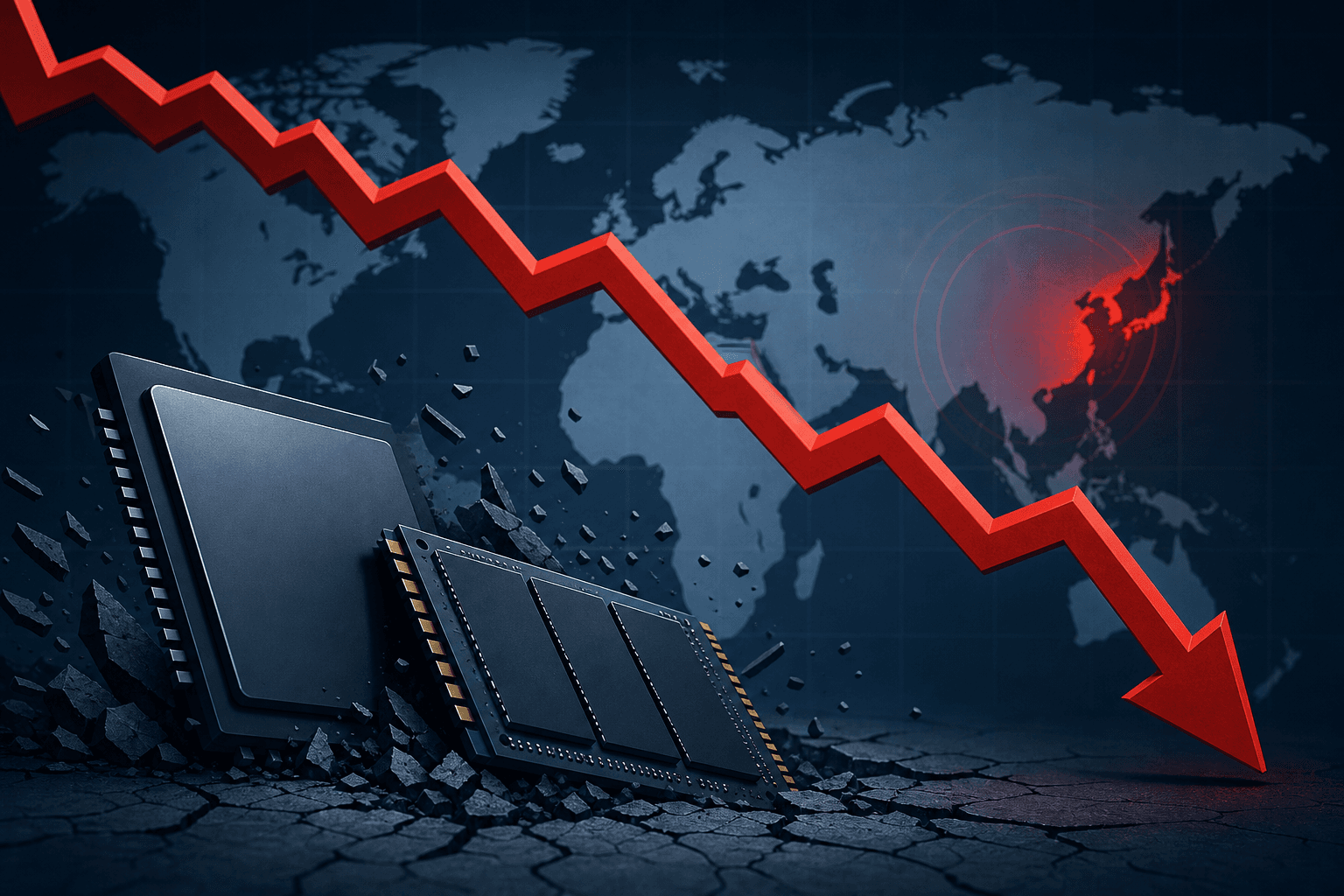
Seldom has a market correction unfolded with such ferocity across the global semiconductor sector. South Korea's benchmark Kospi index plunged over eight percent on Tuesday, triggering a circuit breaker that halted all trading for twenty minutes. Samsung Electronics and SK Hynix, the two largest constituents of the index, led the rout. Both chipmakers fell approximately twelve percent in a single session. The precipitous decline marked the Kospi's eighth circuit breaker activation this year.
The sell-off has not been confined to Asian markets. The Nasdaq 100 fell 1.8 percent, edging closer to official correction territory. The Philadelphia Semiconductor Index has plummeted twenty-four percent since its June peak, entering a bear market. In the United States, Nvidia surrendered its position as the world's most valuable company to Apple. Other prominent chipmakers, including AMD, Intel, and Micron, have sustained significant losses.
What distinguishes this downturn from previous episodes of profit-taking is the underlying scepticism about AI returns. Alphabet recently reported negative free cash flow for the first time as a public company. This was attributed to massive AI capital expenditure. Investors are scrutinising whether trillion-dollar infrastructure commitments will yield commensurate financial returns. The sustainability of the AI spending boom has become the central question for equity strategists.
Compounding these concerns, China's advancing chipmaking capabilities have unsettled markets further. Reports emerged that China has begun mass-producing its own deep ultraviolet lithography equipment. Meanwhile, Chinese memory chipmaker CXMT debuted on the Shanghai STAR Market with shares surging over four hundred percent. These developments suggest that competitive pressures may erode the pricing power of established semiconductor firms.
Nevertheless, some analysts characterise the current turbulence as a mid-cycle reset rather than a structural collapse. Bank of America maintains that the AI market is roughly halfway through an eight-to-ten-year evolution. The firm projects that AI capital expenditure could reach 1.2 trillion dollars by 2030. Whether this conviction proves prescient or overly sanguine will depend on forthcoming earnings from major technology firms.