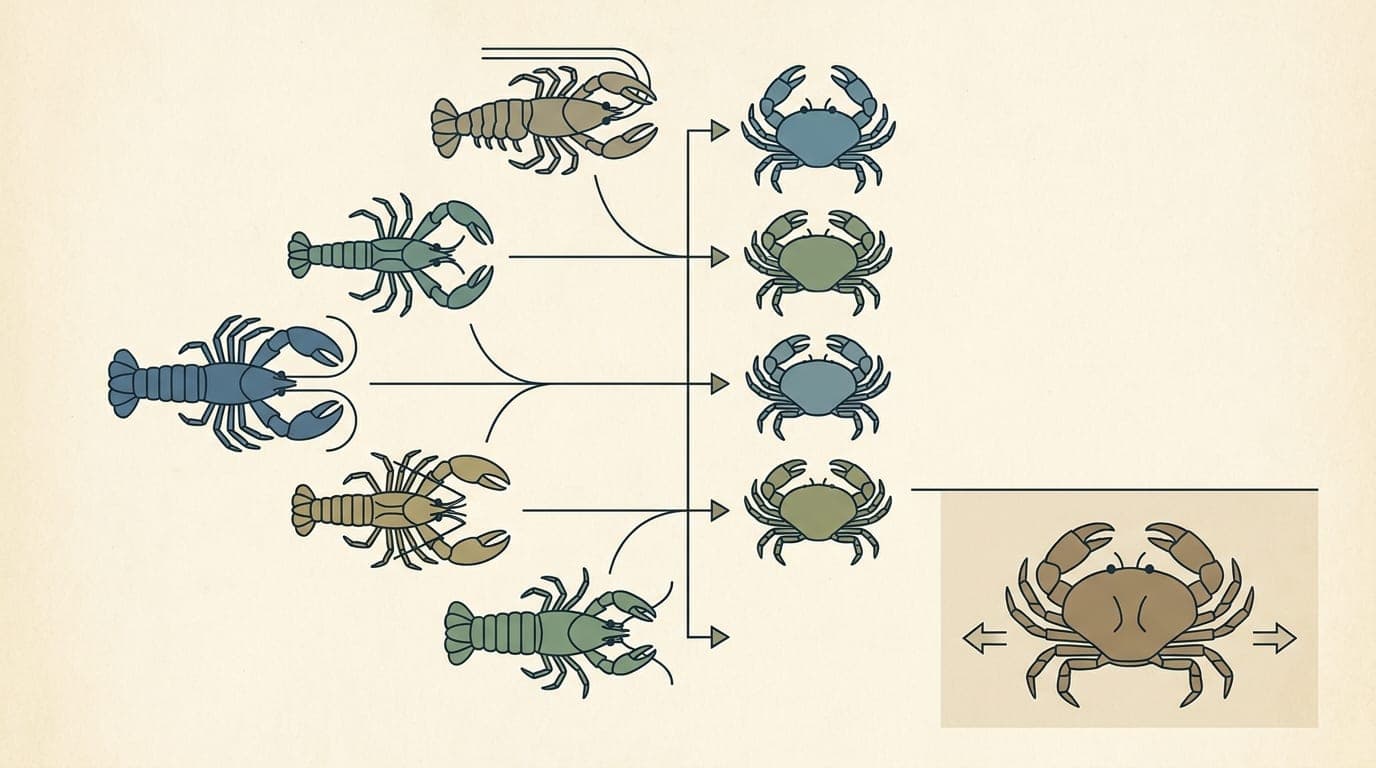
Evolution has a remarkable tendency to produce crab-like body shapes again and again. Scientists call this phenomenon "carcinization," a form of convergent evolution. In this process, unrelated crustacean species independently develop flat shells and tucked tails. The crab-like body plan has evolved at least five separate times over millions of years. This pattern has become so well known that it has even inspired popular internet memes.
However, new research published in the journal eLife has identified one crucial distinction. While the crab body shape has arisen repeatedly, the characteristic sideways walk evolved only once. Behavioral ecologist Yuuki Kawabata from Nagasaki University led the study with colleagues from Japan, Taiwan, and the United States. The team observed the walking behavior of fifty different true crab species in laboratory experiments. They found that thirty-five species were predominantly side-walkers, while fifteen moved forward.
By combining behavioral data with genetic analysis, the researchers traced sideways walking to a single common ancestor. This ancestral innovation appears to have occurred approximately 200 million years ago, shortly after the Triassic-Jurassic extinction. At that time, shifts in Earth's crust had expanded shallow marine environments, which are ideal crab habitats. The sideways walk may have provided a significant adaptive advantage for escaping predators unpredictably.
This finding contrasts starkly with carcinization, which has occurred repeatedly across many species. The study suggests that sideways locomotion acted as a key innovation for ecological success. It may have allowed true crabs to diversify rapidly into numerous habitat niches worldwide. Nevertheless, peer reviewers have noted certain limitations, including the use of only one individual per species. Future research could further clarify whether body shape or locomotion drove crab evolution more significantly.