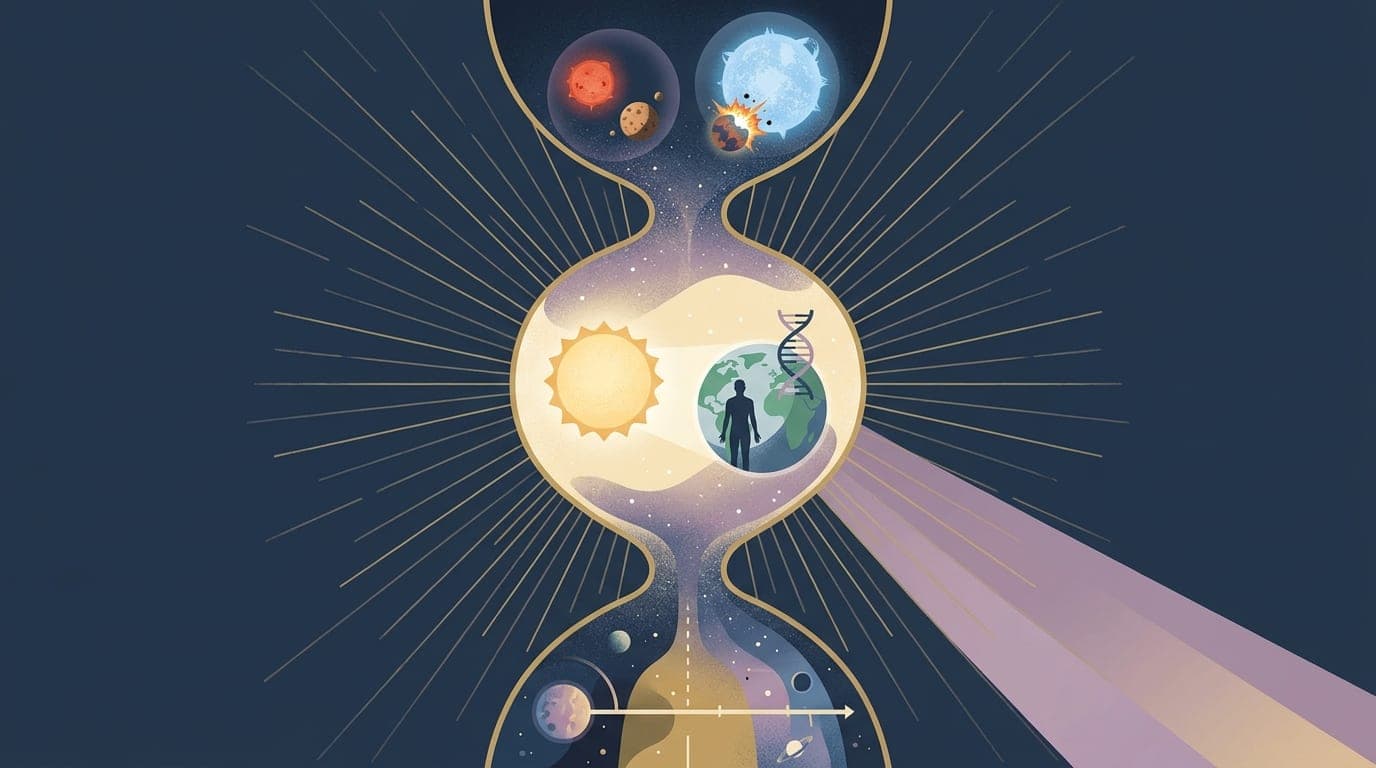
A fundamental question in astrophysics concerns the timing and location of human existence. Harvard professor Avi Loeb has posed a compelling inquiry in a recent essay. Why do we find ourselves orbiting a middle-aged star at this particular cosmic epoch? Dwarf stars, the most abundant stellar type, live for trillions of years. Statistically, intelligent life should more likely emerge near such long-lived stars in the distant future.
Loeb's argument hinges on a probabilistic paradox regarding stellar lifespans and habitability. If life commonly arose around low-mass dwarf stars, we would most likely exist far in the future. The Sun's lifespan of approximately 12.2 billion years closely matches the universe's current age of 13.8 billion years. This temporal coincidence suggests that solar-mass stars represent the most plausible hosts for complex life. We appear to inhabit the cosmological era best suited for our emergence.
However, dwarf stars present formidable challenges that may preclude the development of complex organisms. Their habitable zones lie extremely close to the star, often causing tidal locking of orbiting planets. A tidally locked planet maintains a permanent dayside and nightside, creating extreme temperature contrasts. Furthermore, dwarf stars frequently emit intense ultraviolet radiation and powerful stellar flares. These flares can strip planetary atmospheres, rendering surface conditions inhospitable for biological evolution.
Massive stars, conversely, prove equally unsuitable despite their tremendous energy output. Research by Loeb and his colleague Devesh Nandal demonstrates that massive stellar winds preclude habitability. A star nine times the Sun's mass sustains a habitable zone for merely thirty million years. Early stars in the infant universe also lacked the heavy elements essential for rocky planet formation. Carbon-based chemistry, fundamental to terrestrial life, requires these heavier elements to be synthesised first.
These converging constraints offer a coherent explanation for humanity's cosmic circumstances. Neither the distant past near massive stars nor the far future near dwarf stars provides adequate conditions. Our existence beside a Sun-like star during the present epoch appears neither accidental nor premature. Rather, it reflects the narrow window where stellar longevity, chemical enrichment, and planetary stability converge. This synthesis of astrophysics and philosophy illuminates why we inhabit this particular moment in cosmic history.