
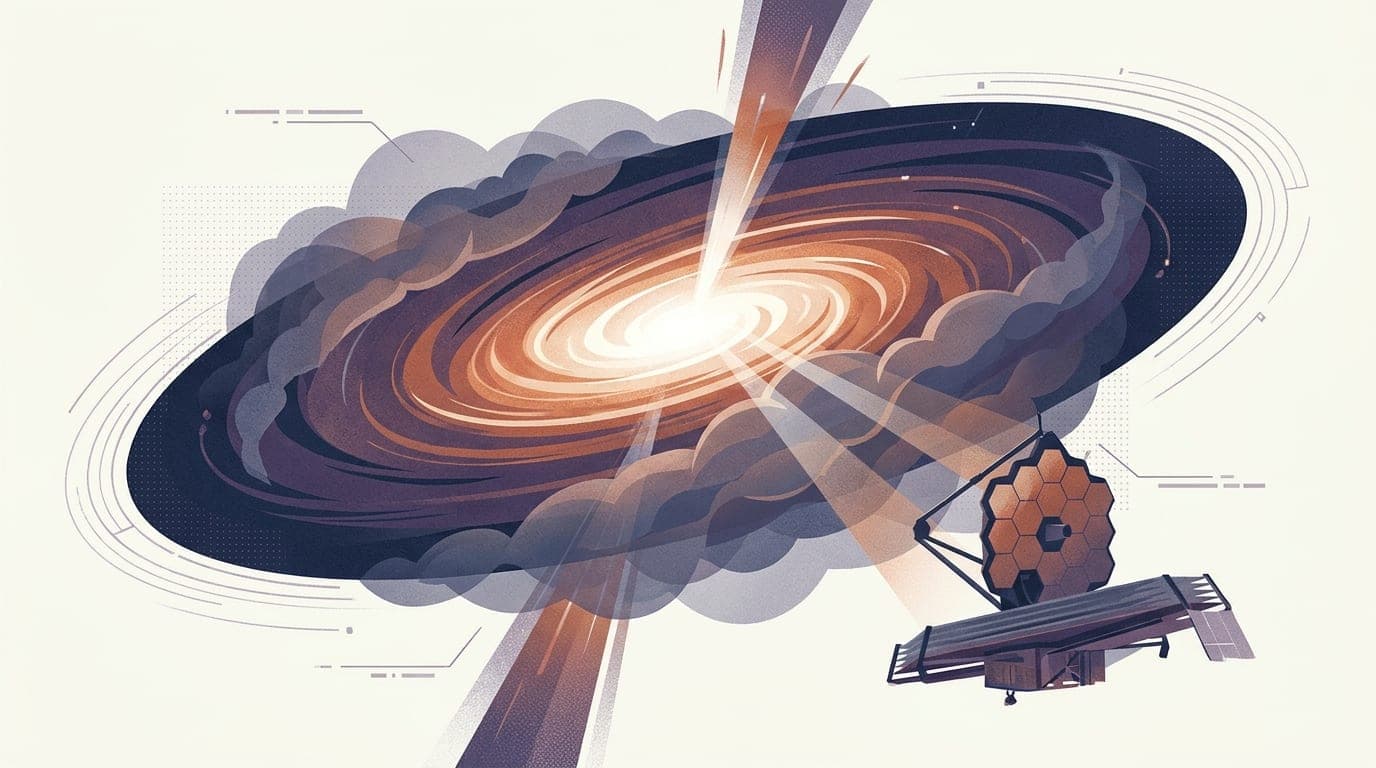
NASA's James Webb Space Telescope has recently captured a striking image of Messier 77. This spiral galaxy is located 45 million light-years away in the constellation Cetus. Its core shines so brightly that it outshines nearly everything around it. The extraordinary brightness is generated by a supermassive black hole at the galaxy's centre. This black hole has been consuming surrounding material at an astonishing rate.
The image was captured using Webb's mid-infrared instruments, which proved essential for this observation. Infrared radiation can penetrate dust that would otherwise obscure visible light entirely. As a result, astronomers have gained an unprecedented view of the galaxy's active nucleus. Gas spiralling toward the black hole is heated to extreme temperatures through friction. This process causes the core to radiate intensely across multiple wavelengths of light.
Messier 77 is classified as having an active galactic nucleus, a term used for such phenomena. Active galactic nuclei had been studied for decades before Webb's launch in 2021. However, previous telescopes had struggled to penetrate the dense dust surrounding these regions. Had scientists possessed Webb's infrared technology earlier, they could have advanced this research significantly. The telescope has thus become a transformative tool for modern astronomy.
This discovery demonstrates how advanced technology can reshape our understanding of the universe. The black hole at Messier 77's centre weighs approximately eight million times the mass of our Sun. Such supermassive black holes are believed to exist at the heart of most large galaxies. By studying how they consume surrounding matter, researchers hope to explain broader patterns of cosmic evolution. These findings may ultimately illuminate how galaxies and black holes develop together over time.