
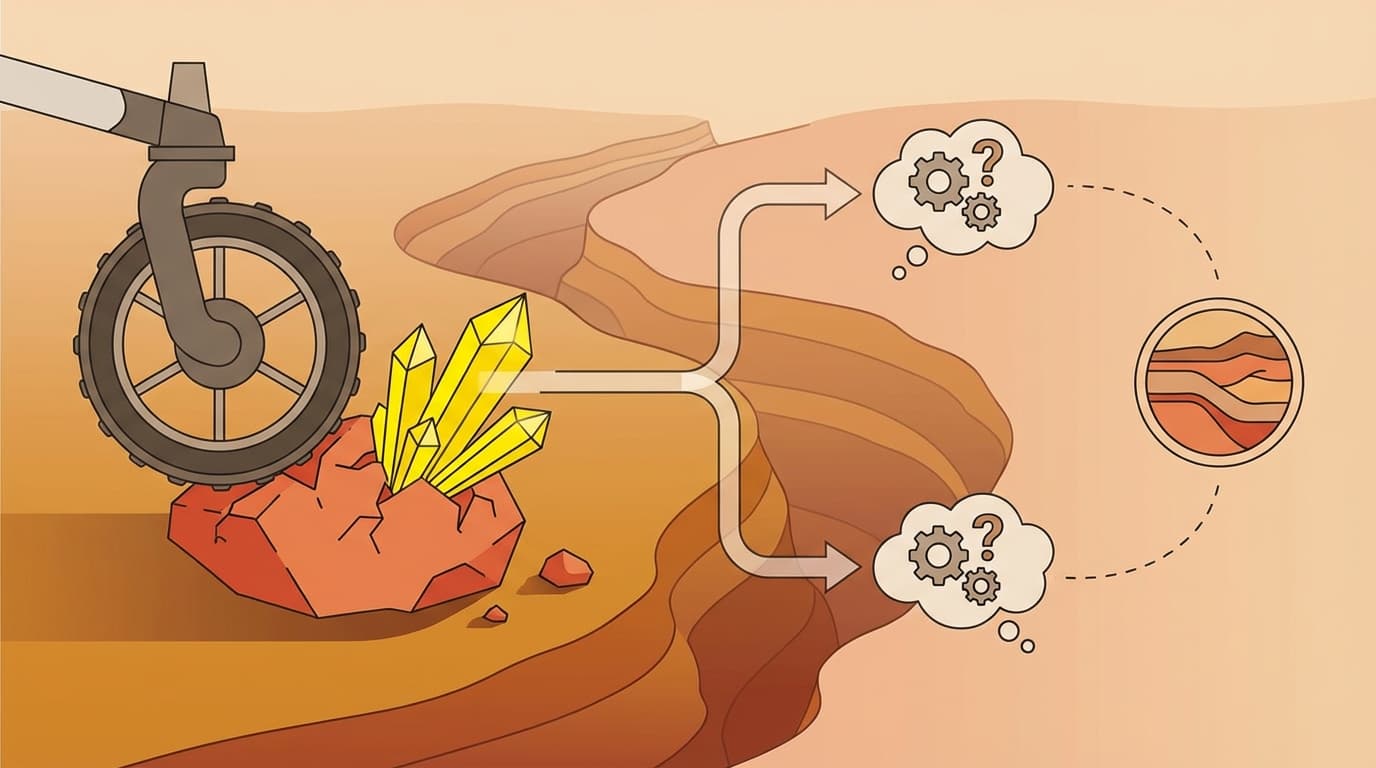
Seldom has a chance event yielded such a consequential scientific revelation. On May 30, 2024, NASA's Curiosity rover inadvertently drove over an unremarkable rock on Mars. The rover's considerable mass of 899 kilograms crushed the fragile mineral deposit. Inside lay yellow crystals of elemental sulfur, a substance never previously identified in pure form on Mars.
The discovery was made in the Gediz Vallis channel, a geological groove winding down the slopes of Mount Sharp. This 5-kilometre-tall mountain sits at the centre of Gale Crater, where Curiosity has been operating since 2012. Each layer of the mountain represents a distinct period of Martian history. Scientists confirmed the crystals' composition using the rover's Alpha Particle X-Ray Spectrometer.
What renders this finding particularly perplexing is that pure sulfur forms under a narrow set of conditions. These conditions had not previously been associated with this Martian location. While sulfates — salts containing sulfur that form as water evaporates — had been detected in the region before, elemental sulfur is fundamentally different. It consists solely of pure sulfur atoms, unlike the compound forms previously observed.
Project scientist Ashwin Vasavada of NASA's Jet Propulsion Laboratory characterised the discovery as unprecedented. He noted that an entire field of bright rocks resembling the crushed specimen was subsequently identified. The sulfur crystals were too small and brittle to be sampled directly with the rover's drill. Consequently, Curiosity drilled a nearby rock nicknamed Mammoth Lakes for further analysis.
The broader implications of this serendipitous discovery extend beyond mere mineralogy. Sulfur is an essential element for all known life, used to produce amino acids necessary for protein synthesis. Not only must scientists now determine what geological processes created these deposits, but they must also reconcile this finding with existing models of Martian evolution. The Gediz Vallis channel, an ancient waterway bearing imprints of rivers that flowed billions of years ago, may yet hold further revelations.