
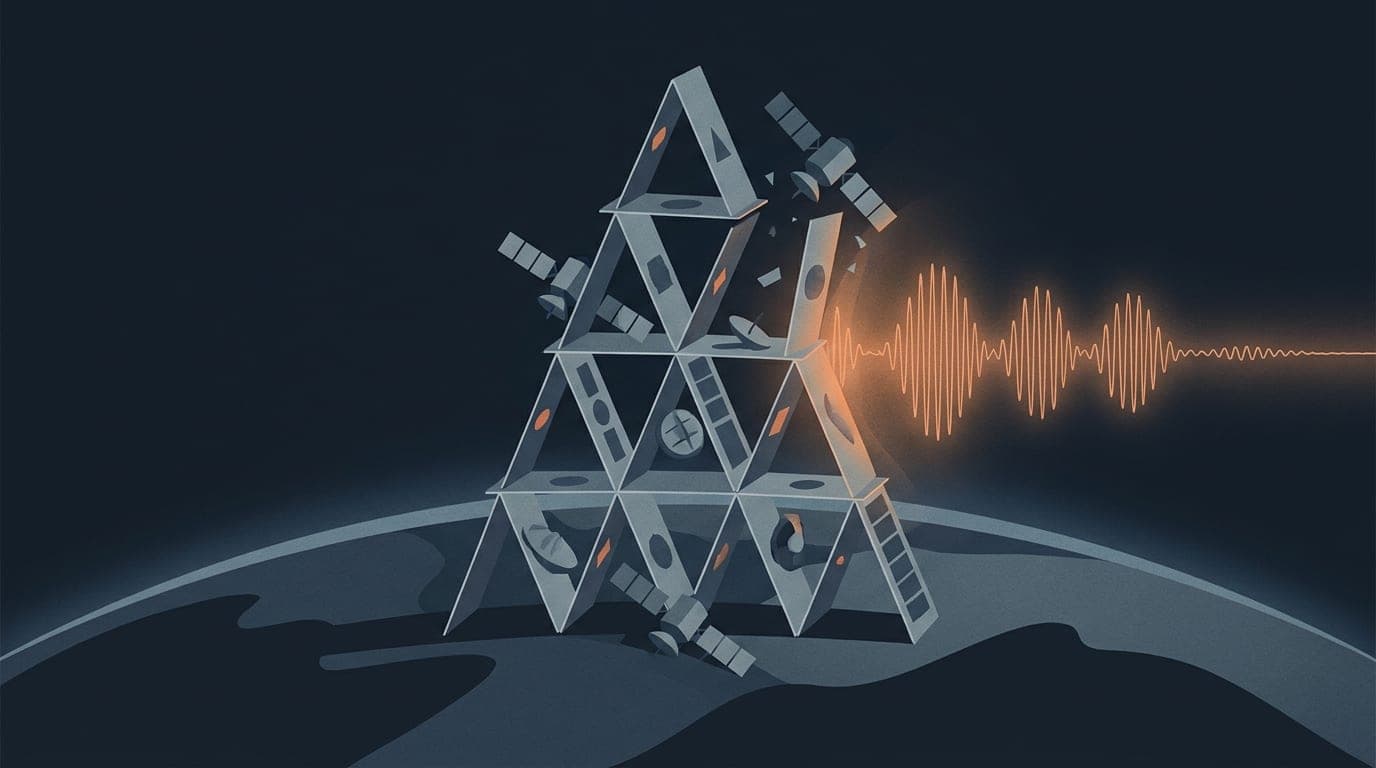
Seldom has a scientific finding so starkly illustrated the vulnerability of modern infrastructure. A new study led by Sarah Thiele, now at Princeton University, characterises satellite mega-constellations as an orbital house of cards. The research, published as a preprint on arXiv, introduces a metric called the CRASH Clock. This tool estimates how rapidly a catastrophic collision could unfold if satellite operators suddenly lost control. The conclusion is profoundly alarming for governments and industries alike.
Using satellite catalogue data from June 2025, the researchers calculated a startling figure. Should operators lose the ability to command avoidance manoeuvres, a devastating collision could occur within approximately 2.8 days. A broader estimate, encompassing all orbital objects, extended this window to merely 5.5 days. Notably, losing control for just 24 hours carries a 30 percent probability of triggering a major collision. In contrast, comparable conditions in 2018 would have permitted roughly 121 days before such an event.
The sheer congestion of low Earth orbit underpins this vulnerability. Across all mega-constellations, a close approach between satellites occurs approximately every 22 seconds. Within the Starlink network alone, such encounters happen roughly every 11 minutes. Each Starlink satellite must execute an average of 41 collision avoidance manoeuvres annually. This constant vigilance demonstrates how dependent orbital safety has become on uninterrupted, real-time coordination.
Solar storms represent the most plausible trigger for such a disruption. These events heat Earth's upper atmosphere, increasing atmospheric drag on spacecraft and degrading orbit predictions. The 2024 Gannon Storm was the strongest geomagnetic event in decades, yet it pales beside the Carrington Event of 1859. Were a Carrington-scale storm to strike today, it could incapacitate satellite control systems for far longer than three days. Such a scenario could initiate what scientists term the Kessler Syndrome.
The Kessler Syndrome describes a cascading chain reaction in which collisions generate debris that causes further collisions. Ultimately, this process could render entire orbital regions impassable for generations. The implications extend beyond space exploration to terrestrial life itself. Communications, navigation, weather forecasting, and financial systems all depend heavily on satellite infrastructure. This research underscores the imperative for robust international frameworks governing orbital safety and resilience.