
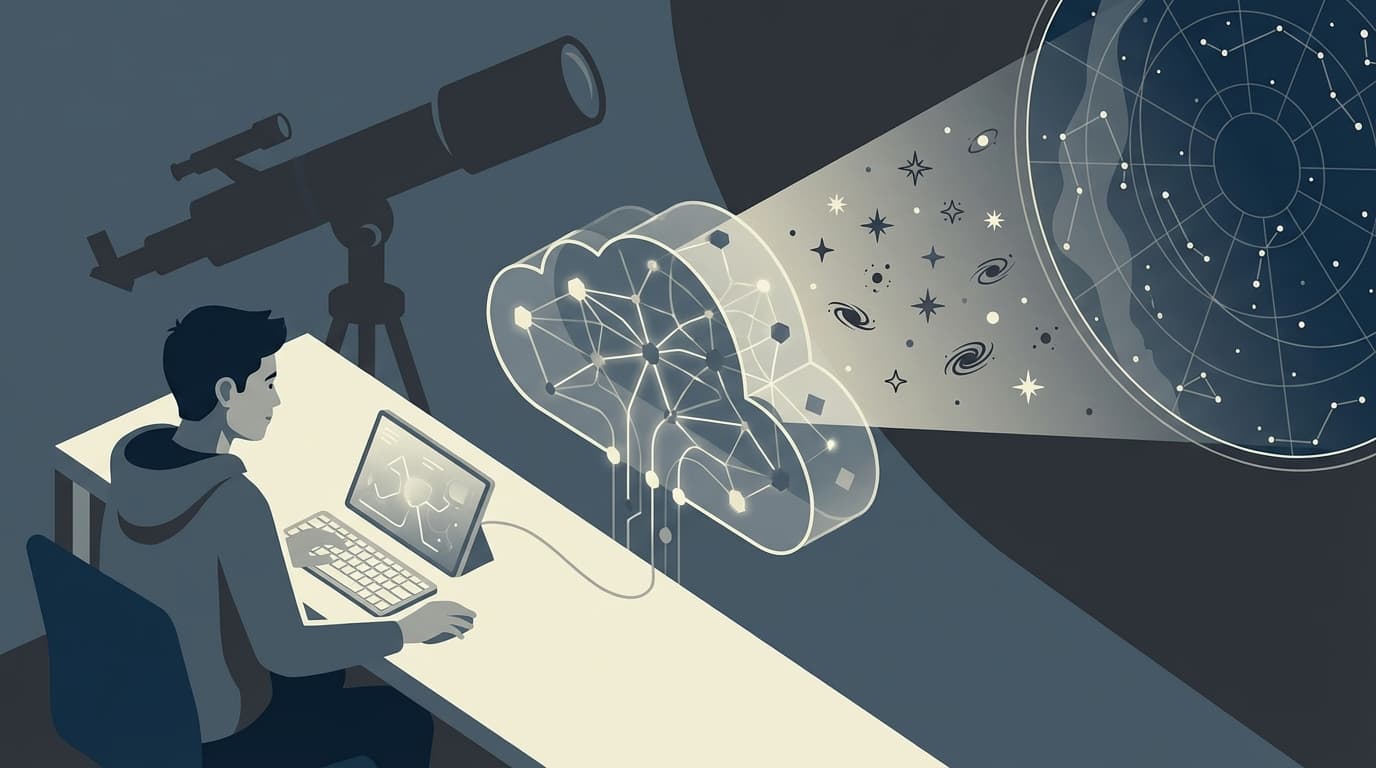
Seldom has a scientific contribution from a teenager generated such profound implications for contemporary astrophysics. Matteo Paz, an eighteen-year-old student from Pasadena, California, developed an AI algorithm that uncovered approximately 1.5 million previously unidentified cosmic objects. His model processed roughly 200 billion infrared detections gathered over a decade by NASA's now-retired NEOWISE telescope. The findings were published in The Astronomical Journal in November 2024, with Paz listed as the sole author.
The NEOWISE telescope was originally launched in 2009 to detect near-Earth asteroids and comets. However, it simultaneously collected vast infrared data on distant variable objects, including quasars, exploding stars, and eclipsing binary systems. Much of this supplementary data had remained untapped for years. Paz's mentor, Caltech senior scientist Davy Kirkpatrick, had initially envisioned a modest manual analysis of a small portion of the sky.
Rather than pursuing a conventional approach, Paz constructed a machine-learning pipeline called VARnet within just six weeks. The architecture integrates wavelet decomposition, Fourier transforms, and a convolutional neural network to classify variable sources. This sophisticated methodology enabled the algorithm to detect subtle brightness fluctuations that traditional tools had overlooked. Each flagged source constitutes a candidate requiring subsequent observational verification by professional astronomers.
Paz's achievement earned him the first-place prize of 250,000 dollars in the 2025 Regeneron Science Talent Search. The resulting catalog, released publicly in late 2025, is already facilitating observations at major facilities such as the Vera C. Rubin Observatory. Furthermore, NASA leadership has formally acknowledged the significance of his AI-driven breakthrough. Paz is now employed at Caltech's Infrared Processing and Analysis Center while completing his secondary education.
What distinguishes this accomplishment is its broader implications for scientific methodology and accessibility. The algorithm's adaptability suggests potential applications in fields such as financial analysis, environmental monitoring, and neuroscience. Paz developed his advanced mathematical skills through a public programme for gifted students in Pasadena. His trajectory underscores a paradigm shift in which democratised artificial intelligence empowers individuals outside institutional frameworks to make substantive contributions.