
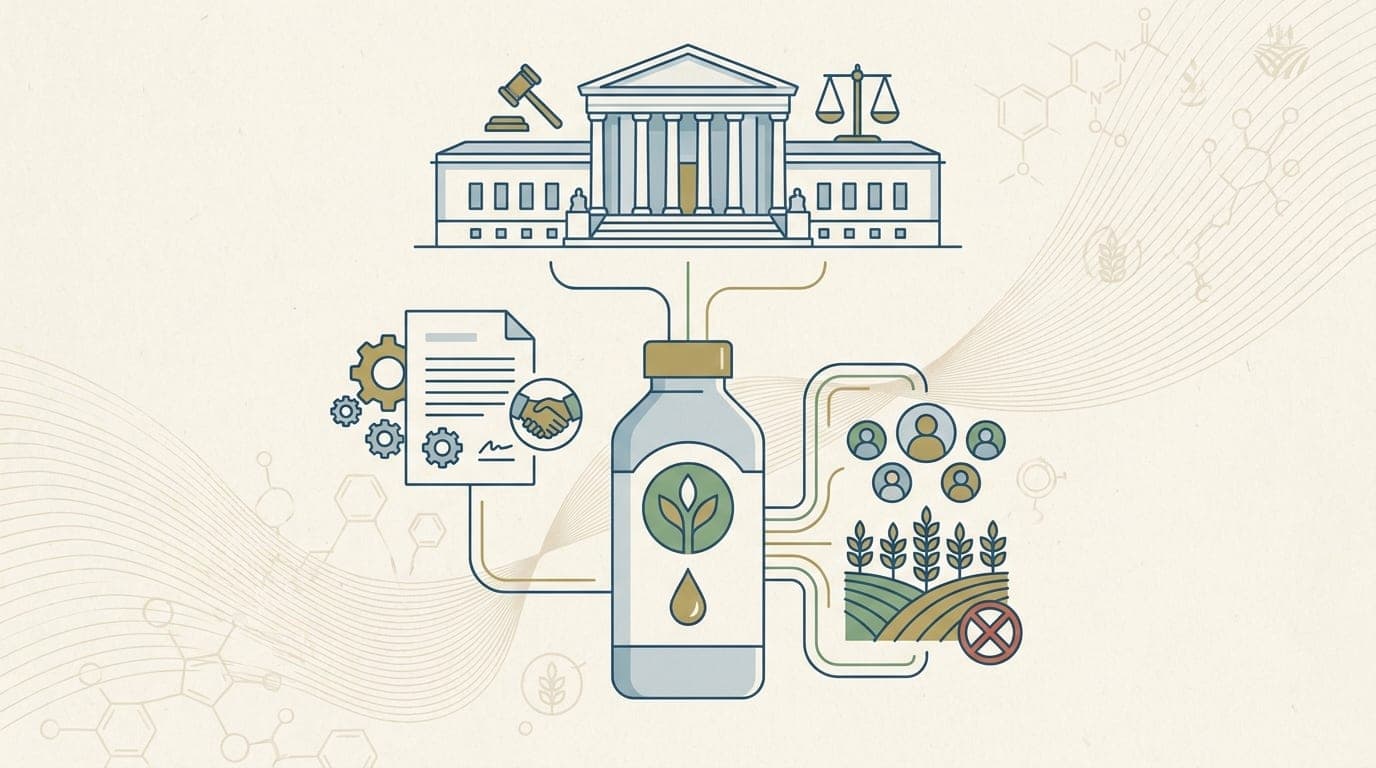
Seldom has a single product liability case carried such profound implications for public health and corporate accountability. The U.S. Supreme Court heard oral arguments on April 27 in Monsanto Company v. Durnell. The justices appeared divided over whether federal pesticide regulations preempt state-level failure-to-warn lawsuits. At the heart of this litigation lies a deceptively simple question about warning labels on herbicide products. The ruling, expected by the end of June, could reshape the legal landscape for the entire agrochemical industry.
The case originated with John Durnell, a Missouri resident who used Roundup for over two decades. His lawsuit alleged that prolonged exposure to glyphosate, the herbicide's active ingredient, caused his non-Hodgkin lymphoma. In 2023, a jury awarded him $1.25 million after finding Monsanto liable for failing to warn consumers. His case is merely one among more than 100,000 similar claims filed against Bayer, which acquired Monsanto in 2018. Bayer has already set aside approximately $16 billion to settle these cases and proposed a $7.25 billion class settlement.
The scientific evidence underpinning this dispute remains fiercely contested. The World Health Organization's International Agency for Research on Cancer classified glyphosate as probably carcinogenic in 2015. Conversely, the Environmental Protection Agency has determined that glyphosate is not likely to be carcinogenic when used as directed. A federal court in 2022 ordered the EPA to reassess its evaluation, citing inadequate consideration of cancer risks. This divergence between international and domestic regulatory conclusions has fueled the ongoing litigation.
Bayer's legal strategy centers on the principle of federal preemption, arguing that uniform national labeling standards supersede state requirements. Paul Clement, representing Bayer, contended that permitting state-level lawsuits would subject manufacturers to contradictory obligations. Several conservative justices appeared sympathetic to this uniformity argument during oral proceedings. Nevertheless, Chief Justice Roberts suggested that states should retain the capacity to alert citizens to emerging dangers. Liberal justices similarly questioned whether federal preemption inappropriately constrains states from responding to evolving scientific research.
The ramifications of this decision extend well beyond a single corporation's financial liability. Agricultural industry groups have warned that continued litigation could force glyphosate's withdrawal from American farming. The American Farm Bureau Federation characterized such an outcome as posing a devastating risk to the nation's food supply. Simultaneously, environmental and public health advocates argue that corporate immunity would leave thousands of affected individuals without legal recourse. Regardless of the outcome, this case will establish a consequential precedent for the intersection of federal regulation and consumer protection.