
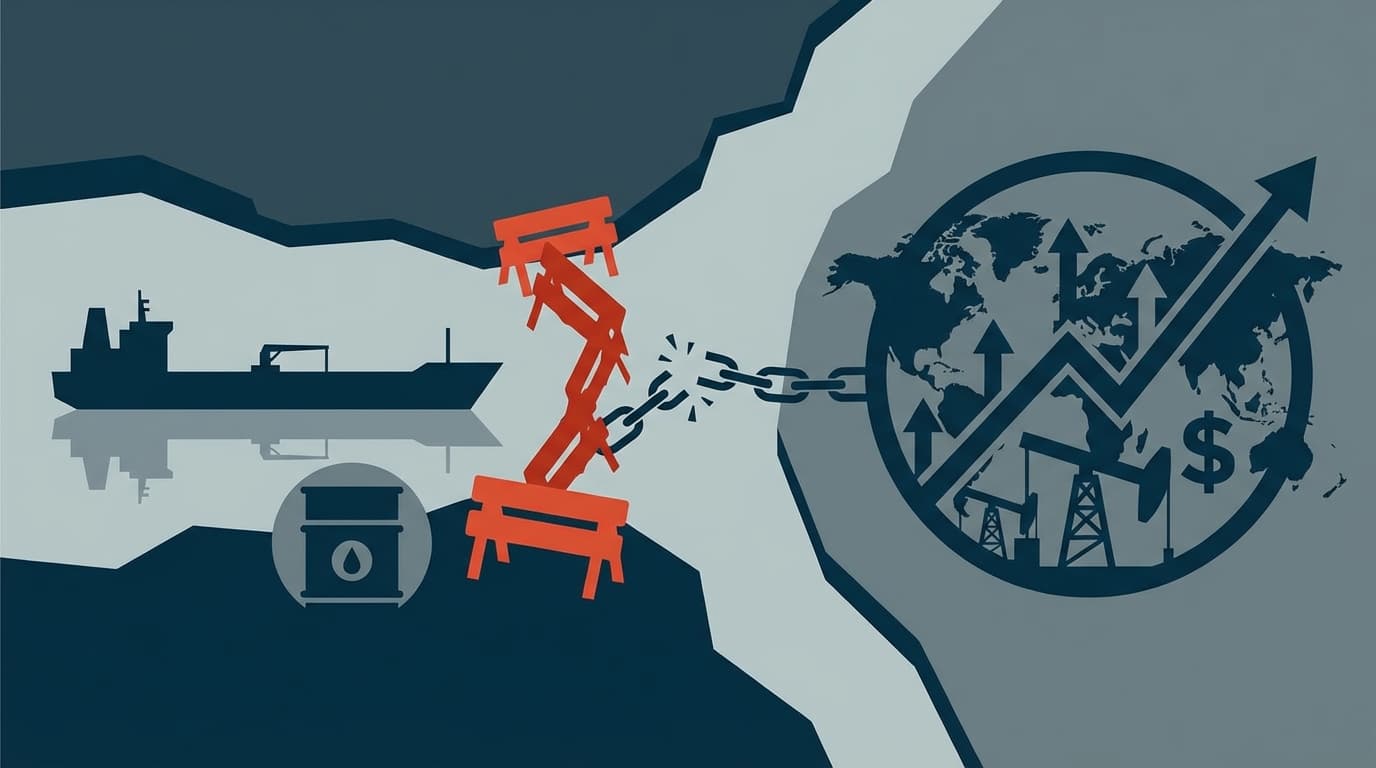
Seldom has a single maritime chokepoint commanded such global attention. The Strait of Hormuz, through which approximately twenty percent of the world's oil transits daily, now faces an unprecedented disruption. Following coordinated military strikes on Iran in late February 2026, Tehran's Revolutionary Guard Corps announced the strait's closure. Tanker traffic has plummeted, with shipping giants Maersk and Hapag-Lloyd suspending all transits through this critical corridor. What was once a theoretical geopolitical risk has materialized into a tangible supply shock reverberating across commodity markets worldwide.
The immediate economic ramifications have been substantial. Brent crude surged by as much as thirteen percent, reaching its highest level since early 2025. Insurance premiums for vessels transiting the strait have climbed to six-year highs, rendering passage economically unviable for most commercial operators. Analysts at Goldman Sachs and Barclays have cautioned that sustained restrictions could propel oil prices beyond one hundred dollars per barrel. OPEC+ has pledged a modest production increase of 206,000 barrels per day, yet this measure scarcely offsets the magnitude of displaced volume.
The strait's strategic significance cannot be overstated. Approximately one hundred miles long and merely twenty-one miles wide at its narrowest point, it is irreplaceable. Unlike the Suez Canal, where vessels can reroute around Africa, the Persian Gulf has no alternative maritime exit. Saudi Arabia and the UAE possess pipeline infrastructure capable of bypassing the strait, but spare capacity is limited to roughly 2.6 million barrels daily. This represents a fraction of the nearly twenty million barrels that ordinarily flow through the waterway each day.
Asian economies face disproportionate exposure to this disruption. China, India, Japan, and South Korea collectively receive approximately eighty-four percent of crude oil transiting the strait. India imports roughly sixty percent of its oil from the Middle East, while Japan and South Korea source seventy-five and seventy percent respectively. South Asian nations, particularly Pakistan and Bangladesh, confront acute vulnerability regarding liquefied natural gas supplies from Qatar and the UAE. The cascading effects on inflation and current account balances across the region could prove profoundly destabilizing.
For global markets, the implications extend well beyond petroleum. One-third of the world's fertilizer trade passes through the strait, compounding existing agricultural supply chain pressures. Thirty percent of Europe's jet fuel either originates from or transits via this corridor. Should the disruption persist, industries from aviation to manufacturing will contend with escalating input costs. The crisis underscores a fundamental vulnerability in the architecture of global trade: excessive dependence on a single, narrow passage for essential commodities.