
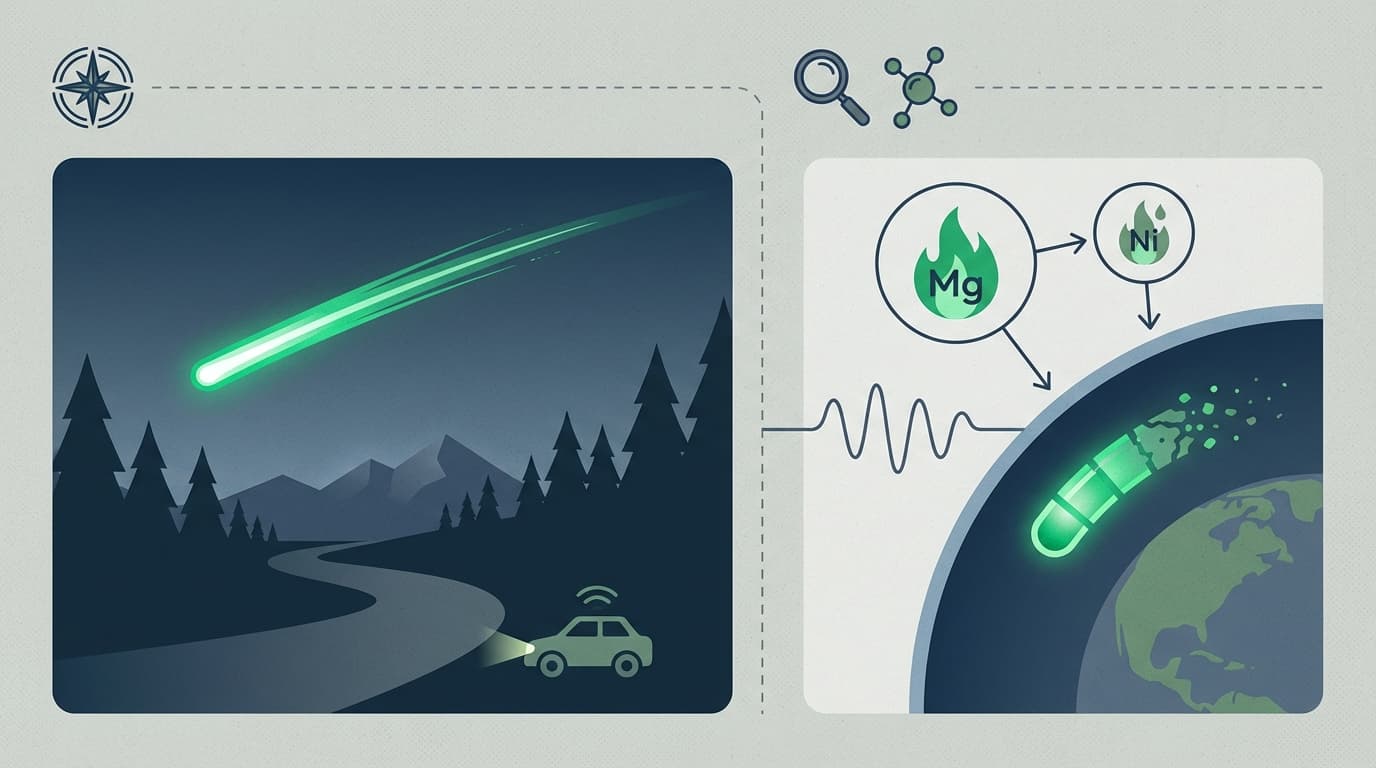
On March 24, 2026, a spectacular green fireball was observed over the Pacific Northwest. A driver named Jason Jenkins captured the event on his dashcam at 6:06 a.m. He had been driving through southwestern Washington state, approximately 20 miles north of Portland. The bright green streak initially led him to believe he was witnessing a comet. However, he soon concluded that the object was far too close for that.
According to the Oregon Museum of Science and Industry, the phenomenon was classified as a fireball. A fireball is defined as a particularly bright meteor visible up to 80 miles above the Earth. The green color is attributed to the presence of magnesium within the meteor. When magnesium is heated and vaporized in the atmosphere, it emits a distinctive blue-green light. Nickel, another element sometimes found in meteors, can also contribute to the green hue.
This event was not an isolated occurrence in the United States. The previous week, a 7-ton meteor had sped across the Ohio sky before breaking apart. Its disintegration produced a thunderous boom that startled residents across multiple states. Additionally, a meteor traveling at 35,000 miles per hour broke apart north of Houston on Saturday. NASA confirmed that the Houston meteorite had originally weighed approximately one ton.
Jim Todd, the museum's director of space science education, noted the fireball's high altitude. Its position in the dark early morning sky had made it widely visible across the region. As dashcams and doorbell cameras have become increasingly prevalent, more celestial events are being documented. Scientists may now use the video footage to determine the fireball's trajectory. Such data could reveal whether any fragments reached the Earth's surface.