
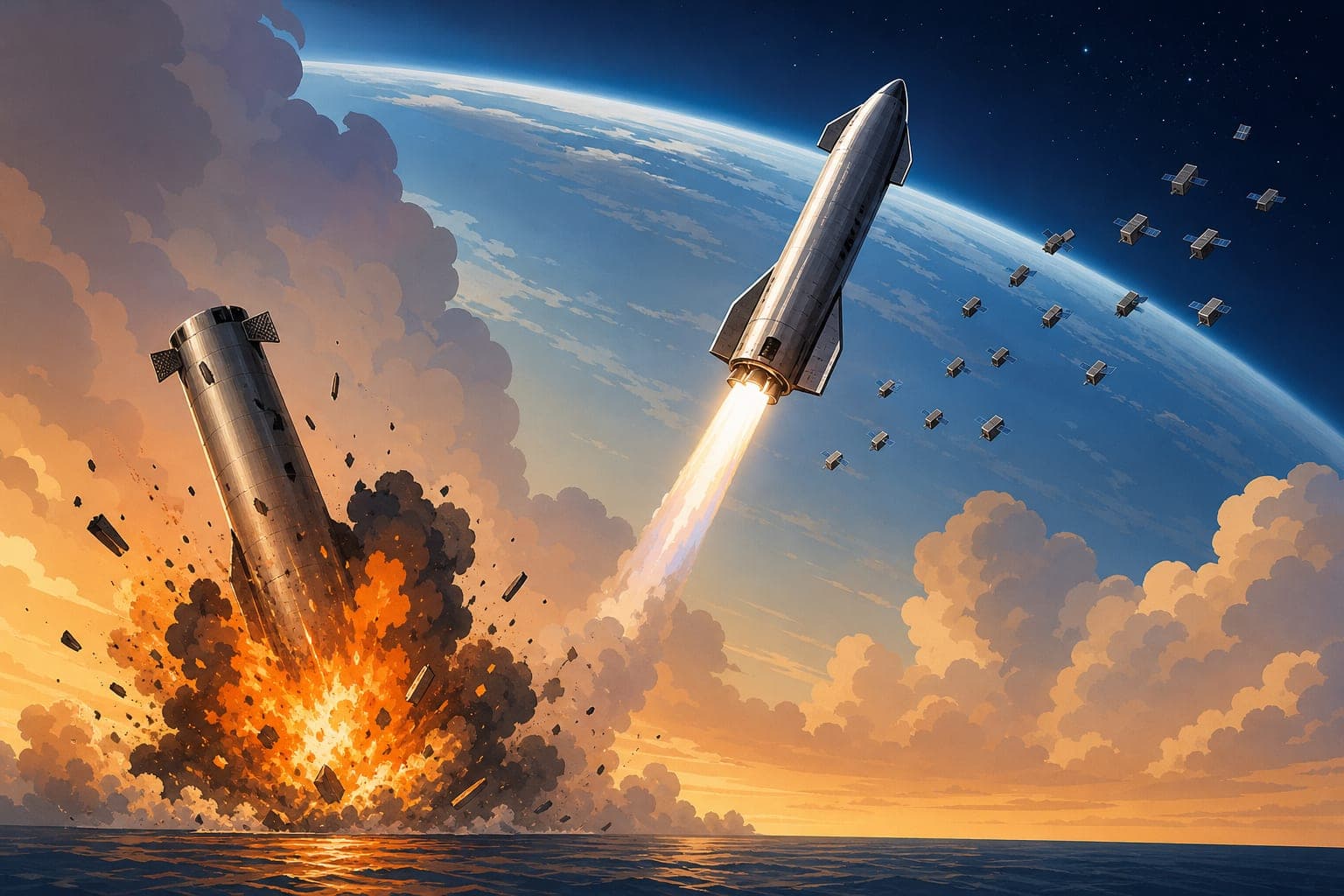
Seldom has a single rocket launch embodied both triumph and disappointment so vividly. On November 13, SpaceX launched Starship Flight 15 from its Starbase facility in Texas. The spacecraft soared into orbit for only the second time in the program's history. However, the mission's most ambitious objective—recovering both rocket stages—ended in a fiery spectacle over the Gulf of Mexico.
The Super Heavy booster, stretching 72 meters tall, was diverted offshore after an automatic abort halted its return to the launch pad. It subsequently exploded upon splashing down in the Gulf. SpaceX had intended to catch the booster midair using enormous mechanical arms mounted on the launch tower. This unprecedented double-catch maneuver would have marked a pivotal milestone in reusable rocket technology.
Despite the booster setback, the upper stage continued performing remarkably well. Ship 42 entered a low Earth orbit at approximately 275 kilometers altitude. It then deployed all 26 Starlink V3 satellites, each capable of adding one terabit of capacity to the network. The spacecraft was still orbiting Earth and preparing for a potential tower-catch attempt of its own.
Full reusability remains the cornerstone of SpaceX's long-term vision for affordable space travel. Traditional rockets are discarded after a single use, making launches extraordinarily expensive. By catching and reusing both stages, SpaceX aims to scale from dozens to thousands of launches annually. Such a paradigm shift could fundamentally transform humanity's relationship with space exploration.
Nevertheless, this setback illustrates that engineering breakthroughs rarely follow a linear trajectory. SpaceX has cultivated a culture of iterative testing, where each failure yields invaluable data. The company's vice president of launch recently emphasized that full reusability is essential for establishing bases on the Moon and Mars. Whether this ambitious timeline proves feasible remains to be seen, yet the incremental progress is undeniable.