
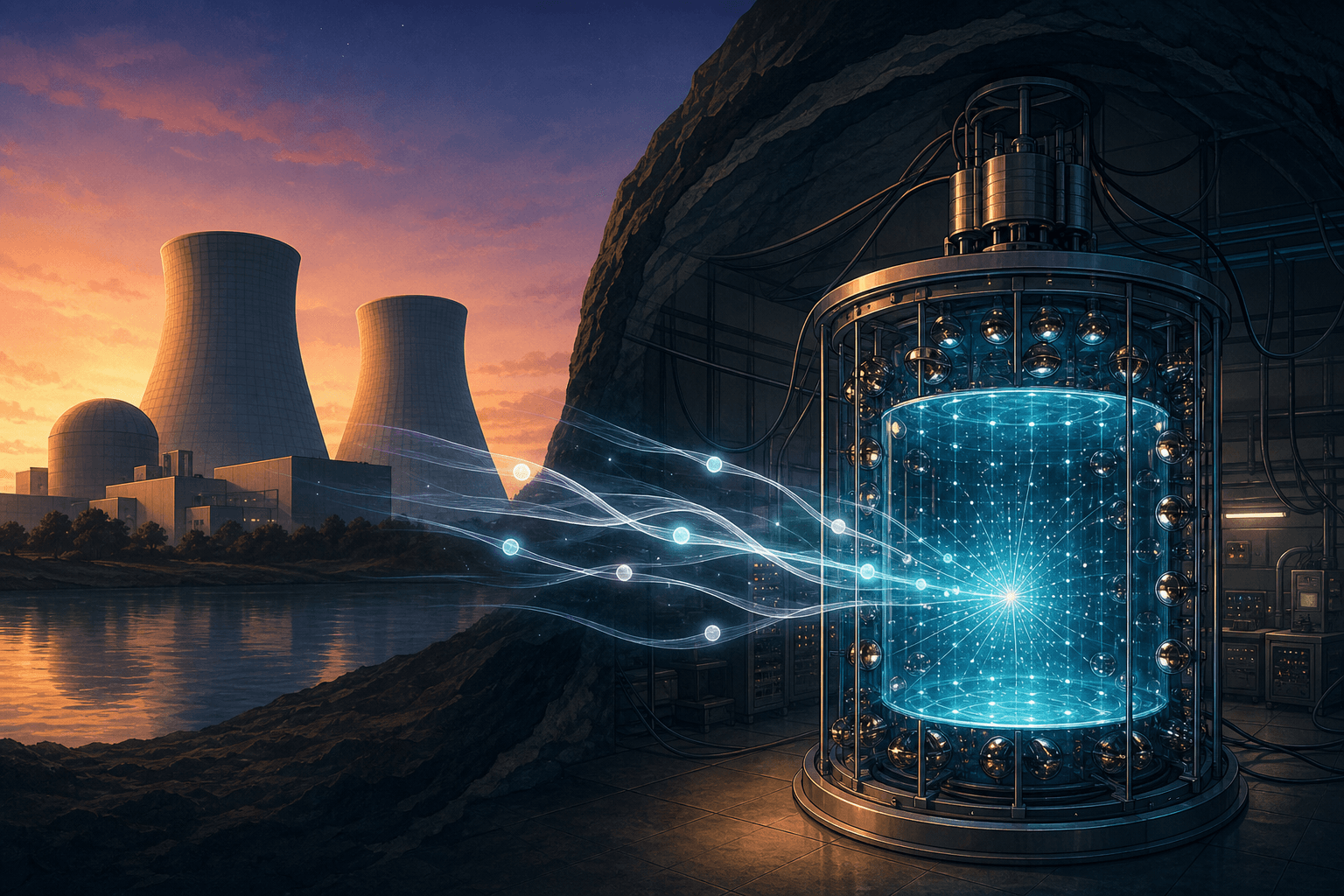
Seldom has a scientific achievement sounded so eerie. Physicists have measured the faint glow of ghost particles escaping from silent nuclear reactors. These particles, called antineutrinos, are emitted even after a reactor has been completely shut down. The breakthrough was led by the Double Chooz Collaboration, based at the Chooz Nuclear Power Station in France.
Antineutrinos are called ghost particles because they almost never interact with ordinary matter. They carry no electric charge and possess nearly nonexistent mass. Trillions of them pass through our bodies every second without leaving any trace. Detecting such elusive particles required exceptionally sensitive equipment and years of careful analysis.
The Double Chooz experiment operated from 2011 to 2017, using two underground detectors near the French power station. During a 17.2-day observation period when both reactor cores were switched off, researchers detected the residual signal. They measured 106 antineutrino events, which agreed remarkably well with the 88 events predicted by simulations. This represented less than one percent of the signal produced during normal reactor operation.
What distinguishes this achievement is its practical significance for nuclear safeguards. Because antineutrinos travel freely through walls, shielding, and rock, they carry information from otherwise inaccessible places. Future detectors could provide a non-intrusive method to verify reactor activity and monitor spent-fuel inventories. This proof-of-concept could ultimately reshape how international inspectors assess nuclear facilities.
The field is already gaining momentum. Initial results from the JUNO-TAO experiment, presented at Neutrino 2026, show other teams pursuing similar research. The Double Chooz measurement now serves as the first published benchmark for evaluating future observations. Had this technology existed decades earlier, nuclear monitoring might look fundamentally different today.