
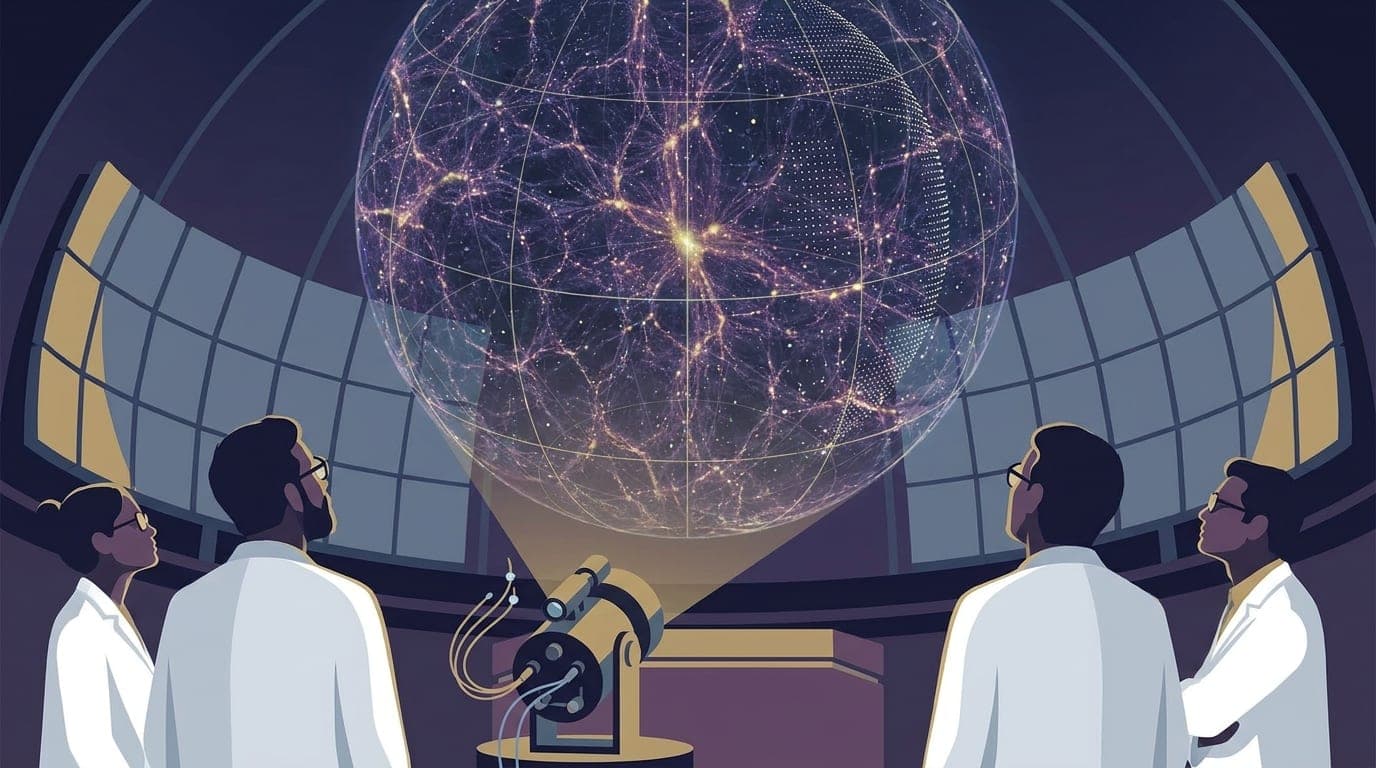
An international team of scientists has achieved a remarkable milestone in modern cosmology. The Dark Energy Spectroscopic Instrument, known as DESI, has completed the largest 3D map of the universe. This extraordinary project had been planned as a five-year survey of the night sky. DESI, which is mounted on a telescope in Arizona, finished its observations ahead of schedule. The instrument used 5,000 fiber-optic sensors to capture light from distant cosmic objects.
The results have far surpassed the original expectations of the research collaboration. Scientists had initially planned to gather data on 34 million galaxies and quasars. However, DESI performed so efficiently that it recorded more than 47 million galaxies and quasars. It also observed over 20 million nearby stars that are being used to study the Milky Way. DESI has now measured six times as many cosmic objects as all previous surveys combined.
The primary purpose of this unprecedented map is to investigate dark energy. Dark energy is the fundamental force that makes up approximately 70 percent of the universe. It is believed to be driving the accelerating expansion of the cosmos. Surprising early results had hinted that dark energy might be evolving over time. If this were confirmed, it would represent a major shift in our understanding of physics.
Although the planned survey is now complete, the DESI project will continue its exploration. The instrument will keep observing the sky until 2028 to further expand the map. More than 900 researchers from over 70 institutions worldwide are involved in this endeavor. The first results from the full five-year dataset are expected in 2027. Scientists remain eager to discover what new surprises may be hidden within the data.