
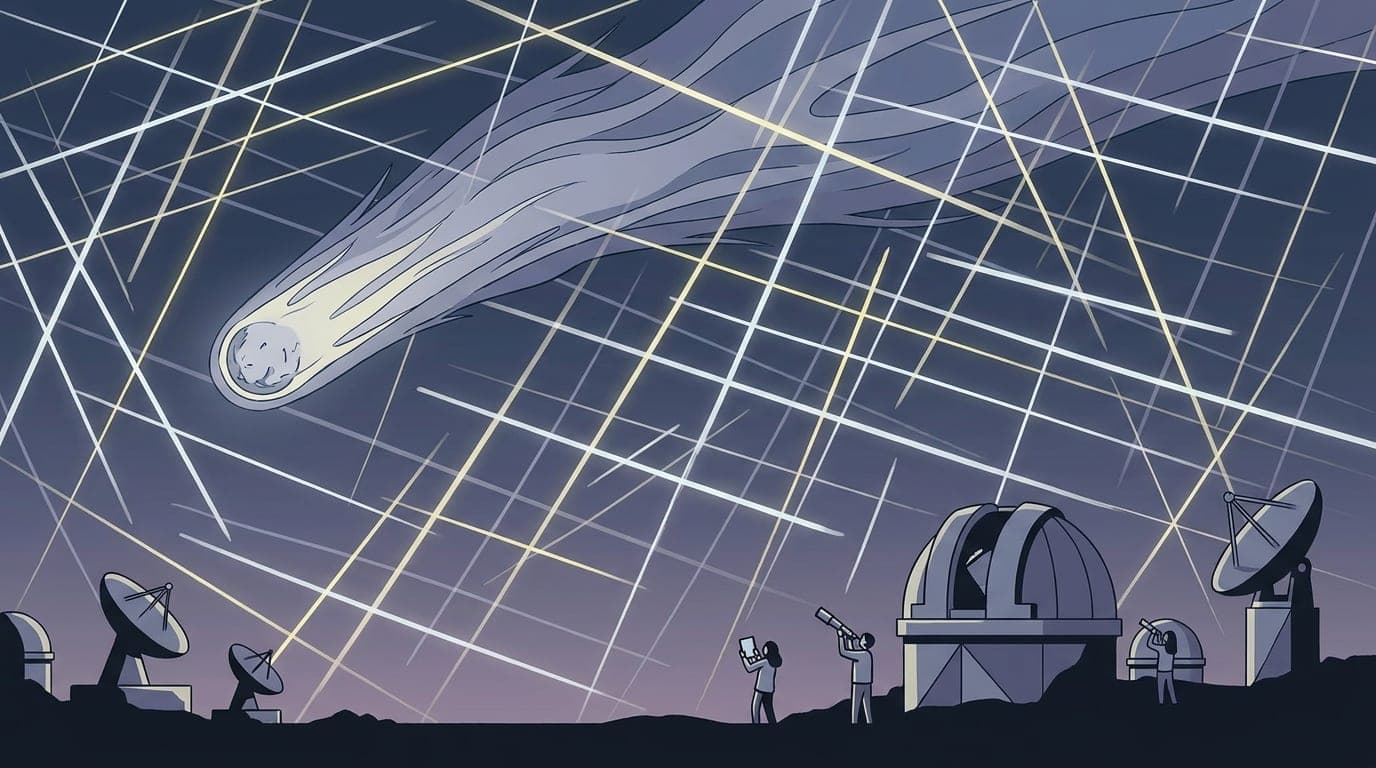
Seldom has a single photograph so powerfully illustrated the tension between technological progress and scientific inquiry. A recent long-exposure image of Comet C/2025 R3 (PanSTARRS) has become a stark symbol of this conflict. Captured from Bavaria, Germany, just before sunrise, the ten-minute exposure reveals the comet ensnared in a web of bright satellite trails. Rather than showcasing the celestial visitor in its full splendour, the image depicts what has been described as a celestial cage of light.
The satellite streaks appear because of the prolonged camera exposure required for astrophotography. During the ten minutes the shutter remained open, numerous Low Earth Orbit satellites traversed the field of view. Each satellite reflected sunlight as it passed, leaving a luminous streak across the frame. To the unaided eye, these satellites appear merely as slowly drifting points of light, visible primarily around sunset and sunrise.
The proliferation of LEO satellites has accelerated dramatically in recent years, driven by commercial demand for global broadband connectivity. Approximately 15,000 artificial satellites currently orbit Earth, with the vast majority residing in Low Earth Orbit. Companies such as SpaceX, Amazon, and others have collectively proposed constellations numbering in the tens of thousands. Conservative projections suggest that over 43,000 active satellites could be in orbit by 2032, further intensifying the problem.
The consequences for astronomical research are increasingly severe. A study published in Nature found that satellite mega-constellations pose a substantial threat to both ground-based and space-based observatories. Researchers predict that up to 80 percent of twilight exposures from next-generation telescopes could be contaminated by satellite trails. Astrophotographer Michael Jaeger has noted that removing Starlink satellite streaks has become routine, as nearly every image now contains them.
The International Astronomical Union has established brightness limits to mitigate interference, yet compliance remains inadequate. A recent study found that 92 percent of Amazon's LEO satellites exceeded the recommended threshold for research interference. Had regulations been implemented earlier, the current degradation might have been less pronounced. Without binding international frameworks, the preservation of dark skies for future generations of scientists and observers remains profoundly uncertain.