Seldom has a single astronomical observation so profoundly expanded the boundaries of radio astronomy. An international team led by Dr. Thato Manamela of the University of Pretoria has detected the most distant hydroxyl megamaser ever recorded. This remarkable signal originated from a violently merging galaxy system located over eight billion light-years from Earth. Designated HATLAS J142935.3–002836, the source emitted its radio waves when the universe was less than half its present age.
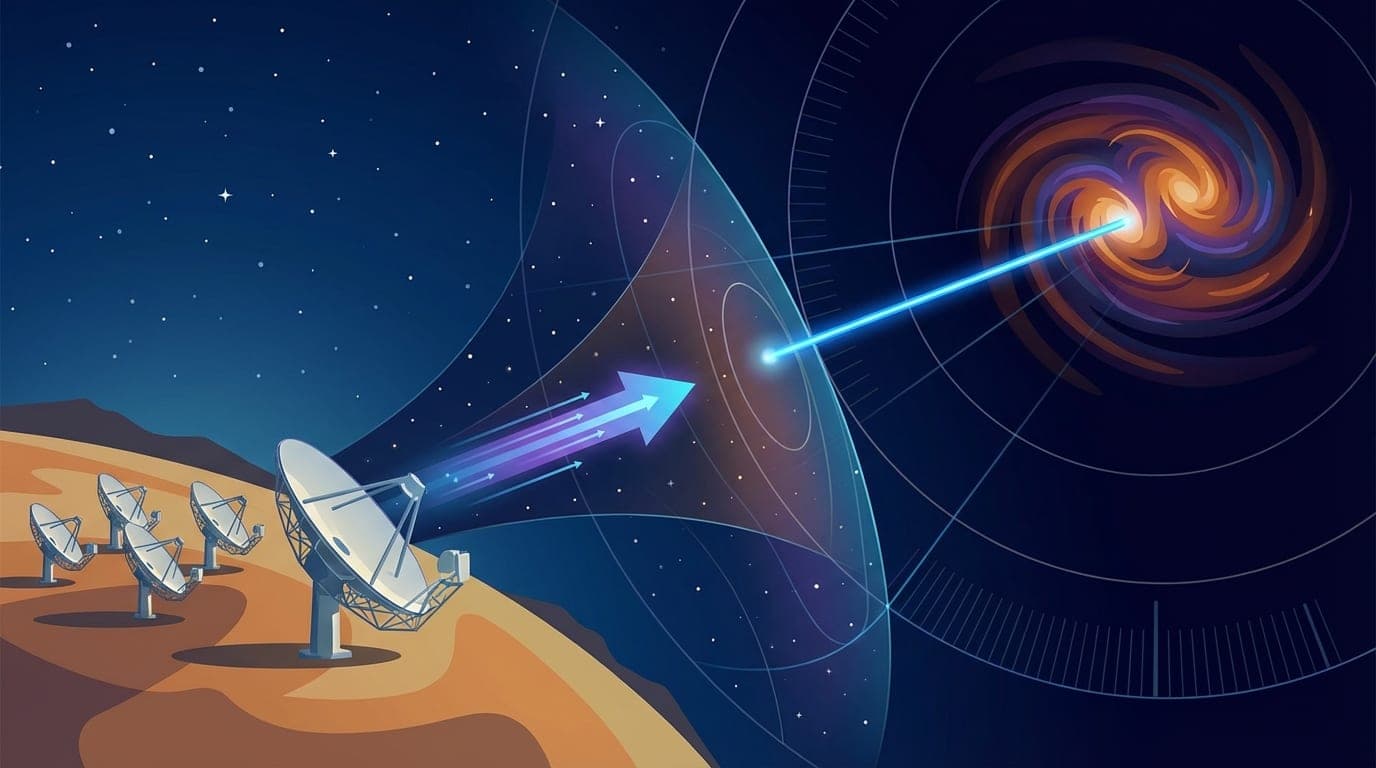
A hydroxyl megamaser is essentially a natural microwave amplifier produced when gas-rich galaxies collide with tremendous force. During these cataclysmic mergers, vast clouds of interstellar gas become compressed, stimulating hydroxyl molecules to amplify radio emissions. The underlying mechanism closely resembles that of terrestrial lasers, yet it operates at considerably longer wavelengths of approximately eighteen centimetres. Indeed, this particular signal proved so extraordinarily luminous that researchers proposed reclassifying it as a gigamaser.
What renders this detection particularly noteworthy is the role of gravitational lensing in making it observable. A massive foreground galaxy, positioned between the source and Earth, bent and magnified the incoming radio waves. This phenomenon, first predicted by Einstein's theory of general relativity, effectively transformed the intervening galaxy into a cosmic telescope. Without such serendipitous alignment, the signal would likely have been far too faint to detect.
The discovery was achieved using the MeerKAT radio telescope, an array of sixty-four linked dishes in South Africa's Northern Cape. Remarkably, the team confirmed the signal with only a 4.7-hour observation, achieving a signal-to-noise ratio exceeding one hundred and fifty. The study has been accepted for publication in Monthly Notices of the Royal Astronomical Society Letters. These findings underscore the sophisticated computational infrastructure required to calibrate and analyse terabytes of astronomical data.
The broader implications of this discovery extend well beyond a single detection. Hydroxyl megamasers trace the most vigorous galaxy collisions, where enormous gas reservoirs fuel intense starbursts and feed supermassive black holes. By identifying such phenomena at unprecedented distances, astronomers gain a powerful new probe of cosmic evolution. As Dr. Manamela stated, the team aspires to discover not merely one system but hundreds to thousands in future surveys.