
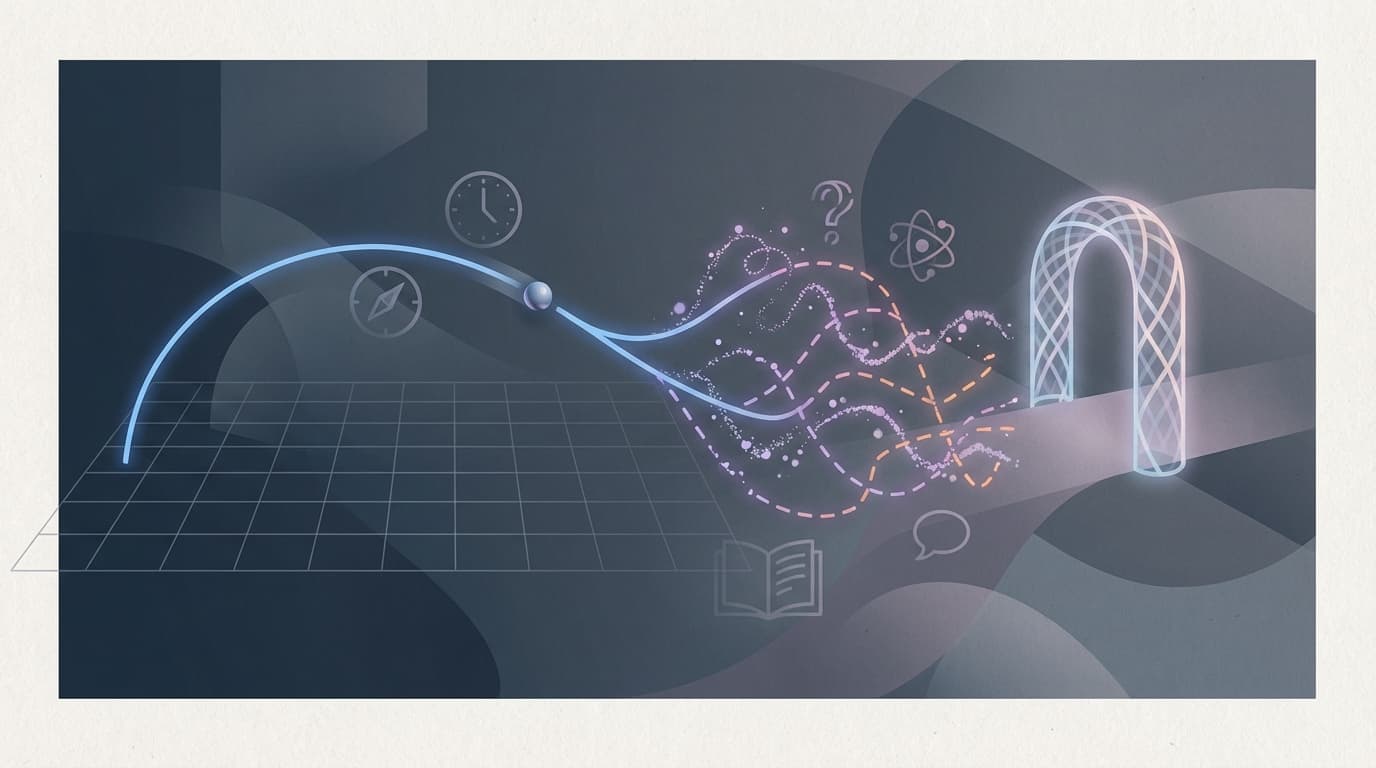
A team of physicists has made an important discovery about how particles move through space. Researchers at the Vienna University of Technology developed a new equation called the q-desic equation. This equation suggests that particles do not always follow the shortest path through curved spacetime. According to Einstein's theory, massive objects like stars curve the space around them. Planets and other objects were believed to follow precise paths called geodesics.
Modern physics currently relies on two successful but incompatible frameworks. Quantum theory explains the behavior of tiny particles at the microscopic level. Einstein's general relativity, on the other hand, describes gravity and cosmic structures. Scientists have long searched for a way to merge these two theories. Several candidates exist, including string theory, but none has been confirmed.
The researchers applied quantum rules to the mathematical measurement of spacetime curvature. In quantum physics, properties like position are based on probability rather than certainty. The team found that deviations from Einstein's predicted paths are extremely small under ordinary gravity. These deviations measure only about ten to the power of negative thirty-five meters. However, when the cosmological constant related to dark energy was included, results changed dramatically.
At vast distances of around ten to the power of twenty-one meters, deviations become substantial. Benjamin Koch from TU Wien compared the search for a unified theory to a fairy tale. He said that several candidate theories exist, but only one can be correct. If scientists could observe these deviations, they would identify which theory truly describes our universe. This research represents a significant step toward solving one of physics' greatest challenges.