
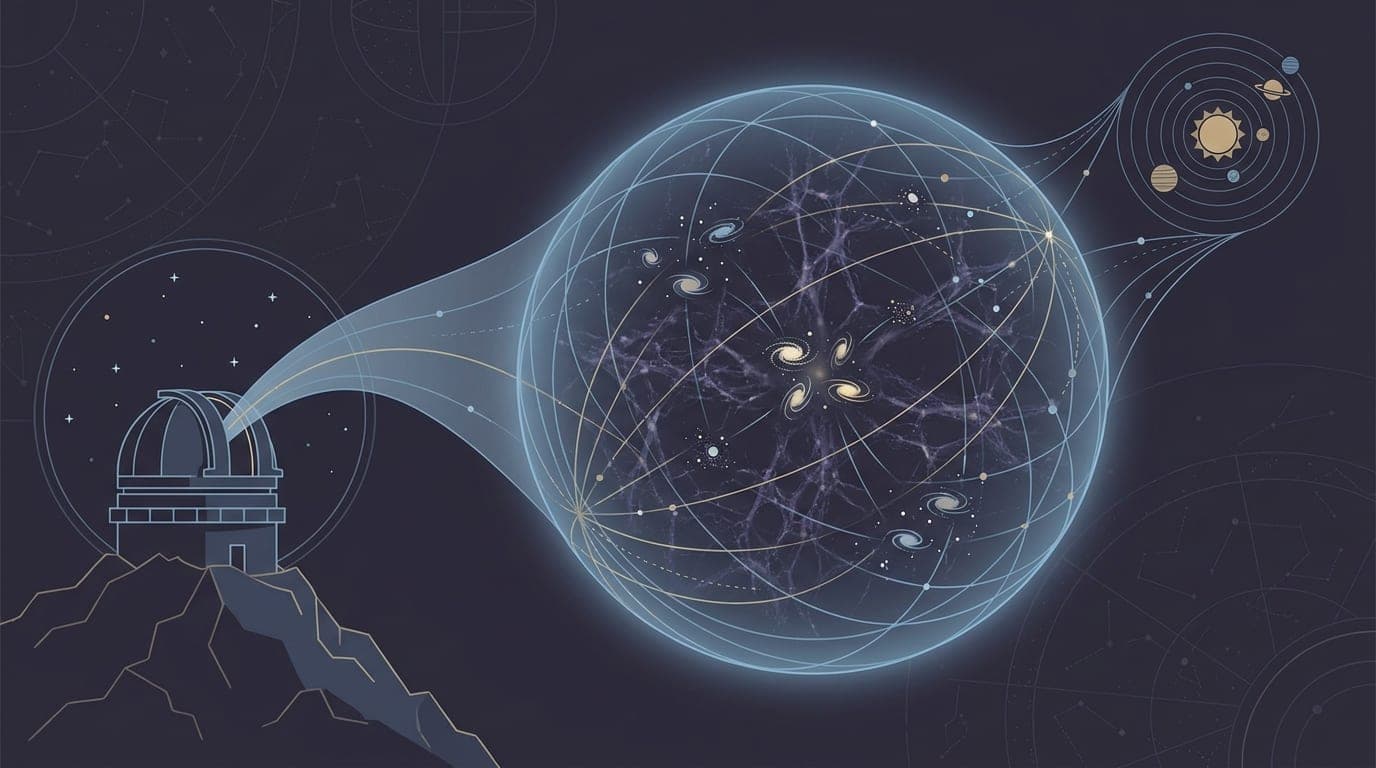
Seldom has a scientific principle demonstrated such enduring resilience as Newton's inverse square law of gravitation. First published in 1687, this foundational equation describes how gravitational force weakens proportionally to the square of the distance between two objects. A landmark study, published in Physical Review Letters in April 2026, has now validated this law on an unprecedented scale. Researchers examined galaxy clusters separated by up to 750 million light-years, constituting the most extensive direct test of gravity ever undertaken.
The research team, led by cosmologist Patricio Gallardo of the University of Pennsylvania, employed data from the Atacama Cosmology Telescope in Chile. This instrument detects the cosmic microwave background, the faint afterglow of radiation released approximately 380,000 years after the Big Bang. As this ancient light traverses massive galaxy clusters, their motion subtly alters its signal through the kinematic Sunyaev-Zeldovich effect. By measuring these distortions across hundreds of thousands of clusters, the scientists could determine how gravity operates at vast distances.
The findings revealed that gravitational force varied as the inverse of the distance to the 2.1 power, plus or minus 0.3. This result is remarkably consistent with the predictions of both Newton and Einstein. Gallardo described the outcome as extraordinary, noting that the inverse square law is still holding its ground in the twenty-first century. The team probed accelerations as minute as ten femtometers per second squared, approximately one-quadrillionth of Earth's gravity.
These results carry profound implications for the ongoing debate between dark matter and modified gravity theories. Had gravity weakened more slowly with distance, alternative frameworks such as Modified Newtonian Dynamics would have gained support. Instead, the data effectively narrows the scope for such theories, reinforcing the standard cosmological model. The study strengthens the argument that an unseen component, dark matter, must be generating the additional gravitational pull observed throughout the universe.
Not all scientists, however, are wholly persuaded by these conclusions. Astronomer Stacy McGaugh of Case Western Reserve University has questioned whether the study genuinely tests MOND. Nevertheless, future observations promise even greater precision. The Simons Observatory, successor to the Atacama Cosmology Telescope, has already commenced operations. With enhanced sensitivity, it will enable researchers to probe gravitational behaviour across still larger distances and detect subtler deviations.