
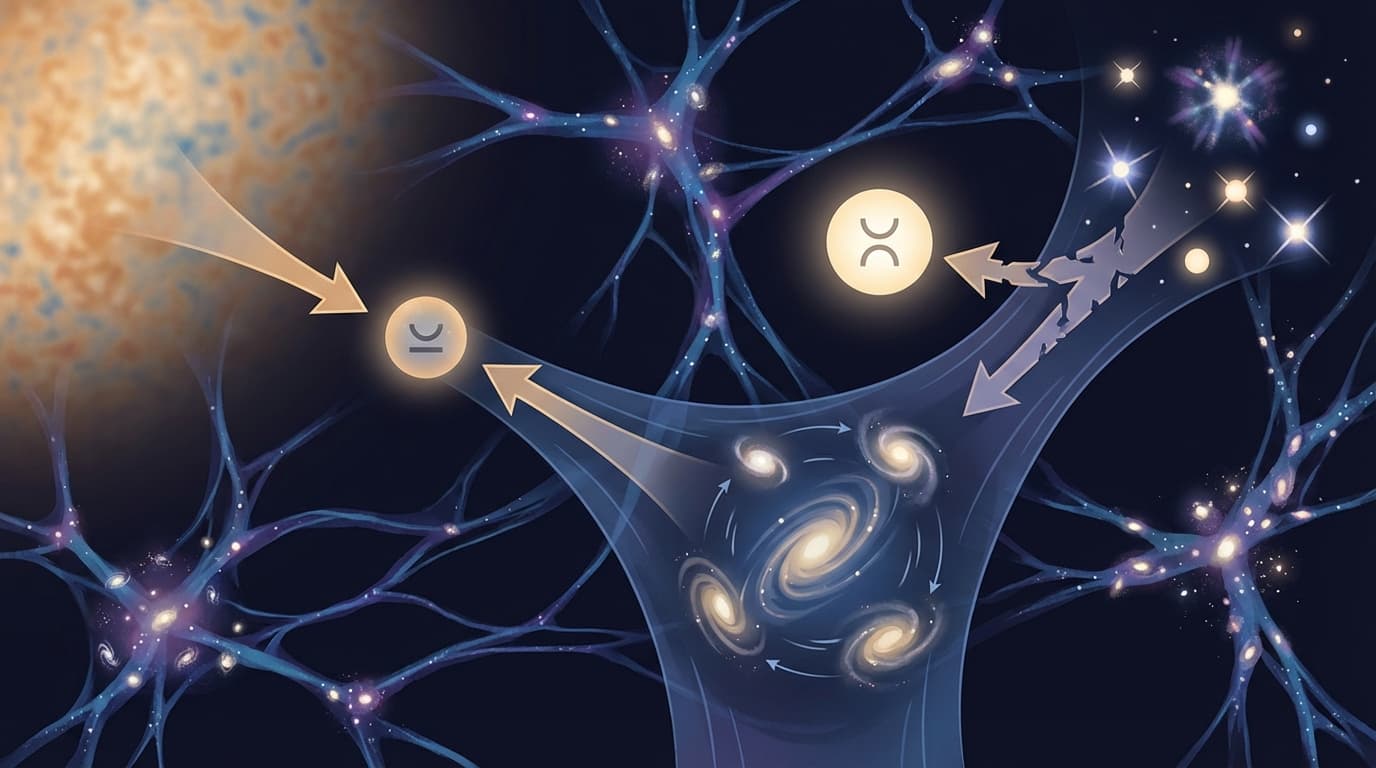
Seldom has a single cosmological measurement generated such profound implications for our understanding of the universe. Two new studies, published in Astronomy & Astrophysics, have analysed nearby galaxy groups using a novel methodology. The research, led by David Benisty of the Leibniz Institute for Astrophysics Potsdam, yielded a striking result. The local universe appears to be expanding more slowly than prior estimates had suggested. This finding could help resolve the persistent discrepancy known as the Hubble tension.
The Hubble constant, named after astronomer Edwin Hubble, quantifies the rate at which the universe expands. Measurements derived from the cosmic microwave background favour an expansion rate of approximately 67 km/s/Mpc. Conversely, observations using Type Ia supernovae in the local universe have consistently produced values near 73 km/s/Mpc. This discrepancy, exceeding five times the combined uncertainty, constitutes the Hubble tension. For over a decade, this unresolved contradiction has perplexed the astrophysics community.
The researchers adopted a fundamentally different approach to constrain the Hubble constant. They examined the velocities of galaxies within two nearby groups relative to their distance from Earth. Gravity pulls group members inward, while cosmic expansion endeavours to tear outer galaxies apart. This delicate equilibrium simultaneously constrains both the group's mass and the Hubble constant. The technique yielded a value of approximately 64 km/s/Mpc, notably closer to early-universe predictions.
The two galaxy groups under investigation were the Centaurus A group and the M81 group. Intriguingly, the analysis revealed that the Centaurus A group is not centred on Centaurus A alone. Instead, it forms a binary structure with the M83 galaxy, necessitating a revised mass estimate. Furthermore, both groups demonstrated that the masses of their brightest galaxies constitute most of the total mass. This observation implies that less dark matter is required than previously assumed.
Nevertheless, considerable work remains before this methodology overturns prevailing paradigms in cosmology. The technique has thus far been applied to only two local galaxy groups. Future observations from the 4-metre Multi-Object Spectroscopic Telescope may extend this analysis to greater distances. Should subsequent data corroborate these findings, the Hubble tension might be attributable to observational methods. Such a resolution would profoundly reshape our comprehension of the cosmos and its expansion.