
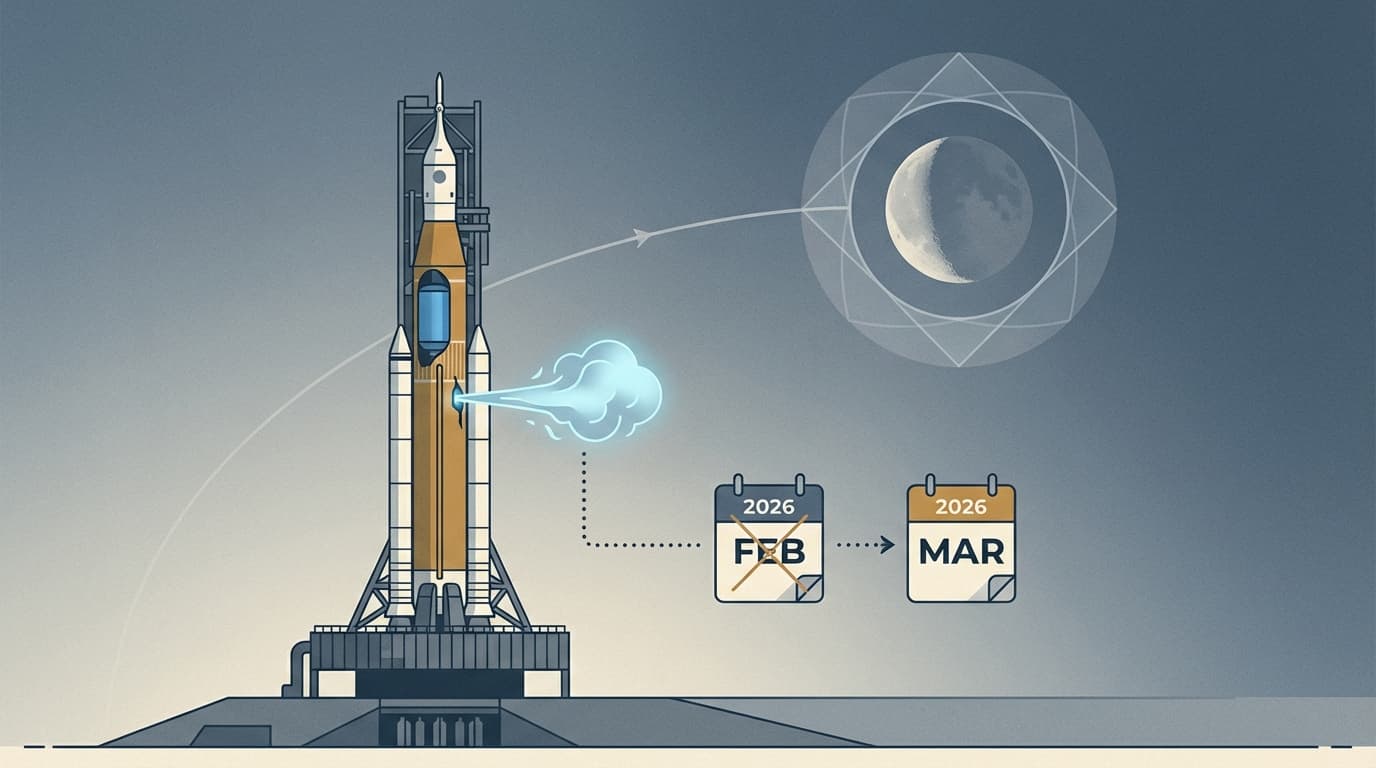
Seldom has a space agency confronted so persistent a technical adversary as NASA has with liquid hydrogen. During a critical fueling rehearsal for the Artemis 2 mission in early February 2026, engineers detected a hydrogen leak that forced termination of the countdown at the T-5:15 minute mark. The leak occurred at a tail service mast umbilical on the mobile launcher. These 35-foot-tall structures channel cryogenic propellant lines and electrical connections to the rocket's core stage. Consequently, NASA has postponed its February launch window and is now targeting March 6 at the earliest.
What makes this incident particularly noteworthy is its striking resemblance to problems encountered during Artemis 1 in 2022. That mission experienced significant delays and cancelled launch attempts due to nearly identical hydrogen leaks in the same hardware. Despite having over three years to implement corrective measures, the recurrence of these issues has prompted scrutiny from both the scientific community and the public. As one senior mission manager conceded, the reappearance of these leaks during the rehearsal took the engineering team off guard.
The underlying challenge stems from the inherent properties of hydrogen itself. As the smallest molecule in existence, hydrogen can permeate through microscopic gaps in seals with remarkable ease. Furthermore, liquid hydrogen must be stored at approximately minus 423 degrees Fahrenheit, a temperature so extreme that it renders hardware seals brittle and prone to cracking. Nevertheless, liquid hydrogen remains NASA's propellant of choice due to its unmatched energy-to-weight efficiency.
The SLS rocket's design is rooted in heritage Space Shuttle technology, a congressional mandate from 2010 intended to reduce development costs. Three of Artemis 2's four main engines are refurbished shuttle engines that require liquid hydrogen fuel. This reliance on legacy systems has not yielded the anticipated savings. The NASA Inspector General estimated in 2023 that each SLS launch costs approximately 4.2 billion dollars. Meanwhile, commercial competitors are increasingly adopting liquid methane propulsion systems that circumvent hydrogen's inherent difficulties.
Despite the setback, officials have characterised the rehearsal as a qualified success in several respects. Engineers successfully loaded both the rocket's upper and core stages with cryogenic propellant on the first attempt. Technicians have since replaced two seals inside the tail service masts and are conducting further analysis to identify the root cause. Should the subsequent rehearsal proceed without incident, Artemis 2 could become the first crewed lunar mission since 1972. The stakes, both scientific and institutional, could scarcely be higher for the beleaguered programme.