
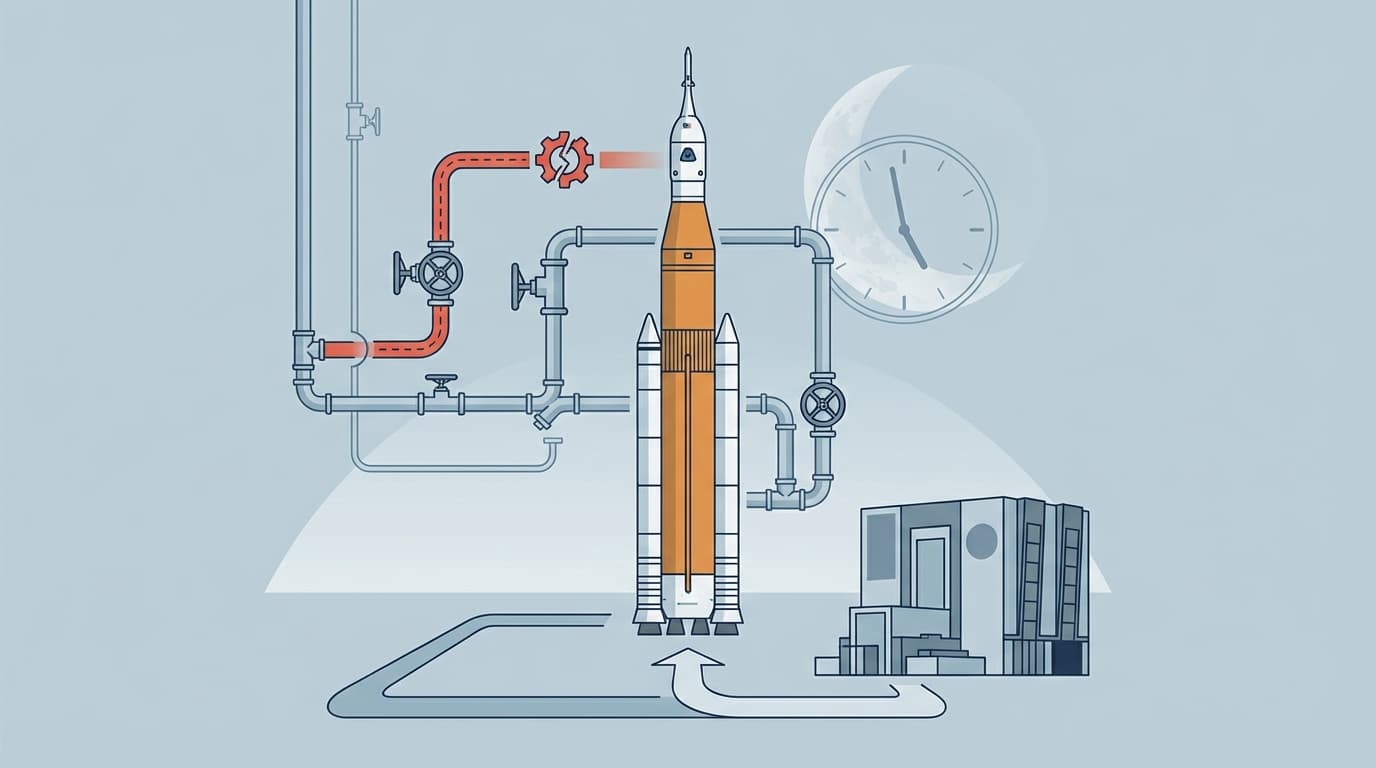
Seldom has a space mission experienced such an abrupt reversal of fortune. Just one day after NASA targeted March 6 as a potential launch date for Artemis II, a newly discovered helium flow disruption has placed every March launch window in jeopardy. The complication emerged overnight on Friday at the Kennedy Space Center in Florida, where the rocket currently sits on Launch Pad 39B. NASA Administrator Jared Isaacman confirmed the anomaly, describing it as an interrupted flow of helium to the rocket's upper stage propulsion system.
The helium system is integral to the rocket's operation. It is used to maintain proper environmental conditions for the upper stage engines and to pressurize propellant tanks. Engineers have identified three possible causes for the disruption, including a blocked filter and a failed valve. Crucially, none of these potential faults can be remedied at the launch pad itself. Should the rocket require a rollback to the Vehicle Assembly Building, March launch dates will be definitively eliminated.
This is not the first technical obstacle Artemis II has encountered. An earlier wet dress rehearsal in February revealed a liquid hydrogen leak, which necessitated replacement of certain seals. Cold weather at Kennedy Space Center further complicated initial testing procedures. A second rehearsal on February 19 was deemed successful, briefly restoring optimism among mission managers. However, the subsequent helium issue has swiftly undermined that confidence.
Artemis II represents a pivotal milestone in humanity's return to deep space. The ten-day crewed mission will carry four astronauts on a trajectory around the Moon and back to Earth. The crew comprises NASA astronauts Reid Wiseman, Victor Glover, and Christina Koch, alongside Canadian Space Agency astronaut Jeremy Hansen. Notably, this flight will mark the first time a person of color, a woman, and a non-American have traveled beyond Earth orbit.
The volatile nature of spaceflight schedules is well illustrated by this latest development. NASA has consistently maintained that safety remains the paramount priority. Isaacman stated that the agency will only launch when it believes the mission is ready. If the April window is preserved, the delay may prove relatively modest, yet it underscores how even minor technical faults can fundamentally alter ambitious exploration timelines.