
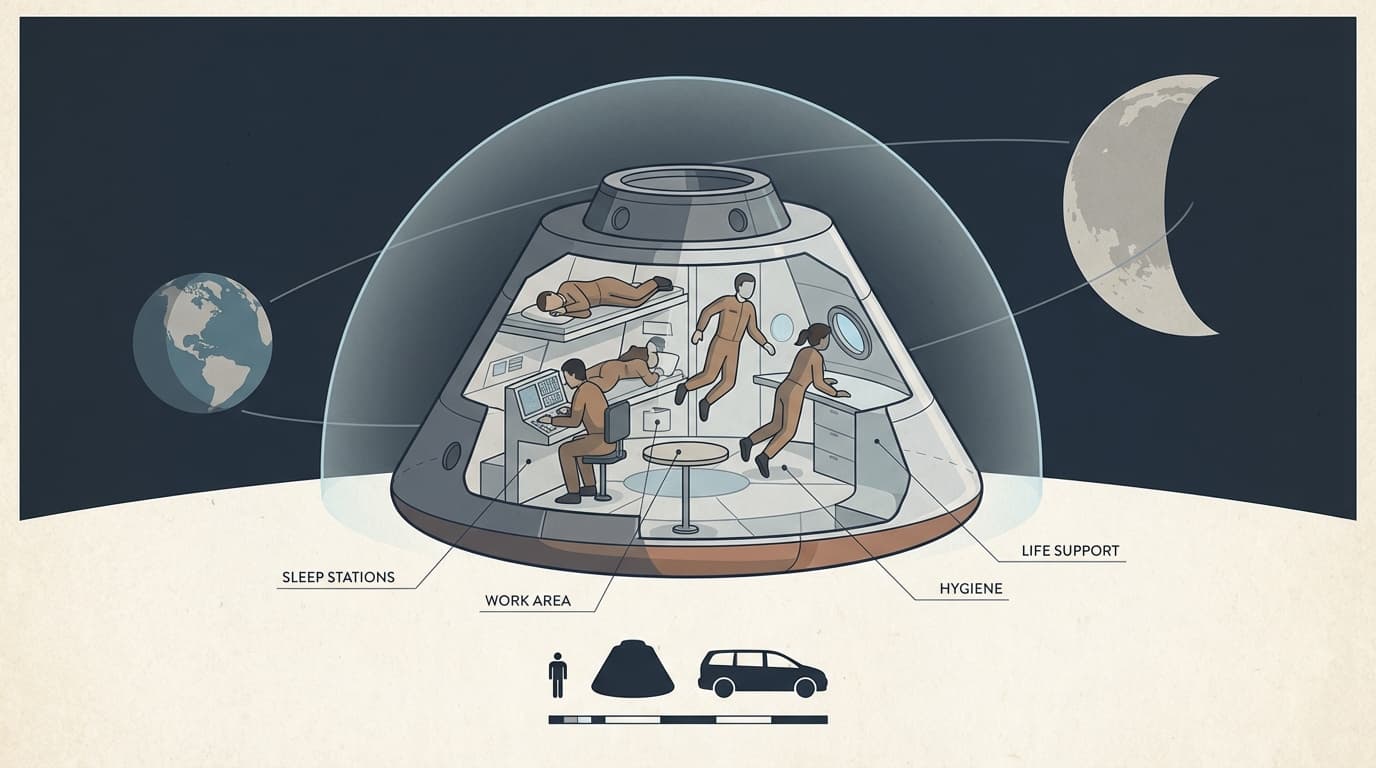
NASA's Artemis 2 mission could launch as early as April 2026. Four astronauts will travel around the far side of the moon. The entire journey will cover 685,000 miles over ten days. This will be the first crewed mission beyond low-Earth orbit in over fifty years. The compact Orion spacecraft will sit atop a 322-foot rocket at Cape Canaveral, Florida.
The crew will live inside just 330 cubic feet of space. That is roughly the size of a minivan. However, it is fifty percent more room than Apollo astronauts had. It is drastically smaller than the 13,000-cubic-foot International Space Station. Because the crew cannot leave the capsule, it must serve many purposes simultaneously.
Daily life aboard Orion has been carefully planned by NASA engineers. Meals will come from food pouches warmed on a compact hot plate. All four astronauts will sleep in bags strapped to the walls at night. A small flywheel device will allow them to exercise against resistance. NASA will study how exercise vibrations affect the spacecraft's steering systems.
Safety is a critical concern for this ambitious deep-space mission. The crew will rehearse sheltering in a shielded area beneath the floor during solar storms. New orange survival suits can sustain astronauts for up to 144 hours during emergencies. If Orion fails as a reliable habitat, broader lunar-return plans cannot proceed. This mission will prove whether humans can safely live in deep space.