
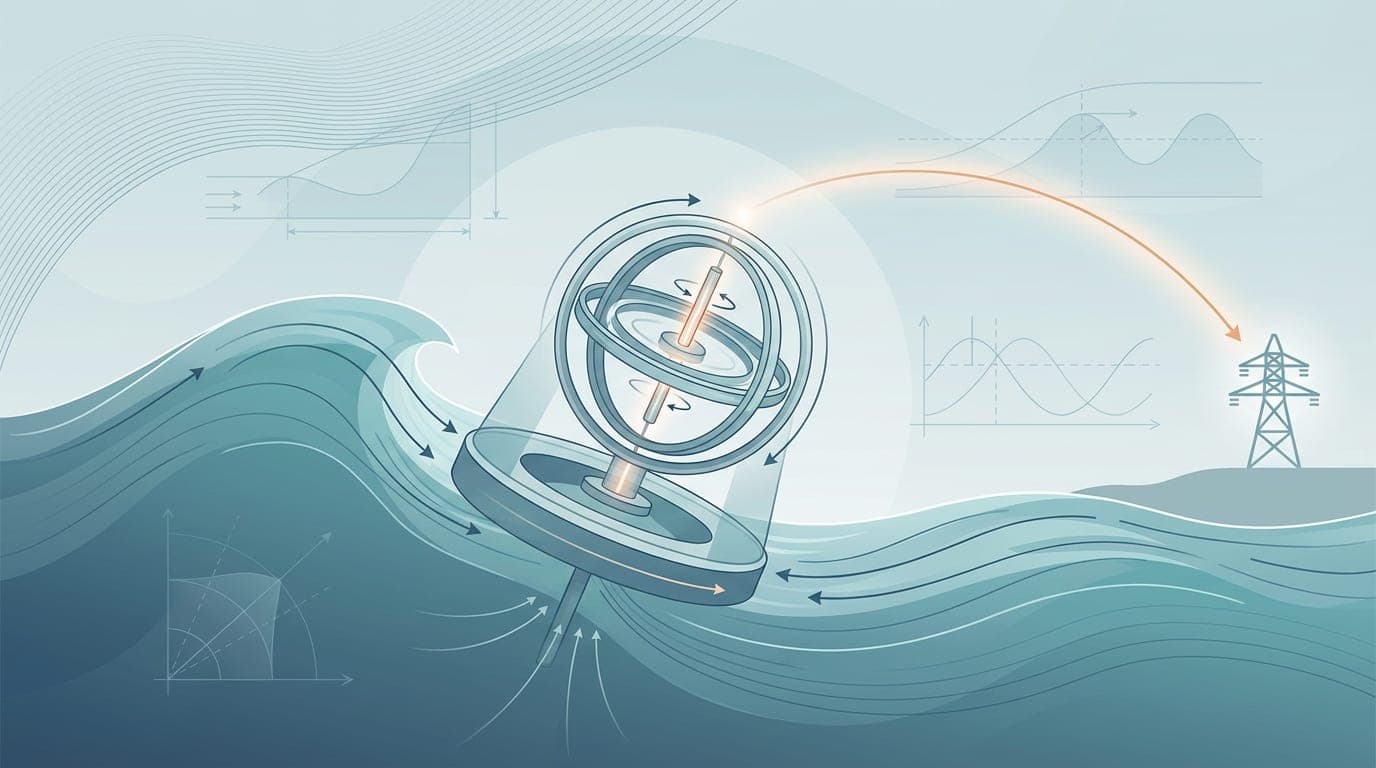
Seldom has a single theoretical advance generated such optimism in the field of marine renewable energy. A new study by Takahito Iida of the University of Osaka proposes a gyroscopic wave energy converter. The device, known as a GWEC, uses a spinning flywheel inside a floating structure. It converts the complex motion of ocean waves into electricity with remarkable adaptability. The findings were published in the Journal of Fluid Mechanics in 2026.
What distinguishes this approach from conventional wave energy devices is its broadband efficiency. Traditional converters operate effectively only within a narrow range of wave conditions. The GWEC, however, exploits gyroscopic precession to absorb energy across varying wave frequencies. By fine-tuning the flywheel's rotational speed and the generator's resistance, the system can theoretically achieve 50 percent efficiency. This represents the maximum energy a single floating body can extract under ideal conditions.
Iida employed linear wave theory to model the coupled interactions among waves, the floating platform, and the gyroscope. This analytical framework enabled the identification of optimal control parameters for the device. Numerical simulations in both frequency and time domains subsequently validated the theoretical predictions. The results demonstrated that the GWEC maintains high performance near its resonance frequency. Such mathematical rigor lends considerable credibility to the proposed design.
Nevertheless, certain limitations warrant acknowledgment. The calculations relied predominantly on idealized wave conditions. Furthermore, the energy cost of operating the gyroscope itself was not incorporated into the model. Iida concedes that asymmetrical designs might eventually surpass the 50 percent efficiency ceiling. A prototype is currently being constructed for wave tank testing, which will provide empirical validation. The target output of 300 kilowatts aligns with the auxiliary power demand of a commercial vessel.
The broader implications of this research are substantial for the global energy transition. Ocean waves represent one of the most abundant and predictable renewable energy sources on the planet. Wave energy can be available for up to 90 percent of the time, far exceeding wind and solar. Should gyroscopic converters prove viable at scale, they could complement existing renewables in unprecedented ways. This study constitutes a pivotal first step toward unlocking the vast, untapped power of the oceans.