
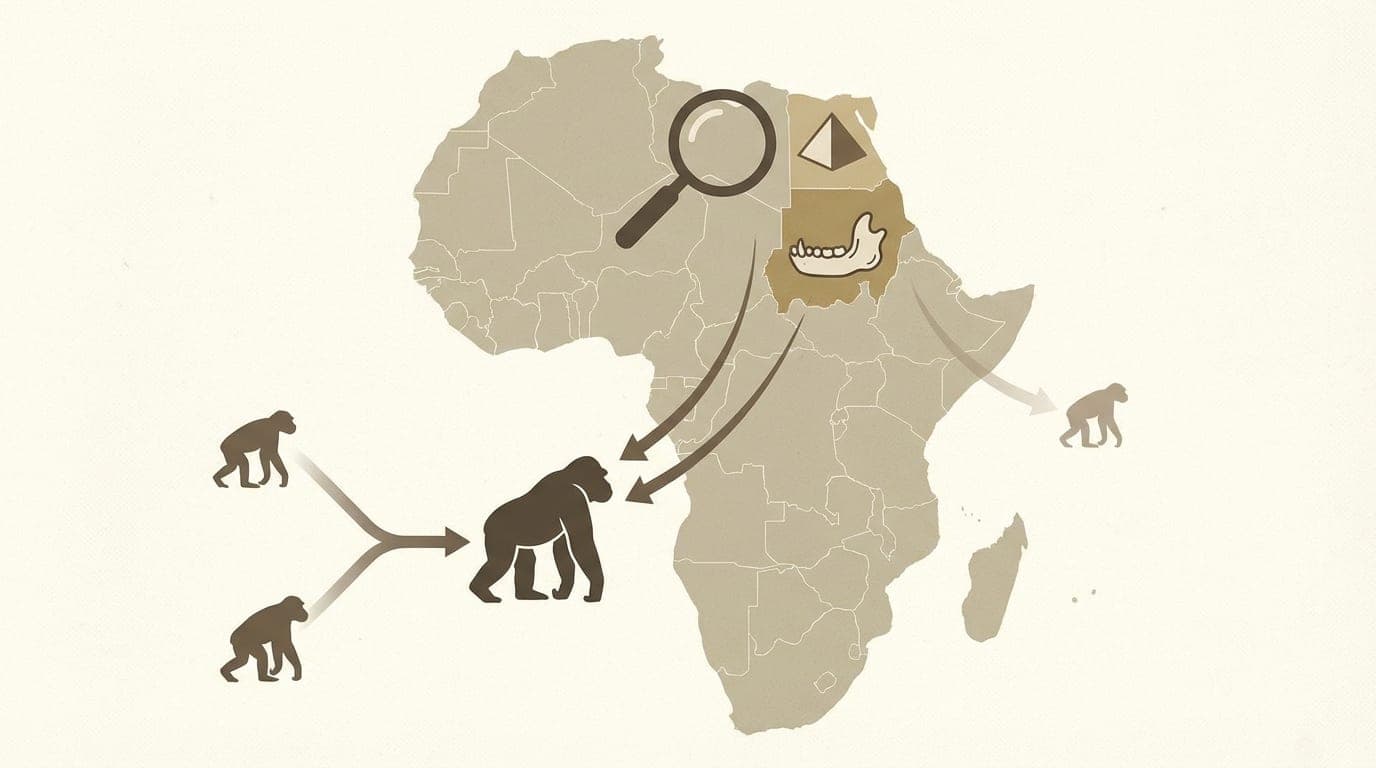
Seldom has a single fossil discovery so fundamentally challenged the prevailing scientific consensus on primate evolution. A fossilized lower jaw unearthed in northern Egypt is now reshaping long-held assumptions about the geographic origins of modern apes. Published in the journal Science, the study describes a newly identified species called Masripithecus moghraensis. This ancient primate lived approximately 17 to 18 million years ago during the Early Miocene epoch.
The fossil remains were recovered from the Wadi Moghra site in northern Egypt between 2023 and 2024. Although the material is highly incomplete, consisting only of jawbone fragments and worn teeth, it is nonetheless significant. Researchers determined that the specimens did not belong to any previously known ape species. The fossil represents the first definitive evidence of an ape in North Africa from this period.
To ascertain where this species fits within the evolutionary tree, researchers employed a Bayesian tip-dating methodology. This sophisticated approach integrates anatomical traits with fossil ages to estimate divergence times and evolutionary relationships. Their analysis indicates that Masripithecus is closely related to the lineage that gave rise to all living apes. It is positioned just before the split between great apes and lesser apes occurred.
For decades, the scientific community has largely assumed that apes originated in East Africa. Fossils from Kenya and Uganda had predominantly shaped this paradigm. However, this discovery suggests that northern Afro-Arabia may have been the true epicenter of early ape diversification. The finding places Egypt and the wider Middle East at the heart of a pivotal evolutionary transition.
Not all researchers are wholly convinced by these conclusions, with some describing the interpretation as far-fetched. More complete fossil evidence will undoubtedly be required to corroborate these findings. Nevertheless, the discovery underscores how incomplete our understanding of primate evolution remains. Key chapters of our evolutionary history may still lie hidden in regions that have yet to be explored.