
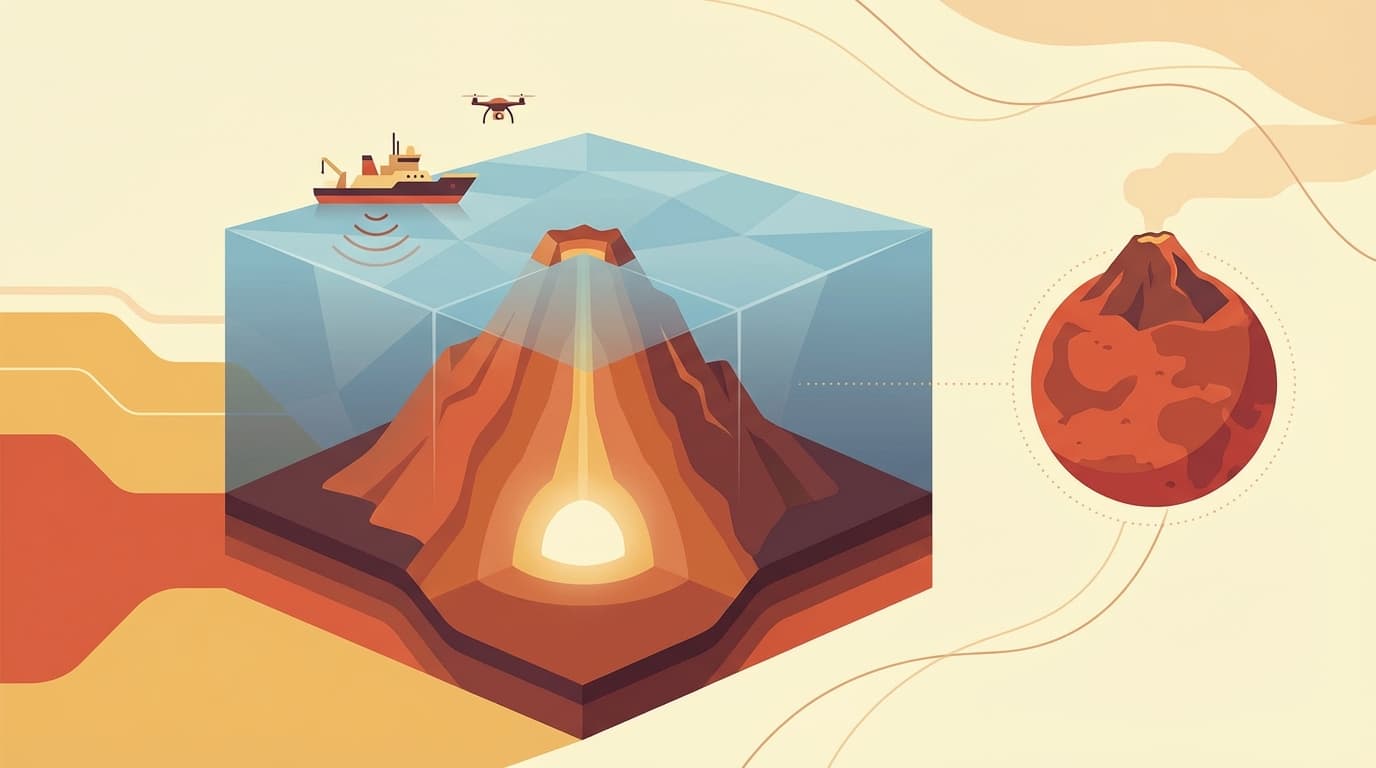
What if the biggest volcano on Earth looked nothing like one? Deep under the Pacific Ocean, scientists found an enormous hidden structure. It is called the Tamu Massif, and it is truly remarkable. A team led by Dr. William Sager identified it as Earth's largest single volcano. This immense discovery is reshaping our understanding of the planet's geology.
The Tamu Massif is located about 1,000 miles east of Japan. Its summit sits roughly 6,500 feet below the ocean surface. The volcano spans approximately 120,000 square miles, which is comparable to New Mexico. Unlike steep volcanoes that most people imagine, it is incredibly flat. Its slopes are so gradual that someone standing on it could not tell which way was downhill.
Scientists believe the volcano formed around 145 million years ago. It became inactive shortly after it was created. Massive lava flows spread outward from a central source over millions of years. These flows created a wide, shield-like structure unlike any other submarine volcano. Dr. Sager reported that a huge volume of magma rose from deep within Earth's mantle.
This finding challenges how scientists previously interpreted underwater plateaus in the region. Researchers had treated the area's features as three distinct formations for years. However, seismic data revealed that continuous lava flows linked the entire structure. Only Olympus Mons on Mars, the solar system's largest volcano, can rival its scale. This discovery provides crucial information for understanding how Earth's interior truly works.